DAI GLOBAL, LLC
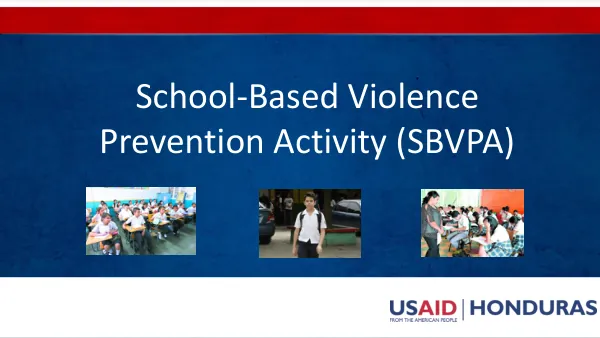
School-Based Violence Prevention Activity (SBVPA)
School-Based Violence Prevention Activity (SBVPA) is a program aimed at reducing violence in Honduran schools.
2018 · 8 pages
Sign in to readA free account is required to download.
Abstract
The initiative focuses on creating safe learning environments and strengthening local networks to increase school safety. SBVPA is being implemented in hotspot areas within five urban municipalities: Tegucigalpa, San Pedro Sula, La Ceiba, Choloma, and Tela. According to statistics, 39% of teachers face violence in the classroom, and 41% confirm that one student has attacked another. Additionally, 360 schools have been completely abandoned in areas controlled by gangs. Furthermore, 40% of school-aged children in San Pedro Sula sympathize with gangs, and 80% of students in the Instituto Chavez school report carrying a firearm, knife, or other weapon to school. Gender-based violence is also a significant concern, with 68% of girls being bullied or teased, 25% being touched intimately, and 24% having something thrown at them. The program has identified key objectives, including improving schools' ability to reduce school-based violence through the creation of safe learning environments, strengthening local networks that increase school safety, increasing the capacity of the Ministry of Education (MOE) and social protection actors to prevent and respond to school-based violence, and lowering risk factors and enhancing protective factors for students who qualify for secondary prevention services. SBVPA emphasizes the importance of responding to multiple types of violence, both internal and external to schools, through interagency collaboration from various actors, including school personnel, students, parents, teachers, and other agencies. The program requires working at different levels of the social asset network, with clear and established responsibilities across agencies. To truly transform violence, schools need to develop and implement holistic strategies that promote convivencia, prevention of, and attention to violence. The program's approach involves several key steps, including selecting schools, creating required socio-political conditions, developing the operating structure, conducting participatory systems mapping, school diagnostics, and baseline data collection, identifying and defining problems and their symptoms, programming prevention activities based on school themes and need, and ensuring institutional support from the MOE and other actors. The program also involves prevention program implementation, deployment of a support model for responding to different cases of violence, documentation, evaluation, communication, and promotion of experiences for replication among other schools in Honduras.