DAI
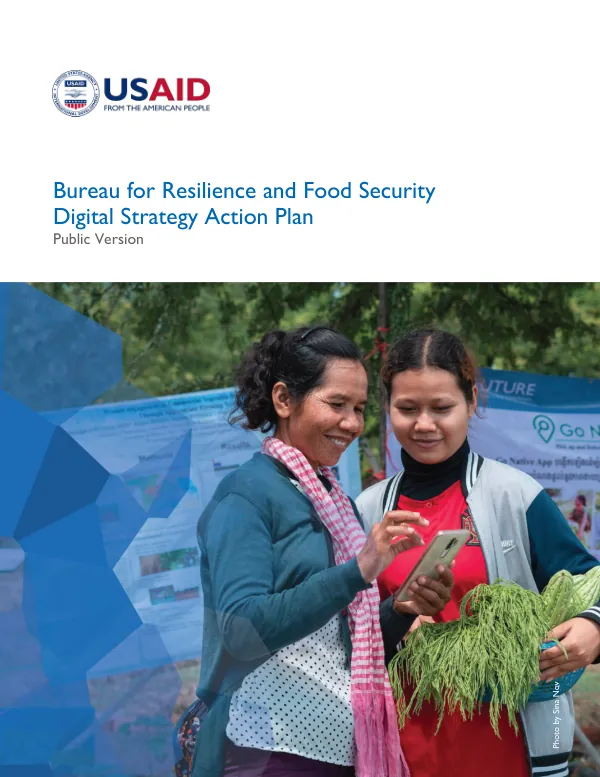
Bureau for Resilience and Food Security Digital Strategy Action Plan
The Bureau for Resilience and Food Security (RFS) Digital Strategy Action Plan aims to leverage digital technologies to support the development objectives of RFS and its Missions.
2021 · 16 pages
Sign in to readA free account is required to download.
Abstract
The plan is grounded in an understanding of RFS's current digital programming, existing priorities, and the broader context beyond USAID. The priorities are aligned with the USAID Digital Strategy 2020-2024, focusing on improving measurable development and humanitarian assistance outcomes through the responsible use of digital technology and strengthening the openness, inclusiveness, and security of country digital ecosystems. Digital technologies present opportunities to benefit multiple RFS sectors in parallel, increasing efficiency and broader impact. For instance, risk management tools used in resilience programming contribute to sustaining availability and affordability of nutritious foods, while digital technologies applied to addressing food-safety risks have directly contributed to SME growth and access to finance. Digital inclusion is a critical aspect of the RFS Digital Strategy Action Plan. More than one in three people in rural areas in Least Developed Countries lack access to mobile networks entirely or only have access to 2G coverage. Women often face even more barriers to accessing technology, which might otherwise increase their access to finance and expand employment opportunities. The benefits of digital inclusion are multiple, including strengthening women's household decision-making power and increasing their labor-force participation. Common examples of digital technology in the countries where RFS works include those deployed to support providers of extension and advisory services, facilitate access to financial services, and enable access to market-, risk-, and production-related information. Agricultural insurance providers are also increasingly using digital platforms such as satellite-based index insurance to monitor vegetation levels and other factors. The RFS Digital Strategy Action Plan recognizes the importance of prioritizing local needs met by local suppliers to ensure the appropriateness, effectiveness, and viability of digital technology solutions. Local actors, such as extension agents, local businesses, and others, can serve as a key vehicle for feedback, helping to ensure the development of demand-driven products. Effective data governance, data privacy risk mitigation, and solution interoperability also require attention in the contexts where RFS works. The plan aims to guide RFS's work in digital, including support to USAID Missions on this topic, and serves as a starting point for strategic planning to facilitate greater coherence in programming across countries and collaboration across technical sub-areas of RFS. The RFS Digital Strategy Action Plan is a three-year plan covering the same time frame as the Agency's Digital Strategy (through 2024) and may be revisited and updated periodically in the interim as appropriate. The application of digital technology within RFS sectors has both sectorally unique elements and some commonalities. For instance, digital ecosystem barriers related to the digital divide, limited rural connectivity, inclusion and policy gaps, lack of widespread data literacy, and inadequate data management and privacy protections limit agriculture, food security, resilience, nutrition, and water security, sanitation and hygiene programming. These barriers are more pronounced in some countries where RFS works than in others. The RFS Digital Strategy Action Plan recognizes the importance of considering the needs, context, and circumstances of population segments that are less likely to afford or benefit from existing digital technologies. There is a growing awareness of the potential for digital identification and e-government to enable excluded populations to access government and private sector services, as well as increasing the overall transparency, accountability, and efficiency of systems. Nevertheless, much work remains in terms of policies, infrastructure, device access, product design, and capacity development before a significant reduction in digital divides can be seen.
Related documents