USAID FAMINE EARLY WARNING SYSTEMS NETWORK
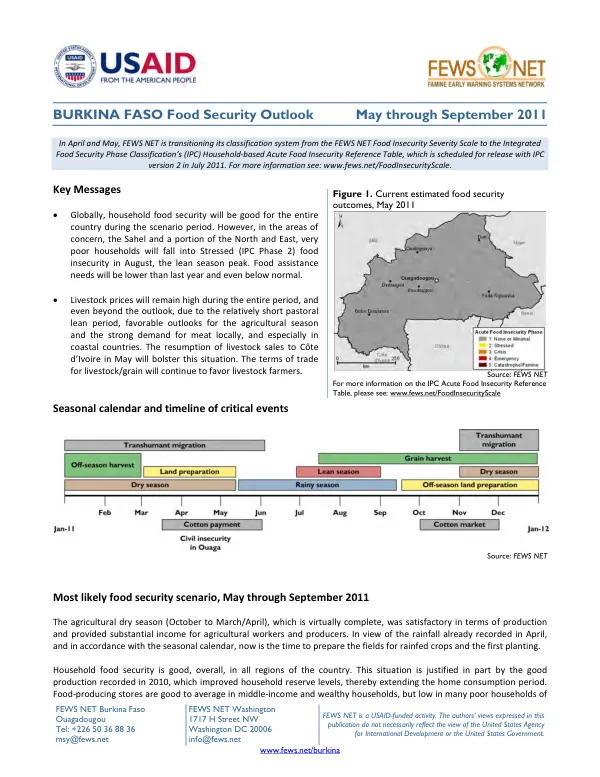
BURKINA FASO Food Security Outlook May through September 2011
The agricultural dry season in Burkina Faso, which spans from October to March/April, has been satisfactory in terms of production, providing substantial income for agricultural workers and producers.
2011 · 5 pages
Sign in to readA free account is required to download.
Abstract
The rainfall already recorded in April has prompted the preparation of fields for rainfed crops and the first planting. Household food security is good overall in all regions of the country, primarily due to the good production recorded in 2010, which improved household reserve levels and extended the home consumption period. Food-producing stores are good to average in middle-income and wealthy households, but low in many poor households of livelihood zones 7 and 8. In these zones, some towns have satisfactory community reserves, built in part with support from certain partners. The markets in these zones are generally well-stocked by traders from production originating from the western and southern parts of the country. Prices, which have remained stable over the last two months and lower than the same period last year, favor access to grains for households dependent on the market for their current nutritional needs. The government has taken steps to reduce the price of certain staple goods, including rice, oil, and sugar, beginning May 9th and continuing for three months. These reductions are XOF 80/kg of rice, XOF 75/liter of oil, and XOF 100/kg of sugar. The National Food Security Reserve Management Company (SONAGESS) has also established charter shops in Ouagadougou, where a 25 kg bag of local rice sells for XOF 7,500, compared with XOF 9,500 to 11,000 on the open market. However, charter shops pose a risk of discouraging the sale of products on the open market, thereby creating artificial shortages. In livestock-raising zones, the food situation for animals is satisfactory despite the seasonal short supply of pastures and watering places, except in the Soum province. The good weight condition of the animals, combined with good grain availability for households since the previous harvests, has reduced the animal supply on the markets in the face of heightened demand overall, in particular in coastal countries. Livestock prices, which have remained virtually stable since last December, favor livestock farmers. The resumption of livestock sales to Côte d'Ivoire will bolster this situation, and the terms of trade for livestock/grains remain favorable to the latter. The nutritional situation remains a concern in the area, with a prevalence of acute malnutrition of 14.7 percent in the Sahel region in 2009, which remained basically unchanged in the same period in 2010. The most likely food security scenario is based on the following general hypotheses: normal establishment of the rainy season in May-June in the South and West, and in June-July in the Central Zone and the North; normal to abundant seasonal cumulative rainfall during the 2011/12 winter season; and normal to good agricultural production, beginning in September with the harvest of yams in the South and green grain harvests throughout the country.
Related documents