DAI
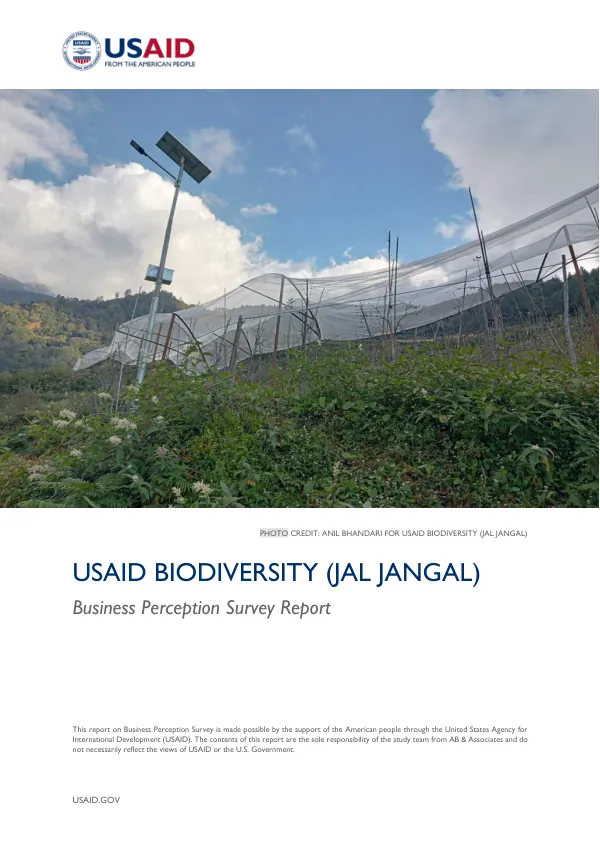
Business Perception Survey Report
The USAID Biodiversity (Jal Jangal) Business Perception Survey Report focuses on assessing businesses' understanding of climate change, potential impacts on operations, and preparedness for adaptation in Nepal.
2024 · 39 pages
Sign in to readA free account is required to download.
Abstract
The survey targeted the ecotourism, non-timber forest products (NTFP), and aquaculture sectors, which are priority areas for USAID Biodiversity (Jal Jangal). Conducted in 11 districts across four landscapes, the survey included interviews with 40 businesses, covering 15 in NTFP, 13 in ecotourism, and 12 in the aquaculture sector. The surveyed businesses demonstrated a notable awareness of weather changes, indicating a keen observation of shifting climate patterns. Most respondents demonstrated a comprehensive understanding of environmental conservation and recognized the significance of biodiversity. However, the private sector displays an intermediate knowledge level about climate change and ecosystem services. A lower proportion of companies are informed about climate adaptation, mitigation, and climate resilience. The findings reveal that larger enterprises are actively adapting to climate change, while some smaller businesses, while recognizing climatic shifts, require assistance to implement effective adaptation measures. This report identifies notable impacts in the NTFP sector, including changes in product availability, community preferences, increased pest and disease pressure, and manufacturing and processing challenges. These impacts cascade into shifting market dynamics, influencing the costs and prices of final products. The aquaculture sector confronts challenges stemming from changes in temperature, resulting in elevated fish seedling mortality and the drying up of ponds. Such temperature fluctuations incur additional costs for businesses, although some, like those dealing with Jalkapur fish, have experienced positive outcomes from increased temperatures. Extreme weather events further disrupt the industry, with some areas experiencing floods and unpredictable rainfall, which alters business calendars. Trading businesses face heightened operational costs due to increased expenses associated with maintaining a cold chain. In the ecotourism sector, shifting weather patterns contribute to a decline in tourism business, impacting customer volume and creating an increased perception of risk for tourists during extreme weather events. Despite some businesses recognizing climate change, consumer behavior has not adapted to the same extent as the changing climate. Indirect impacts are noted, such as the loss of infrastructure due to extreme weather events, which negatively impacts businesses that are reliant on infrastructure, like roads. Businesses' understanding of their impact on emissions and climate change varies, with larger enterprises generally recognizing their influence, while many smaller businesses perceive their impact as insignificant. There is a widespread acknowledgment that climate change results from human actions in the environment. In response to the changing climate, businesses have undertaken various adaptive practices, encompassing strategic planning, operational improvements, and adjustments in marketing and communication strategies. Despite these efforts, the survey found significant gaps and opportunities for improvement to enhance businesses' adaptability to climate change. The team observed weaknesses in climate information services, which are deemed less effective and imprecise, signaling the need for improvements at the governmental level. While many businesses have ventured into sustainable production and procurement practices, the study found remaining challenges and key areas for improvement, such as a lack of skills, capacity, and knowledge as well as limited technical know-how in all three priority sectors. The team concluded that support mechanisms aimed at boosting supply chain efficiency and efficacy can effectively mitigate the impact of climate change on businesses. Another viable solution to promote sustainability in business practices is to explore environmentally friendly alternative products. Addressing these areas of improvement will be crucial to fostering a more resilient and adaptive business landscape in the face of climate change. Due to inadequate government support for priority industries, many businesses—especially small and medium-sized enterprises—require substantial policy and financial aid to tackle climate change challenges. Innovative government assistance is urgently needed in the aquaculture sector, due to a lack of properly implemented tax provisions that support local production and counter corruption in the supply chain of imported fish leading to duty evasions. The NTFP sector calls for enhanced government support in the form of technical knowledge and financial assistance, specifically for sustainable harvesting and strategic planning. The tourism sector requires active support to address the indirect impacts of climate change, such as the loss of infrastructure due to extreme weather events.
Related documents