USAID
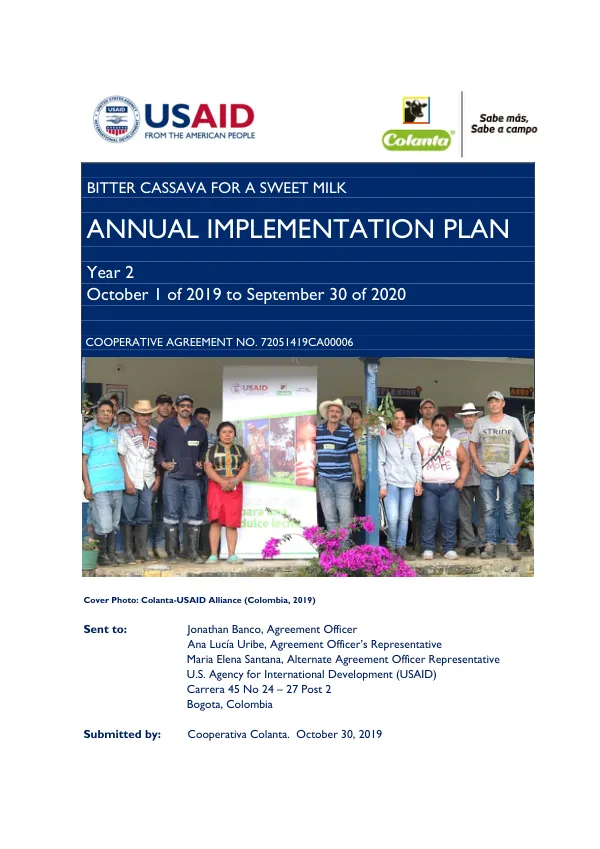
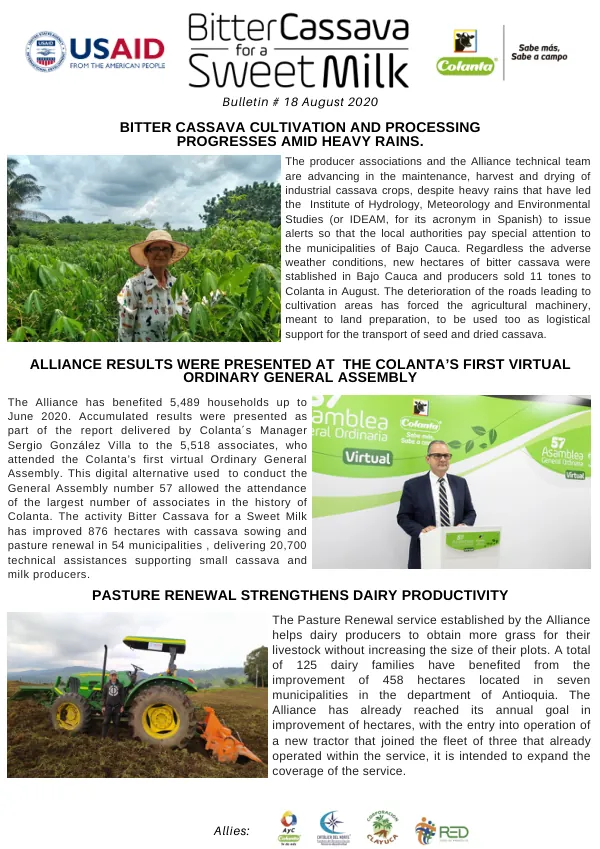
Annual Performance Progress Report: Bitter Cassava for a Sweet Milk
Bitter Cassava for a Sweet Milk is a five-year alliance with a value of $47.11 million dollars, with $5.39 million dollars contributed by USAID, and $41.72 million dollars leveraged by Colanta and its partners from the private sector.
2020 · 6 pages
Sign in to readA free account is required to download.
Abstract
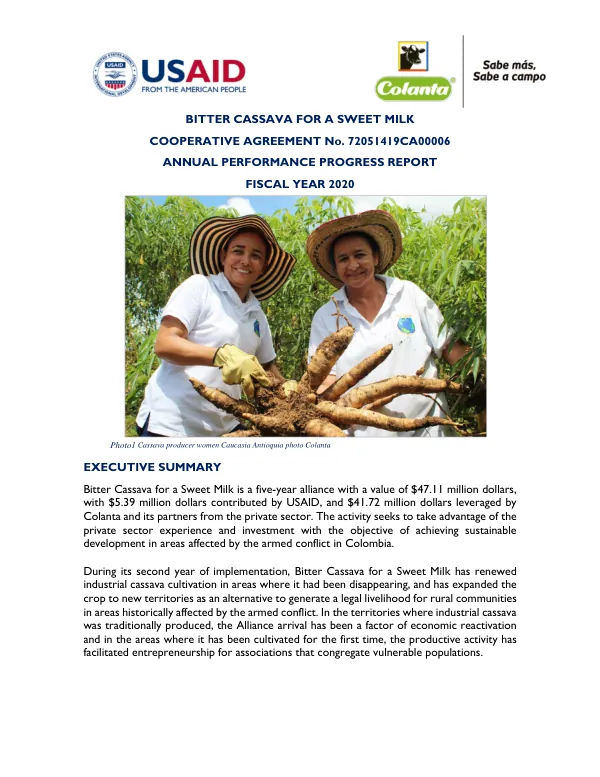
The activity seeks to take advantage of the private sector experience and investment with the objective of achieving sustainable development in areas affected by the armed conflict in Colombia. During its second year of implementation, Bitter Cassava for a Sweet Milk has renewed industrial cassava cultivation in areas where it had been disappearing, and has expanded the crop to new territories as an alternative to generate a legal livelihood for rural communities in areas historically affected by the armed conflict. In the territories where industrial cassava was traditionally produced, the Alliance arrival has been a factor of economic reactivation and in the areas where it has been cultivated for the first time, the productive activity has facilitated entrepreneurship for associations that congregate vulnerable populations. The 785 tons of dry cassava produced in year 2 were sold by the farmers to Colanta, to be used in the production of concentrated feed for dairy cattle. Along the different accompaniment models implemented by the Alliance, the assured purchase of farmers' production is complemented with technical assistance and training, access to financing, production infrastructure, and seeds of high genetic value. The dairy sector in Colombia is constituted mostly of small and medium producers who face great competitiveness challenges in the international market. The Alliance's strategy within this productive chain is to strengthen the livelihood of thousands of peasant families in the country, contributing to the reduction of the production cost of milk liter with an accompanying scheme that offers: technical assistance and training, financing for access to production infrastructure, renovation of pastures, and that seeks generational integration within dairy production. Colanta and USAID seek to take advantage of the infrastructure and experience of the private sector to generate "better conditions for inclusive rural development" by strengthening the legal economy in conflict-affected areas. The Alliance made significant progress in its objective of establishing the production and processing of bitter cassava as a legal livelihood for agricultural communities. Crop growth exceeded by 285% the goal set for the year. 571 new hectares were established, impacting 271 new producer households with an accessory model that offers according to the type of beneficiary: agricultural loans granted by the partner Savings and Credit Colanta, access to machinery, technical assistance and training, improved seed and forward contracts that guarantee to all producers the assured purchase of their crops at a previously agreed price. In the cassava component, the technical assistance and training had as emphasis: the harvest, chopping, drying and dispatch of industrial cassava. During FY2020, emerging producers without previous experience in the processing of crops, faced this phase of the production chain. During the period, 211 technical assistances and 130 trainings were carried out, which contributed to bring the undertakings of some producers to fruition and to start a new sowing cycle with others. The farmers sold a total of 785 tons of dried cassava, delivered to the Colanta Concentrated Food Plant in the municipality of Itagui (Antioquia). The Alliance advances in strengthening the competitiveness of small and medium producers, for this, it applies a comprehensive accompaniment model that through: technical assistance, training, credit for production infrastructure, pasture renovation and genetic improvement, seeks reduce the cost of production per liter of milk. The pasture renovation service, that allows small and medium size farmers the necessary machinery for the integrated management, reached 146% compliance with the annual goal. 338 hectares of established pastures were improved, increasing the availability of pasture for the dairy cattle of the producers without expanding the agricultural frontier. The economic slowdown due to the health emergency caused the country to experience a reduction of around 20% in the demand for dairy products. This situation caused some dairy companies to impose purchase quotas on their producers and even led to the closure of some of them. By not being able to commercialize their total production with the regular buyers, milk farmers experienced an oversupply, seriously affecting thousands of producers. In response to this fact, during the second half of the year, Colanta increased its milk intake by more than 250,000 liters per day, buying from the cooperative's associates and new independent producers. The indicator reported by the Alliance (Liters of Milk Produced per Day), which refers exclusively to producers associated with Colanta, was 1,765,621 liters per day, which constitutes a 91% compliance compared to the goal set for the fiscal year. It is important to highlight the strong increase in the uptake of milk from non-associated producers, who, in order to apply for membership as associated producers, must meet, among others, the requirement of regularly selling their production to the cooperative for three months. The socioeconomic impact of keeping milk intake open during a crisis in the sector demonstrates the implementer's commitment to dairy in Colombia and may translate into a greater number of associated producers. Digital transformation has promoted youth engagement in agricultural production. La Peñuela is the