WORLD WILDLIFE FUND INTERNATIONAL
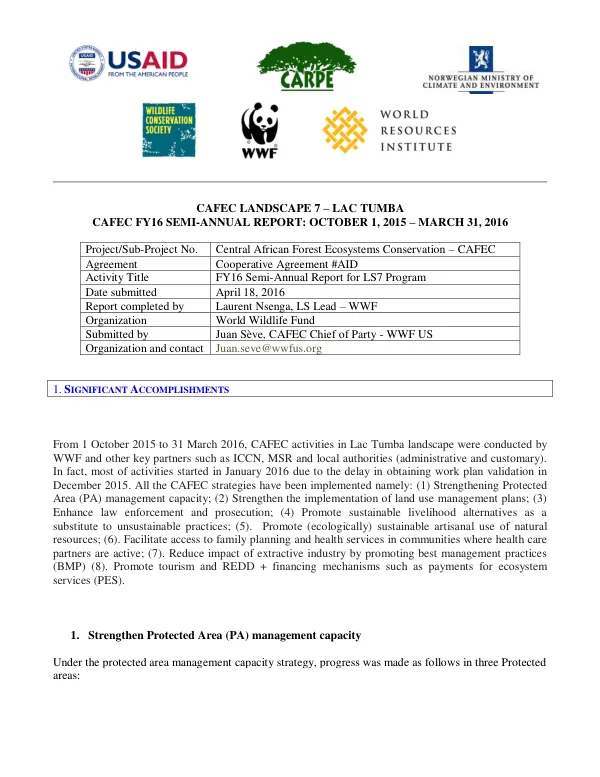
CAFEC FY16 SEMI-ANNUAL REPORT: OCTOBER 1, 2015 – MARCH 31, 2016
The Lac Tumba landscape in the Democratic Republic of Congo is the focus of the CAFEC project, which aims to conserve the region's natural resources and promote sustainable development.
2016 · 20 pages
Sign in to readA free account is required to download.
Abstract
The project is implemented by the World Wildlife Fund (WWF) in partnership with local authorities, ICCN, MSR, and other key stakeholders. Strengthening Protected Area management capacity is a key strategy of the CAFEC project. In the Tumba-Lediima Reserve Protected Area, data analysis was conducted to inform the development of a classification system and strategic development scenarios to ensure the maintenance of natural values. Discussions were held with ICCN to advance reclassification options. In the Ngiri Triangle Nature Reserve PA, a technical orientation visit was conducted to define community supervision strategies and ensure community involvement in the development and selection of alternative activities. The implementation of land use management plans is another critical component of the CAFEC project. In the Lac Tumba Segment, legal texts were disseminated to provide for the allocation of forest concessions to local communities, allowing the establishment of community forests for 51 communities in Bikoro territory. Participatory mapping and land use planning were implemented in various communities, and 11 community concessions were registered, validated, and ready to be submitted to governors for allocation. Enhancing law enforcement and prosecution is also a key strategy of the CAFEC project. In the Lac Tumba Segment, a group of 25 criminal investigators, including 3 women, were trained on the Nature Conservation law. Seventeen members of the group were sworn in as criminal investigation officers. WWF's law enforcement specialist seized a bonobo with two poachers at Mbandaka airport, and investigations are underway. The project also supports the enhancement of law enforcement on the use of insecticide-treated mosquito nets as fishing nets and other unsustainable practices. The CAFEC project also focuses on promoting sustainable livelihood alternatives, ecologically sustainable artisanal use of natural resources, and access to family planning and health services in communities where healthcare partners are active. The project also aims to reduce the impact of extractive industries by promoting best management practices and to promote tourism and REDD+ financing mechanisms such as payments for ecosystem services. In the Bikoro Itipo CBNRM zone, a wildlife data collection system is being implemented in collaboration with CLDs. In the Ngombe CBNRM zone, a wildlife data collection system is being implemented in collaboration with CLDs. In the Nkala Nko CBNRM zone, a wildlife data collection system is being implemented in collaboration with CLDs. The CAFEC project has made significant progress in the Lac Tumba landscape, with a focus on strengthening protected area management capacity, implementing land use management plans, enhancing law enforcement and prosecution, and promoting sustainable livelihood alternatives. The project's efforts aim to conserve the region's natural resources and promote sustainable development.