BANK FOR WEST AFRICAN DEVELOPMENT
Cameroon—Property Rights and Resource Governance Profile
Cameroon's extensive climatic, geographic, and ecological diversity has not led to the anticipated economic prosperity.
2011 · 30 pages
Sign in to readA free account is required to download.
Abstract
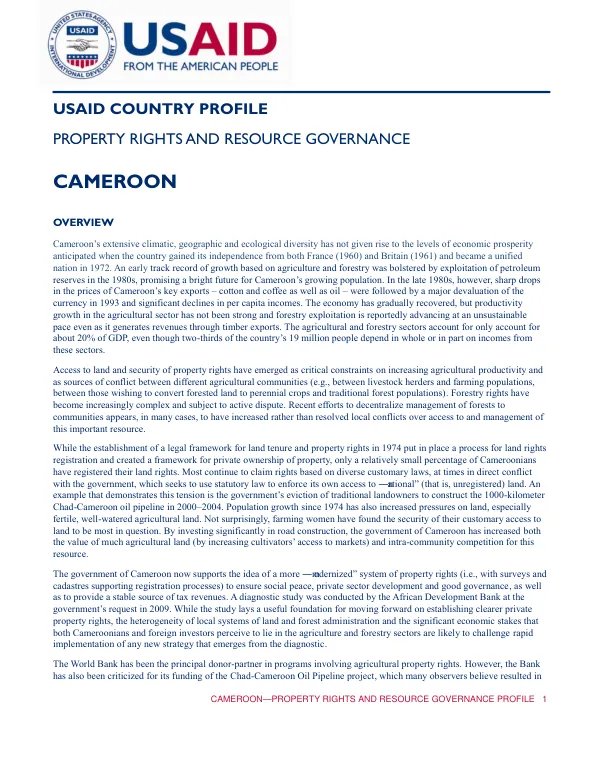
The country's early growth was based on agriculture and forestry, bolstered by the exploitation of petroleum reserves in the 1980s. However, sharp drops in the prices of key exports, including cotton and coffee, as well as oil, led to a major devaluation of the currency in 1993 and significant declines in per capita incomes. The economy has gradually recovered, but productivity growth in the agricultural sector has been weak, and forestry exploitation is advancing at an unsustainable pace. Access to land and security of property rights have emerged as critical constraints on increasing agricultural productivity and sources of conflict between different agricultural communities. Forestry rights have become increasingly complex and subject to active dispute. Recent efforts to decentralize management of forests to communities have increased rather than resolved local conflicts over access to and management of this important resource. The establishment of a legal framework for land tenure and property rights in 1974 created a process for land rights registration and a framework for private ownership of property, but only a small percentage of Cameroonians have registered their land rights. The government of Cameroon now supports the idea of a more modernized system of property rights, with surveys and cadastres supporting registration processes, to ensure social peace, private sector development, and good governance, as well as to provide a stable source of tax revenues. A diagnostic study was conducted by the African Development Bank at the government's request in 2009, laying a useful foundation for moving forward on establishing clearer private property rights. However, the heterogeneity of local systems of land and forest administration and the significant economic stakes that both Cameroonians and foreign investors perceive to lie in the agriculture and forestry sectors are likely to challenge rapid implementation of any new strategy. Community participation in forestry governance remains a major challenge, with many groups concluding that the prospects for sustainable forest management in Cameroon are bleak until major governance challenges are overcome. Cameroon's current forest legislation includes opportunities for forest communities to register rights to community forests and enter into agreements regarding their management, but studies have found that the intended benefits are not reaching communities. Donors, including USAID, are well-positioned to help the government and local authorities design and pilot more effective programs for sustainable forest governance and management. Women's rights to land and tenure security are also a major concern, with virtually all observers agreeing that women farmers in Cameroon are facing increasingly insecure access to land and tenure rights. Many women have found that land scarcity has led male authorities to withdraw rights that women previously held. Cameroon is in the process of developing a new family law, which will govern issues of marital property rights, and donors can assist with the development of the legal framework, as well as public awareness campaigns and support for women's legal aid. Land rights formalization is also a critical issue, with many, if not most, pastoralists, smallholders, and occupants of informal settlements in urban and peri-urban areas lacking secure rights to land. Donors can help the government to develop a new land policy and revise the legal framework governing land, as well as support the establishment of a more effective land administration system that provides an accessible, inexpensive window for formalizing rights, with particular attention to protecting the rights of women, pastoralists, and marginalized ethnic groups.
Related documents