TETRA TECH
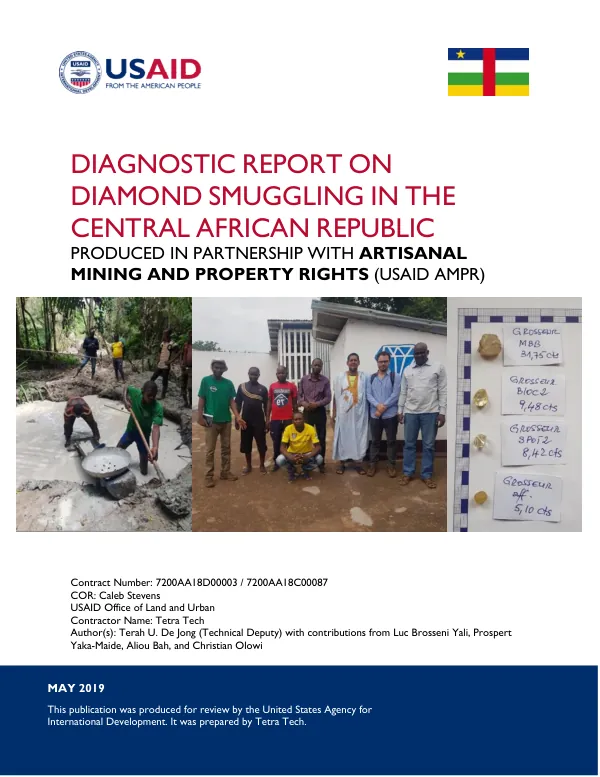
Diagnostic Report on Diamond Smuggling in the Central African Republic
The Central African Republic (CAR) is a country with significant diamond reserves, but it has struggled with diamond smuggling.
2019 · 48 pages
Sign in to readA free account is required to download.
Abstract
The country's diamond supply chain is complex, involving artisanal and small-scale mining (ASM) operations, semi-industrial actors, and cooperatives. The Kimberley Process Operational Framework (KPOF) is a certification scheme aimed at preventing the trade of conflict diamonds, but its effectiveness in CAR is limited due to various factors. One of the primary factors contributing to diamond smuggling in CAR is the lack of financing and production. The country's diamond production has been declining, and the industry is heavily dependent on artisanal mining, which is often informal and unregulated. This lack of financing and production has led to a shortage of diamonds, creating an opportunity for smuggling. Additionally, the difficulties with buying houses, which are the primary buyers of diamonds in CAR, have also contributed to the smuggling problem. The diamond supply chain in CAR is characterized by a lack of transparency and accountability. The collection of statistics on diamond production and trade is inadequate, and data management and analysis are often poor. The transfer of parcels and export procedures are also subject to corruption and manipulation. Rough diamond valuation is another area of concern, as it is often based on incomplete or inaccurate information. The Kimberley Process Certification Scheme (KPCS) is a key component of the diamond supply chain in CAR, but its effectiveness is limited due to institutional challenges at the national and local levels. The KPCS relies on the participation of local monitoring committees, but these committees often lack the capacity and resources to effectively monitor the diamond trade. The lack of definition or application of penalties for non-compliance with the KPCS is also a significant challenge. The role of the Direction des données, de la règlementation et le suivi de la commercialisation (DDRSC) and the Direction générale des mines et de la géologie (DGMG) in enforcing the KPCS is critical, but they often face challenges in collecting intelligence, seizing and forfeiting smuggled diamonds, and communicating with neighboring countries. The dynamics with neighboring countries, particularly the Democratic Republic of Congo (DRC), are also a concern, as they can facilitate the smuggling of diamonds. The artisanal gold mining sector in CAR is also growing, with an estimated 10,000 artisanal miners operating in the country. The growth of the gold sector has created new opportunities for smuggling, as artisanal miners often lack the capacity and resources to comply with regulations. The gold supply chain is also characterized by a lack of transparency and accountability, with many artisanal miners operating informally and unregulated. In conclusion, the diamond smuggling problem in CAR is complex and multifaceted, involving a range of factors, including the lack of financing and production, difficulties with buying houses, and institutional challenges at the national and local levels. The Kimberley Process Certification Scheme is a key component of the diamond supply chain, but its effectiveness is limited due to various challenges. Addressing these challenges will require a coordinated effort from the government, donors, and technical partners to strengthen the diamond supply chain and prevent smuggling. Recommendations for the government include strengthening the DDRSC and DGMG to improve their capacity to enforce the KPCS, increasing transparency and accountability in the diamond supply chain, and improving communication and coordination with neighboring countries. For the Kimberley Process, recommendations include strengthening the KPCS to address the institutional challenges in CAR, improving the capacity of local monitoring committees, and increasing the effectiveness of the KPCS in preventing smuggling. For donors and technical partners, recommendations include providing technical assistance to the government to strengthen the diamond supply chain, supporting the development of the artisanal gold mining sector, and improving the capacity of local monitoring committees to effectively monitor the diamond trade.
Related documents