INTERNATIONAL ORGANIZATION FOR MIGRATION
Political Participation in Post-Peace Accord Contexts: The Case of Colombia
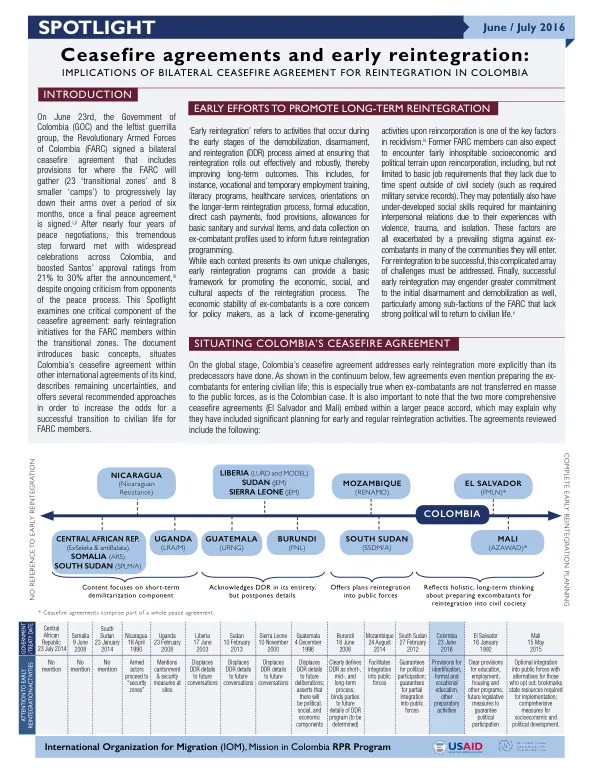
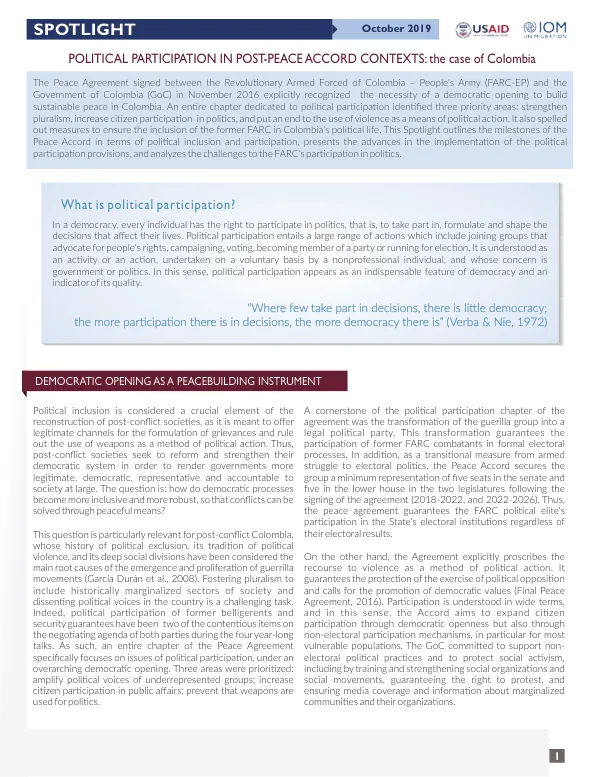
The Peace Agreement signed between the Revolutionary Armed Forces of Colombia - People's Army (FARC-EP) and the Government of Colombia (GoC) in November 2016 explicitly recognized the necessity of a democratic opening to build sustainable peace in Colombia.
2019 · 5 pages
Sign in to readA free account is required to download.
Abstract
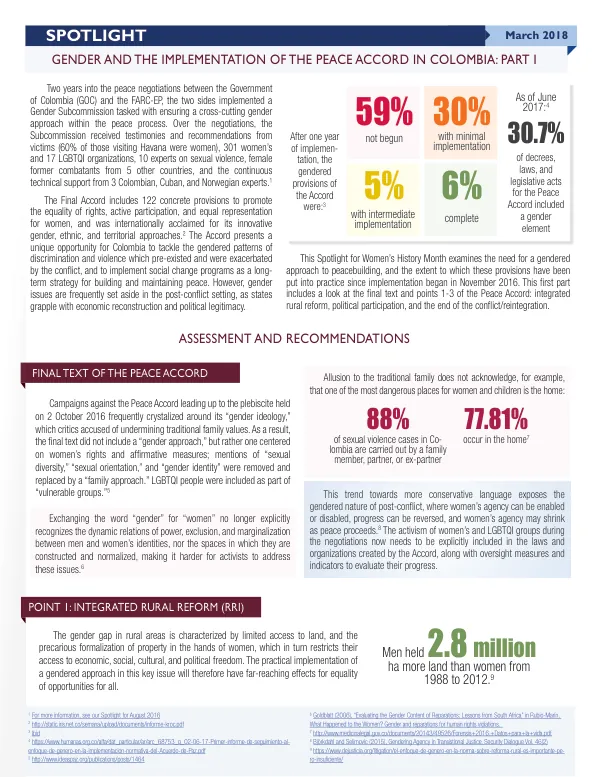
The agreement's chapter on political participation identified three priority areas: strengthen pluralism, increase citizen participation in politics, and put an end to the use of violence as a means of political action. The chapter also spelled out measures to ensure the inclusion of the former FARC in Colombia's political life. The transformation of the guerrilla group into a legal political party was a cornerstone of the political participation chapter of the agreement. This transformation guarantees the participation of former FARC combatants in formal electoral processes. Additionally, as a transitional measure from armed struggle to electoral politics, the Peace Accord secures the group a minimum representation of five seats in the senate and five in the lower house in the two legislatures following the signing of the agreement (2018-2022, and 2022-2026). The agreement explicitly proscribes the recourse to violence as a method of political action, guarantees the protection of the exercise of political opposition, and calls for the promotion of democratic values. The agreement aims to expand citizen participation through democratic openness but also through non-electoral participation mechanisms, particularly for the most vulnerable populations. The Government of Colombia committed to support non-electoral political practices and to protect social activism, including by training and strengthening social organizations and social movements, guaranteeing the right to protest, and ensuring media coverage and information about marginalized communities and their organizations. Poliical participation is considered a crucial element of the reconstruction of post-conflict societies, as it offers legitimate channels for the formulation of grievances and rules out the use of weapons as a method of political action. The question is: how do democratic processes become more inclusive and more robust, so that conflicts can be solved through peaceful means? This question is particularly relevant for post-conflict Colombia, whose history of political exclusion, its tradition of political violence, and its deep social divisions have been considered the main root causes of the emergence and proliferation of guerrilla movements. The implementation of the provisions on political participation has been challenging, with some of the legal provisions having been formally adopted but not yet translating into sufficient effective protection for political, social, and human rights activists. The delays are due to a lack of funding, means, or technical capacity, and the community security and prevention strategies need to be reinforced. Incomplete implementation is significantly affecting not only FARC combatants' but also human rights activists' and social leaders' effective capacity to participate in politics, as political violence has been on the rise since the signature of the Accord. The National Council for Peace, Reconciliation, and Coexistence was created in 2017, but it has not yet completed any of the subsidiary actions contained in the Peace Accord. However, sections regarding the end of the armed conflict and the transformation of the FARC-EP into a democratic political party present some of the highest levels of implementation. The Kroc Institute monitors the implementation of the Colombian Peace Agreement and reports that the second point of the Agreement dedicated to Political Participation is the one that has registered the lowest levels of implementation since November 2016. The transformation of the FARC-EP into a democratic political party has been a significant step towards building peace through democratic opening. The party has been participating in formal electoral processes, and its members have been elected to various positions, including the Senate and the House of Representatives. The party has also been involved in various social and community development projects, aiming to promote peace and reconciliation in the regions where the conflict was most intense. The implementation of the provisions on political participation has been challenging, but it has also presented opportunities for the FARC-EP to reinvent its agenda and engage in politics in a new way. The party has been working to promote democratic values, human rights, and social justice, and it has been involved in various initiatives aimed at promoting peace and reconciliation in Colombia. The transformation of the FARC-EP into a democratic political party has been a significant step towards building peace and promoting democratic opening in Colombia.