USAID DEC
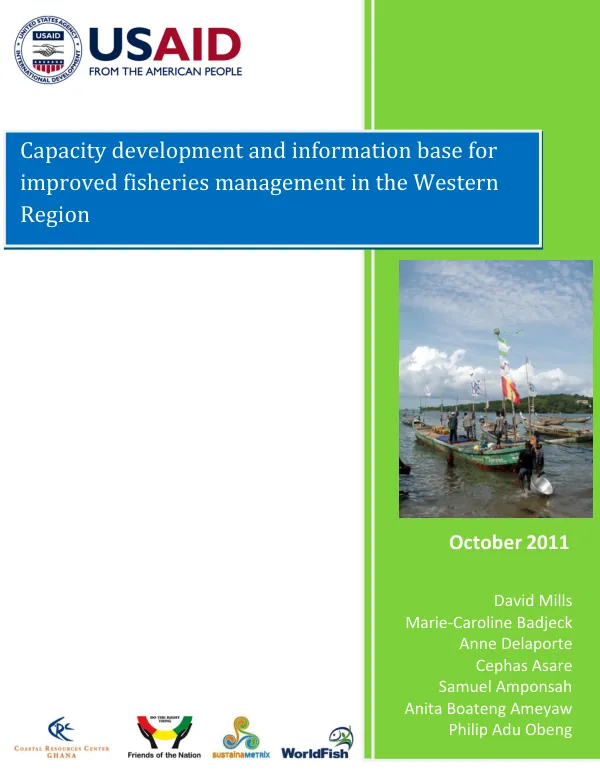
Capacity development and information base for improved fisheries management in the Western Region
Sign inUSAID/GHANMA
Capacity development and information base for improved fisheries management in the Western Region
Capacity development and information base for improved fisheries management in the Western Region began in 2011 as part of the Integrated Coastal and Fisheries Governance (ICFG) Project.
2011 · 76 pages
Sign in to readA free account is required to download.
Abstract
The project aimed to enhance fisheries management in the Western Region of Ghana through capacity development and information base improvement. The initiative was made possible by the generous support of the American people through the United States Agency for International Development (USAID)/Ghana. The project focused on capacity development, which involved training and strengthening the skills of government staff, fisheries extension officers, and community members. The training event in May 2011 on adaptive management met its primary objective, with participants mentioning adaptive management, scenario planning, and the human dimension in fisheries as key takeaways. The training highlighted the importance of facilitation skills and group interaction in implementing adaptive management. The need assessment survey results of the Fisheries Working Group (FWG) conducted in May 2011 showed that to redefine the FWG role in sector reform and management, moving from a passive or "command and control" to an "enabling" role in communities, will require extensive training of government staff. The results emphasized the need for a step-by-step realistic approach that includes leadership and communication skills training. The FWG had a good understanding of what is co-management, but respondents mainly focused on the "process" (i.e., forming groups). The Hen Mpoano project should also prompt partners on the impacts they want to achieve with co-management, including a shared vision of the fisheries sector and the reasons for implementing co-management. The Senegal study tour in August 2011 provided participants with an understanding of why co-management is needed in fishing communities and the process involved in its implementation. An important learning outcome for the participants was the essential role women play in fisheries management and community development. The study tours were an opportunity for participants to get inspired about new ideas and concepts and bring them back home to share them with their community as part of the capacity development process. The Axim community event in August 2011 provided a number of lessons for future engagement and capacity building with communities in the Western Region. These lessons included the need for permanent visual displays of each study tour, excellent facilitation skills, and adequate training in conflict resolution, group dynamics, and communication for fisheries extension officers and study tour participants. Community partnerships, through active participatory meetings such as the Axim meeting, can be an opportunity to develop advocacy arguments that are particularly persuasive to policy makers and can effectively influence policy and practices. The information and testimonies collected during these meetings can provide valuable information to feedback during the proposed national dialogue Hen Mpoano initiative. The community meeting also provided evidence that much more work was needed in terms of education and communication of the new Law and its implications for fishers, as well as practices of naval Task-force who is seeking to enforce regulations by force. The recent demonstration in September 2011 in the Sekondi area against the Task-force shows that for voluntary compliance to occur awareness and education campaigns are still needed. The workshop "Building on the Positive: Informing fisheries management interventions in the Western Region" in August 2011 provided a platform for participants to reflect on their study tours and share their experiences. The display produced during the workshop could be used as a template for future community events and capacity building initiatives.