COASTAL RESOURCES CENTER
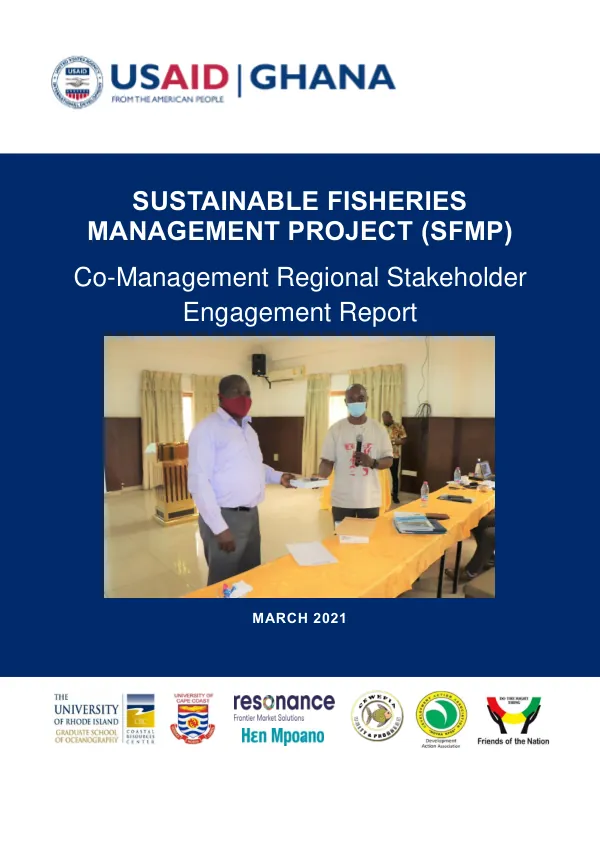
Co-Management Regional Stakeholder Engagement Report
The Sustainable Fisheries Management Project (SFMP) in Ghana aims to promote a fisheries co-management regime.
2021 · 11 pages
Sign in to readA free account is required to download.
Abstract
This approach involves devolving some fisheries management authority from the central fisheries management authority to stakeholders, particularly resource users, through collaborative management arrangements. The development of the new co-management policy has been a multi-year process, involving consultations with various stakeholders across the country. These consultations have been supported by the World Bank, USAID, the Ministry of Fisheries and Aquaculture Development (MOFAD), the Fisheries Commission (FC), and non-governmental organizations (NGOs). The Community-Based Fisheries Management Committees (CBFMC) arrangement, a form of fisheries co-management, was implemented at many fish landing locations along the coast and inland fish landing sites along the Volta Lake between 1997 and 2002. However, this arrangement collapsed due to a lack of necessary guidance, resources, and clarity of responsibilities. Despite this setback, several lessons were learned from the experimentation, which have guided the development of the new co-management policy. The new policy aims to promote collaborative management arrangements between stakeholders, including resource users, to ensure the sustainable management of fisheries resources. This approach is globally viewed as an acceptable best practice. The policy development process has involved extensive consultations with various stakeholders, including fishermen, fishing communities, and other relevant parties. Regional stakeholder engagements on the fisheries co-management policy have been a crucial component of the policy development process. These engagements have provided a platform for stakeholders to discuss key issues related to the policy, share their experiences, and contribute to the development of the policy. The presentations on the fisheries co-management policy and the Canoe Identification Cards (CIC) have been key components of these engagements. The presentation on the fisheries co-management policy highlighted key issues related to the policy, including the need for collaborative management arrangements and the importance of devolving fisheries management authority to stakeholders. The discussion and contribution by stakeholders provided valuable insights into the policy development process and helped to identify key recommendations for the policy. The presentation on the CIC highlighted the importance of this initiative in promoting sustainable fisheries management. The CIC is a tool designed to identify and track canoes used in fishing activities, which is essential for effective fisheries management. The discussion and contribution by stakeholders on this issue helped to identify key recommendations for the implementation of the CIC. The regional stakeholder engagements have been a critical component of the policy development process, providing a platform for stakeholders to discuss key issues related to the policy and contribute to its development. The presentations on the fisheries co-management policy and the CIC have been key components of these engagements, highlighting the importance of collaborative management arrangements and the CIC in promoting sustainable fisheries management. The SFMP has been working closely with various stakeholders, including fishermen, fishing communities, and other relevant parties, to promote a fisheries co-management regime in Ghana. The project has been supported by the World Bank, USAID, MOFAD, FC, and NGOs, and has involved extensive consultations with various stakeholders to develop the new co-management policy. The SFMP has been working to promote a fisheries co-management regime in Ghana, which involves devolving some fisheries management authority from the central fisheries management authority to stakeholders, particularly resource users, through collaborative management arrangements. The project has been supported by the World Bank, USAID, MOFAD, FC, and NGOs, and has involved extensive consultations with various stakeholders to develop the new co-management policy. The policy development process has been a critical component of the project, providing a platform for stakeholders to discuss key issues related to the policy and contribute to its development. The regional stakeholder engagements have been a key component of this process, providing a platform for stakeholders to discuss key issues related to the policy and contribute to its development.