FLORIDA INTERNATIONAL UNIVERSITY
Innovation Platforms to Enhance the Small Ruminant Value Chain
Strengthened value chains can improve food security among smallholder farmers by increasing access to information, agricultural inputs, and markets.
2020 · 1 pages
Sign in to readA free account is required to download.
Abstract
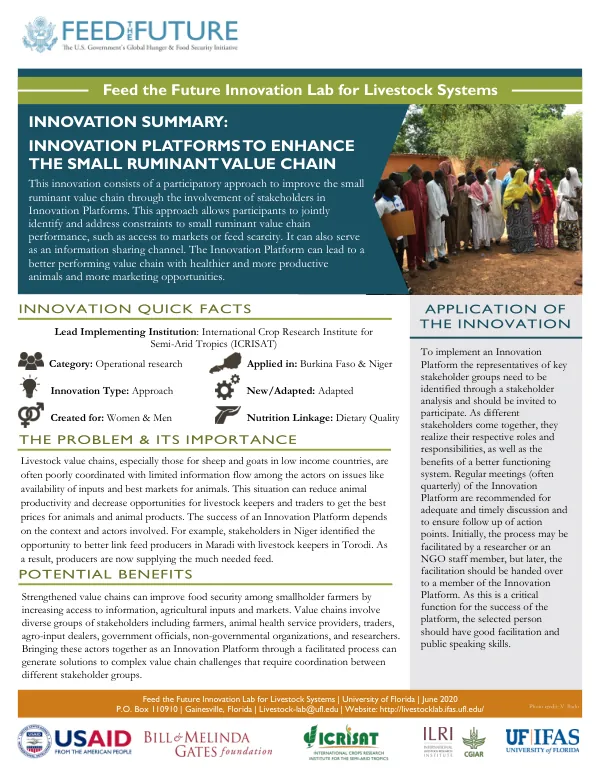
Value chains involve diverse groups of stakeholders including farmers, animal health service providers, traders, agro-input dealers, government officials, non-governmental organizations, and researchers. Bringing these actors together as an Innovation Platform through a facilitated process can generate solutions to complex value chain challenges that require coordination between different stakeholder groups. The Innovation Platform approach involves a participatory process to improve the small ruminant value chain through the involvement of stakeholders. This approach allows participants to jointly identify and address constraints to small ruminant value chain performance, such as access to markets or feed scarcity. It can also serve as an information sharing channel. The Innovation Platform can lead to a better performing value chain with healthier and more productive animals and more marketing opportunities. Livestock value chains, especially those for sheep and goats in low-income countries, are often poorly coordinated with limited information flow among the actors on issues like availability of inputs and best markets for animals. This situation can reduce animal productivity and decrease opportunities for livestock keepers and traders to get the best prices for animals and animal products. The success of an Innovation Platform depends on the context and actors involved. For example, stakeholders in Niger identified the opportunity to better link feed producers in Maradi with livestock keepers in Torodi, resulting in producers supplying the much-needed feed. To implement an Innovation Platform, representatives of key stakeholder groups need to be identified through a stakeholder analysis and invited to participate. As different stakeholders come together, they realize their respective roles and responsibilities, as well as the benefits of a better functioning system. Regular meetings, often quarterly, of the Innovation Platform are recommended for adequate and timely discussion and to ensure follow-up of action points. Initially, the process may be facilitated by a researcher or an NGO staff member, but later, the facilitation should be handed over to a member of the Innovation Platform. As this is a critical function for the success of the platform, the selected person should have good facilitation and public speaking skills. The Innovation Platform approach has been applied in Burkina Faso and Niger, with the goal of improving the small ruminant value chain. The platform brings together diverse stakeholders to identify and address constraints to value chain performance, share information, and improve the overall functioning of the value chain. By facilitating coordination and information flow among stakeholders, the Innovation Platform can lead to a better performing value chain with healthier and more productive animals and more marketing opportunities.