USAID DEC
Capacity Development Gap Analysis: Ethiopia
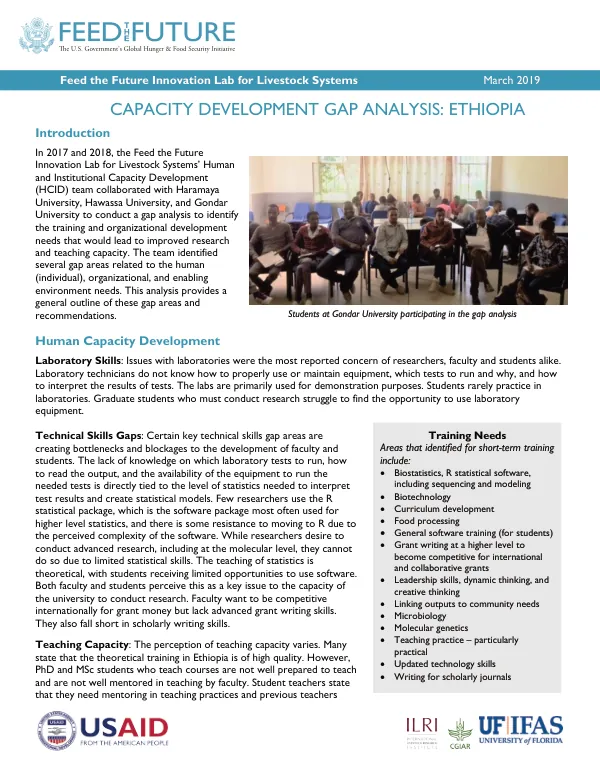
The Feed the Future Innovation Lab for Livestock Systems conducted a capacity development gap analysis in Ethiopia in 2017 and 2018.
2019 · 4 pages
Sign in to readA free account is required to download.
Abstract
The analysis aimed to identify training and organizational development needs to improve research and teaching capacity at Haramaya University, Hawassa University, and Gondar University. The study revealed several gap areas related to human, organizational, and enabling environment needs. Laboratory skills were identified as a major concern, with laboratory technicians lacking knowledge on how to properly use or maintain equipment, run tests, and interpret results. Technical skills gaps were also reported, particularly in biostatistics, R statistical software, and molecular biology. Few researchers use the R statistical package, and there is resistance to moving to R due to its perceived complexity. The teaching of statistics is theoretical, with students receiving limited opportunities to use software. Teaching capacity was also a concern, with many faculty members perceiving that the theoretical training in Ethiopia is of high quality. However, PhD and MSc students who teach courses are not well prepared to teach and are not well mentored in teaching by faculty. Student teachers state that they need mentoring in teaching practices and previous teachers should be willing to share course materials. The teaching of practical skills falls short due to the lack of laboratory equipment and skills. Organizational capacity development was also a focus of the analysis. Laboratory management was identified as a significant challenge, with laboratory managers and technicians lacking the skills to maintain and fix equipment. Staff leveling was also a concern, with the goal of the Ethiopian government being that all university faculty involved in teaching must hold a graduate degree (MSc or PhD) within the next 3 to 4 years. However, all of the Ethiopian universities that participated in the analysis will not be able to reach this target. Institutional linkages between research institutions, universities, and extension were weak, with attempts to establish platforms for these institutions to discuss challenges not being successful. The different institutions suggested the need for joint plans at the national level between ministries as well as a research agenda that supports collaboration and joint resources. Coupled with this is the under-resourcing of laboratories, particularly at regional research locations, which in some areas do not have the equipment to conduct basic tests. Turnover of young faculty was also a concern, with PhD holders being scarce and senior faculty often refusing to teach undergraduate courses. Junior faculty reported that they feel the quality of students has decreased and being a faculty member is not as good of a career choice as it was twenty years earlier. They feel that politics and a lack of motivation are affecting job satisfaction and performance. Thesis support was also identified as an issue, with students reporting a lack of updated knowledge on the part of the faculty, poor laboratory resources, and insufficient funding. Students reported that faculty do not have the knowledge to assist students in researching new ideas, including updated research methods, statistics, and subject matter expertise. The enabling environment was also a focus of the analysis, with laboratory infrastructure being inadequate, lacking equipment and consumables. The Ministry of Finance oversees the purchasing of laboratory equipment and consumables, but this approach results in researchers waiting up to two years to receive their equipment, causing significant delays in research projects. Gender constraints were also identified, with female students facing challenges such as their normative responsibility to take care of children and maintain the household, which prevents them from participating in opportunities to engage with faculty outside of scheduled class time.