USAID DEC
Carbon Stocks of Tropical Coastal Wetlands within the Karstic Landscape of the Mexican
Sign inOPEN UNIVERSITY
Carbon Stocks of Tropical Coastal Wetlands within the Karstic Landscape of the Mexican
Tropical coastal wetlands are one of the most carbon-rich ecosystems in the world.
2013 · 13 pages
Sign in to readA free account is required to download.
Abstract
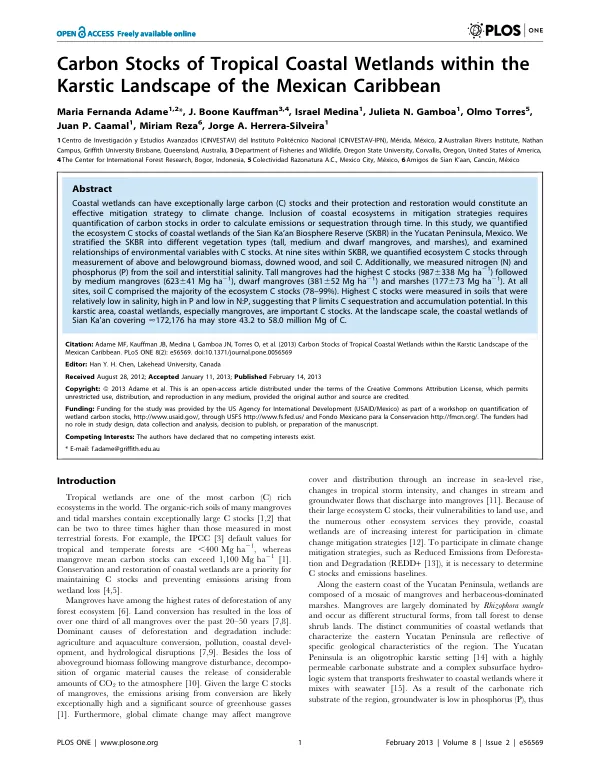
The organic-rich soils of many mangroves and tidal marshes contain exceptionally large carbon stocks that can be two to three times higher than those measured in most terrestrial forests. For example, the IPCC default values for tropical and temperate forests are approximately 400 Mg ha^-1, whereas mangrove mean carbon stocks can exceed 1,100 Mg ha^-1. Conservation and restoration of coastal wetlands are a priority for maintaining carbon stocks and preventing emissions arising from wetland loss. Mangroves have among the highest rates of deforestation of any forest ecosystem, with over one third of all mangroves lost over the past 20-50 years. Dominant causes of deforestation and degradation include agriculture and aquaculture conversion, pollution, coastal development, and hydrological disruptions. Besides the loss of aboveground biomass following mangrove disturbance, decomposition of organic material causes the release of considerable amounts of CO2 to the atmosphere. The Sian Ka'an Biosphere Reserve (SKBR) in the Yucatan Peninsula, Mexico, is a relatively pristine location with a mosaic of mangroves and herbaceous-dominated marshes. Mangroves are largely dominated by Rhizophora mangle and occur as different structural forms, from tall forest to dense shrub lands. The distinct communities of coastal wetlands that characterize the eastern Yucatan Peninsula are reflective of specific geological characteristics of the region. The Yucatan Peninsula is an oligotrophic karstic setting with a highly permeable carbonate substrate and a complex subsurface hydrologic system that transports freshwater to coastal wetlands where it mixes with seawater. In this study, whole-ecosystem carbon stocks of different coastal wetlands within the SKBR were measured. The study site, located in Quintana Roo State in the Yucatan Peninsula, Mexico, covers an area of 551,715 ha that includes evergreen and deciduous upland forests, savannahs, and a large expanse of coastal wetlands. The coastal wetlands of the area are flooded by a mixture of seawater from tidal fluxes and fresh groundwater from subsurface flows through the karstified limestone. Coastal wetland plant communities in the SKBR were separated into four types: tall mangroves, medium mangroves, dwarf mangroves, and herbaceous-dominated marshes. Field sampling was conducted in August 2011 at 9 different coastal wetland sites within the SKBR, representing four kinds of vegetation types. Within each site, whole-ecosystem carbon stocks were measured following methodologies outlined in the study. The results showed that tall mangroves had the highest carbon stocks, followed by medium mangroves, dwarf mangroves, and marshes. Soil carbon comprised the majority of the ecosystem carbon stocks at all sites, ranging from 78-99%. The highest carbon stocks were measured in soils that were relatively low in salinity, high in phosphorus, and low in nitrogen-to-phosphorus ratio, suggesting that phosphorus limits carbon sequestration and accumulation potential. The study provides the first whole-ecosystem carbon stock analysis of different types of coastal wetlands within a tropical karstic zone. Mangroves in karstic regions could account for more than 1.5 million ha, notably in Cuba, the Yucatan Peninsula, Mexico, Madagascar, and the Philippines. The carbon stocks calculated in this study are invaluable information for carbon stock baselines of coastal wetlands of the Yucatan Peninsula and similar coastal settings.