RTI INTERNATIONAL
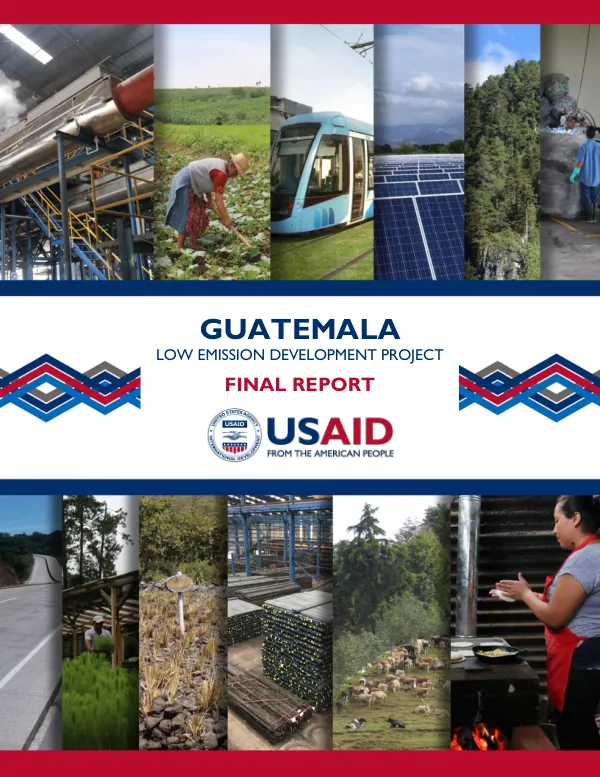
Final Report: USAID Low Emission Development Project | Guatemala
The USAID Low Emission Development Project in Guatemala aimed to support the Government of Guatemala (GOG) and USAID Guatemala in developing and implementing a low emission development strategy (LEDS) to reduce greenhouse gas (GHG) emissions from priority sectors in the Guatemalan economy.
2019 · 98 pages
Sign in to readA free account is required to download.
Abstract
The LEDS establishes the path for countries like Guatemala to fulfill their commitment to the United Nations Framework Convention on Climate Change (UNFCCC) to reduce GHG emissions. The Project successfully built the capacity of not only GOG agencies, but also small- and large-scale private enterprises, farmer organizations, municipal governments, and women and marginalized groups to reduce the effects of climate change and mitigate GHG emissions. In November 2018, the LEDS action planning process was completed and the national LEDS publicly launched. The LEDS will help Guatemala establish the route toward achieving its long-term GHG emission target. Guatemala committed to reducing GHG emissions by 11% over a 2005 business-as-usual (BAU) scenario in its Nationally Determined Contribution (NDC). With additional assistance from the international community, the target increases to a 22% reduction. The USAID Low Emission Development Project assisted key LEDS stakeholders with advancing national-level policies and field-level demonstration activities that further contribute to the reduction of emissions. At the center of the Project's success is its facilitation of seven sectoral working groups, comprised of more than 500 Guatemalans, to address GHG emissions and long-term economic growth in key areas of the economy: agriculture, forestry and other land use (FOLU), waste, industry, energy, transportation, and urban development. GOG leadership remained at the forefront of the process throughout, with GOG agencies having led working group discussions and helping to build on existing policies that meet both LEDS and national development objectives. Each working group also comprised representatives from the private sector, academia, and civil society, contributing to an open, multi-stakeholder dialogue. The working group process was the first time many representatives, especially those from the GOG and private sector, had previously sat down at the same table together to discuss these topics. Over the course of 2017-2018, each working group progressed through six sessions in the LEDS action planning methodology, reviewing GHG emission baselines and forecasts, establishing a vision for long-term LEDS implementation, and voting to adopt 43 priority policy responses that meet sectoral environmental, economic, and social objectives. The Project built a robust network of low emission development champions in various sectors and throughout GOG agencies, the private sector, academia, and civil society. This network will continue to support the implementation of the LEDS and the reduction of GHG emissions in Guatemala. The Project also assisted in the development of a National Climate Change Adaptation and Mitigation Plan, which was approved in 2016, and the launch of the National Energy Plan in 2017. In addition to the LEDS action planning process, the Project also implemented several sectoral activities to reduce GHG emissions. These activities included the promotion of efficient fertilizer practices in agriculture, the adoption of clean cookstoves in households, and the implementation of diversified agroforestry systems in coffee-producing landscapes. The Project also supported the development of a National Greenhouse Gas Inventory, which will help Guatemala track its progress in reducing GHG emissions. The Project's success was also due to its facilitation of gender equity mainstreaming into the design of five small grant activities, resulting in over 5,000 women trained in agroforestry nurseries, savings and loans, and new income generation activities. The Project also supported the development of a National Climate Change Information System, which will provide critical information on climate change impacts and mitigation efforts in Guatemala. Overall, the USAID Low Emission Development Project in Guatemala has made significant progress in reducing GHG emissions and promoting low emission development in the country. The Project's success has been due to its facilitation of a robust network of low emission development champions, its support for the development of a National Climate Change Adaptation and Mitigation Plan, and its implementation of several sectoral activities to reduce GHG emissions.