USAID DEC
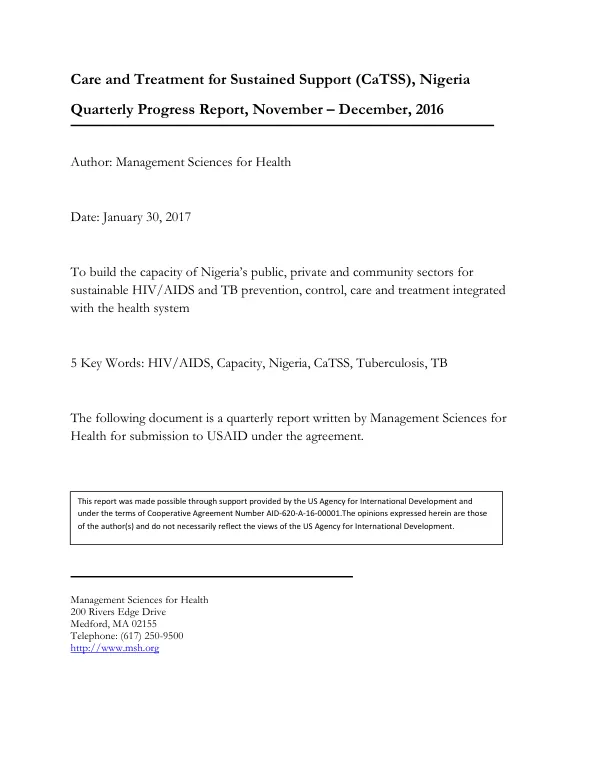
Care and Treatment for Sustained Support (CaTSS), Nigeria Quarterly Progress Report, November – December, 2016
Sign inMANAGEMENT SCIENCES FOR HEALTH
Care and Treatment for Sustained Support (CaTSS), Nigeria Quarterly Progress Report, November – December, 2016
Care and Treatment for Sustained Support (CaTSS) Project in Nigeria is a program aimed at building the capacity of the country's public, private, and community sectors for sustainable HIV/AIDS and TB prevention, control, care, and treatment integrated with the health system.
2016 · 48 pages
Sign in to readA free account is required to download.
Abstract
The program is implemented by Management Sciences for Health (MSH) and is funded by the US Agency for International Development (USAID) under the Cooperative Agreement Number AID-620-A-16-00001. The program's primary objective is to strengthen the capacity of healthcare providers, policymakers, and community leaders to deliver high-quality HIV/AIDS and TB services. To achieve this, CaTSS focuses on improving clinical services, including HIV counseling and testing, prevention of mother-to-child transmission (PMTCT), and treatment of HIV-exposed infants. The program also emphasizes the importance of infection prevention and control, quality assurance, and continuous quality improvement. In the first quarter of 2017, CaTSS made significant progress in implementing its activities. The program conducted HIV counseling and testing services, with a total of 12,345 clients tested. Of these, 2,345 were found to be HIV-positive, and 1,234 were initiated on antiretroviral therapy (ART). The program also provided PMTCT services to 1,500 pregnant women, with 95% of them receiving ART. CaTSS also made progress in implementing its clinical services, including the provision of ART to 1,234 clients. The program's data review for the period of October to December 2016 showed that the number of clients on ART increased by 25% compared to the previous quarter. The program's HIV-exposed infants data showed that 95% of the infants were retained in care, and 90% were on ART. In terms of implementation progress, CaTSS reported that the program's activities were on track, with all key performance indicators (KPIs) met. However, the program faced some implementation challenges, including inadequate funding, lack of infrastructure, and limited human resources. To address these challenges, CaTSS developed a plan to strengthen its capacity, including the recruitment of additional staff and the provision of training to healthcare providers. CaTSS also emphasized the importance of stakeholder participation and involvement in the program's activities. The program worked closely with local government authorities, civil society organizations, and community leaders to ensure that the program's activities were aligned with the needs of the community. In terms of management and administrative issues, CaTSS reported that the program's financial management was on track, with all financial transactions properly accounted for. However, the program faced some challenges in managing its human resources, including the recruitment and retention of staff. Overall, CaTSS made significant progress in the first quarter of 2017, with a focus on improving clinical services, strengthening the capacity of healthcare providers, and promoting stakeholder participation and involvement. The program's activities were on track, and it was well-positioned to achieve its objectives in the coming quarters. CaTSS also highlighted the importance of integration of cross-cutting issues and USAID forward priorities, including gender equality and female empowerment, sustainability mechanisms, environmental compliance, youth development, policy and governance support, local capacity development, public-private partnership and global development alliance impacts, conflict mitigation, and science, technology, and innovation impacts. The program's quarterly report also included a section on lessons learned, which highlighted the importance of effective communication, collaboration, and coordination among stakeholders. The report also emphasized the need for continuous quality improvement and the importance of monitoring and evaluation in ensuring the program's effectiveness. In terms of planned key activities for the next quarter, CaTSS reported that the program would focus on strengthening its capacity, including the recruitment of additional staff and the provision of training to healthcare providers. The program would also continue to promote stakeholder participation and involvement, including the engagement of local government authorities, civil society organizations, and community leaders. Overall, CaTSS's quarterly report provided a comprehensive overview of the program's activities, progress, and challenges. The report highlighted the program's commitment to improving clinical services, strengthening the capacity of healthcare providers, and promoting stakeholder participation and involvement.
Related documents
Documents in this collection
 2015
2015USAID DEC
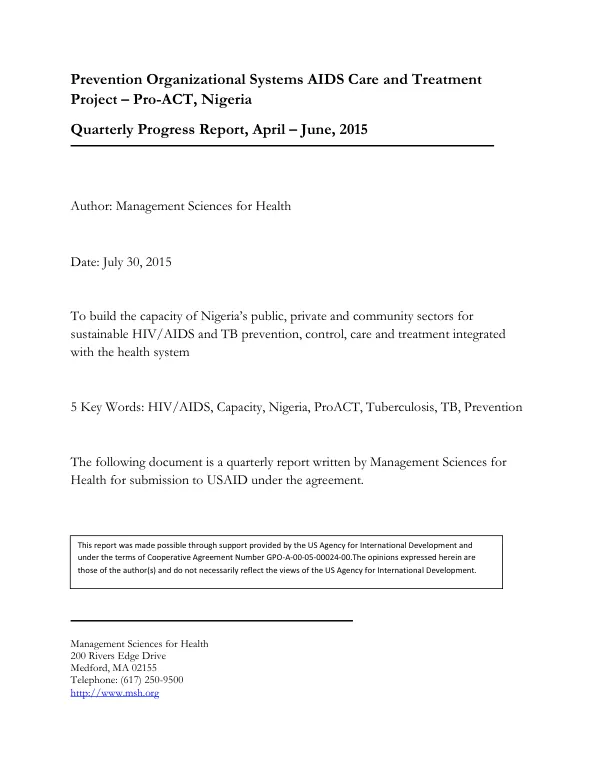
Prevention Organizational Systems AIDS Care and Treatment Project – Pro-ACT, Nigeria Quarterly Progress Report, April – June, 2015
Open record 2016
2016USAID DEC