USAID DEC
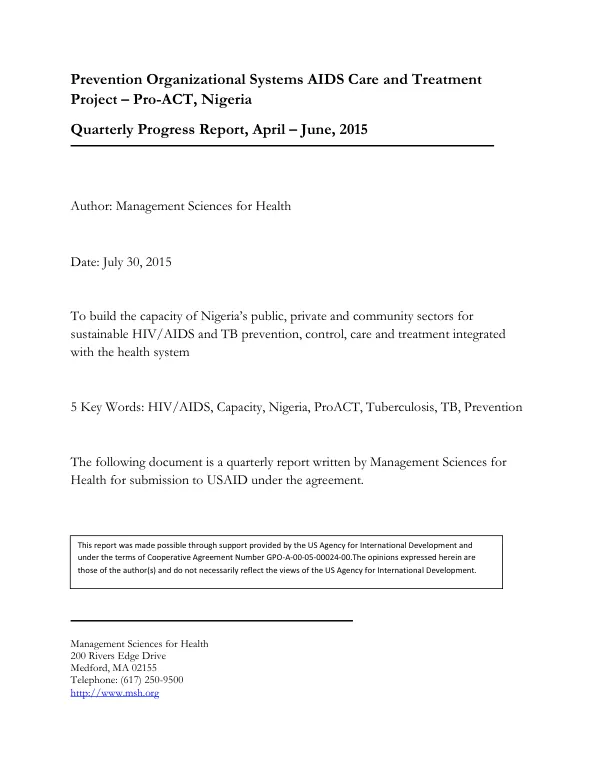
Prevention Organizational Systems AIDS Care and Treatment Project – Pro-ACT, Nigeria Quarterly Progress Report, April – June, 2015
Sign inMANAGEMENT SCIENCES FOR HEALTH
Prevention Organizational Systems AIDS Care and Treatment Project – Pro-ACT, Nigeria Quarterly Progress Report, April – June, 2015
The Prevention Organizational Systems AIDS Care and Treatment Project, also known as Pro-ACT, is a project implemented by Management Sciences for Health in Nigeria.
2015 · 103 pages
Sign in to readA free account is required to download.
Abstract
The project aims to build the capacity of Nigeria's public, private, and community sectors for sustainable HIV/AIDS and TB prevention, control, care, and treatment integrated with the health system. The project is funded by the United States Agency for International Development (USAID) under the agreement number AID-620-A-00-09-00013-00. The project's objectives include increasing demand for HIV/AIDS and TB services and interventions, especially among target groups, increasing access to quality HIV/AIDS and TB services, practices, and products in selected states, and strengthening public, private, and community enabling environments. The project is implemented in five states: Kebbi, Kwara, Niger, Sokoto, and Zamfara. The project's implementation progress is reported in the quarterly progress report for April to June 2015. The report highlights major achievements in community services, clinical services, supply chain management, health system strengthening, and monitoring and evaluation. The report also provides an update on the project's implementation status by state, including Kebbi, Kwara, Niger, Sokoto, and Zamfara. In community services, the project achieved significant results in increasing access to HIV/AIDS and TB services, particularly among target groups. The project also strengthened public, private, and community enabling environments through leadership development programs and quality improvement initiatives. In clinical services, the project made significant progress in increasing access to quality HIV/AIDS and TB services, practices, and products. The project also strengthened the capacity of healthcare providers through training and mentorship programs. In supply chain management, the project improved the availability and accessibility of HIV/AIDS and TB commodities, particularly in rural areas. The project also strengthened the capacity of healthcare providers to manage and distribute commodities effectively. In health system strengthening, the project made significant progress in strengthening public, private, and community enabling environments. The project also improved the capacity of healthcare providers to deliver quality services. The project's monitoring and evaluation system is designed to track progress against project objectives and indicators. The system includes regular data collection, analysis, and reporting to ensure that the project is on track to meet its objectives. The project's implementation status by state is reported in the quarterly progress report. The report highlights the progress made in each state, including Kebbi, Kwara, Niger, Sokoto, and Zamfara. The report also identifies challenges and opportunities for improvement in each state. The project's integration of crosscutting issues and USAID forward priorities is also reported in the quarterly progress report. The report highlights the project's efforts to integrate crosscutting issues, such as gender, youth, and community participation, into project activities. The report also highlights the project's efforts to address USAID forward priorities, such as strengthening health systems and improving access to quality services. The project's local capacity development is also reported in the quarterly progress report. The report highlights the project's efforts to build the capacity of local partners, including civil society organizations and community-based organizations. The report also highlights the project's efforts to strengthen the capacity of healthcare providers to deliver quality services. The project's challenges are also reported in the quarterly progress report. The report highlights the challenges faced by the project, including funding constraints, logistical challenges, and capacity gaps. The report also identifies opportunities for improvement and mitigation strategies to address these challenges. The project's planned activities for the next quarter are also reported in the quarterly progress report. The report highlights the project's plans to continue implementing project activities, including community services, clinical services, supply chain management, health system strengthening, and monitoring and evaluation. The project's performance monitoring plan is also reported in the quarterly progress report. The report highlights the project's efforts to track progress against project objectives and indicators. The report also highlights the project's efforts to identify challenges and opportunities for improvement. The project's success story is also reported in the quarterly progress report. The report highlights the project's achievements and impact, including increased access to HIV/AIDS and TB services, improved health outcomes, and strengthened public, private, and community enabling environments.
Related documents
Documents in this collection
 2016
2016USAID DEC
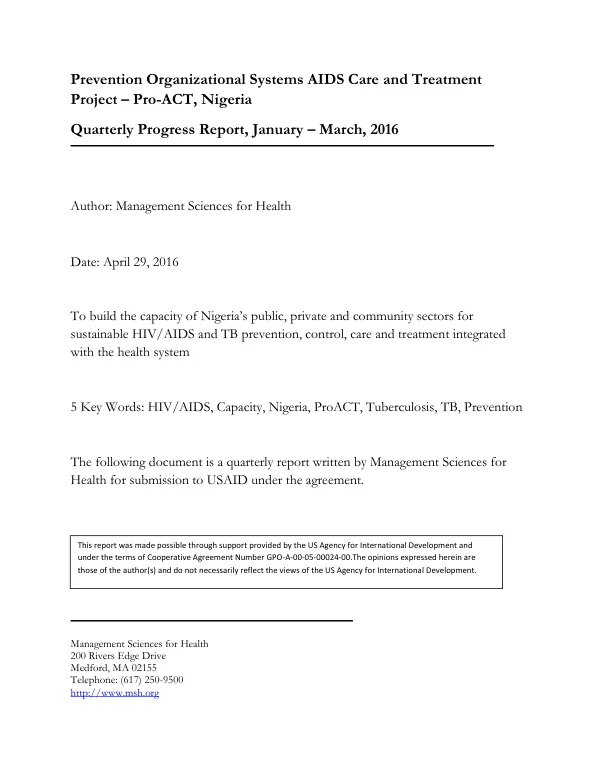
Prevention Organizational Systems AIDS Care and Treatment Project – Pro-ACT, Nigeria Quarterly Progress Report, January – March, 2016
Open record 2016
2016USAID DEC