MANAGEMENT SCIENCES FOR HEALTH
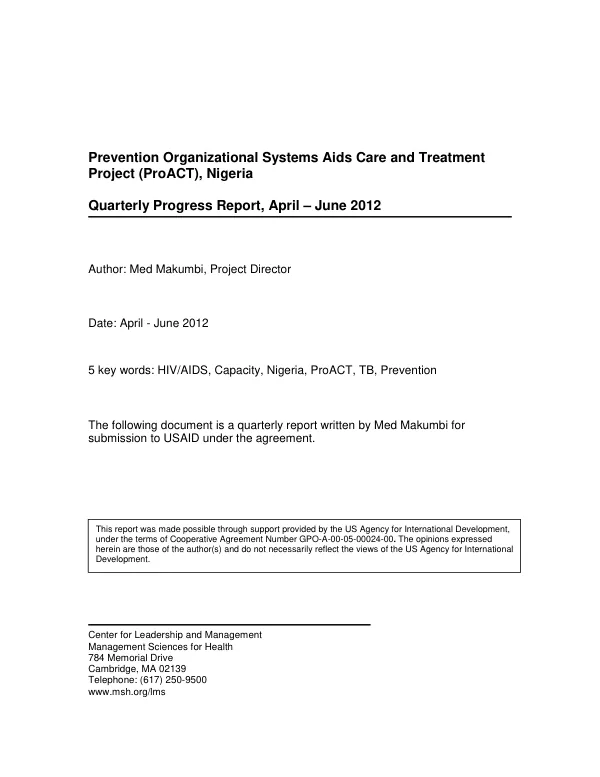
Prevention Organizational Systems AIDS Care and Treatment Project— ProACT
The MSH ProACT project in Nigeria is a USAID-funded initiative aimed at building the capacity of Nigeria's public, private, and community sectors for sustainable HIV/AIDS and TB prevention, control, care, and treatment.
2012 · 41 pages
Sign in to readA free account is required to download.
Abstract
The project is a part of the Leadership, Management, and Sustainability Program (LMS) of Management Sciences for Health (MSH), which is a global five-year cooperative agreement designed to develop leadership and management skills at all levels of healthcare organizations and programs. The project began operations in August 2009 and is implemented in six states: Adamawa, Taraba, Niger, Kogi, Kebbi, and Kwara. ProACT supports 29 comprehensive HIV/AIDS treatment centers and has established offices in each of the six states to provide technical support to the areas of greatest need. The project's main office is located in Abuja, Nigeria. The project's activity summary outlines its objectives, which include increasing demand for HIV/AIDS and TB services and interventions, increasing access to quality HIV/AIDS and TB services, and strengthening public, private, and community enabling environments. The project's implementing partner is MSH, and its activity objective is to build the capacity of Nigeria's public, private, and community sectors for sustainable HIV/AIDS and TB prevention, control, care, and treatment integrated with the health system. In the quarter April-June 2012, the MSH ProACT project continued to support the government of Nigeria in the provision and scale-up of HIV care and treatment services in the six focus states. The project scaled up HIV services to two hospitals situated in underserved and hard-to-reach communities of Taraba and Adamawa states. The 2010 sero-sentinel report indicates that Ganye community in Adamawa has a HIV prevalence rate of 5.8%, which is above the national median of 4.1%. In addition, 16 new PMTCT sites were activated to provide life-saving ARVs to eligible HIV+ pregnant clients. The project achieved several milestones in the period under review, including counseling, testing, and providing test results to 125,201 people, including those receiving services from PMTCT settings. Of these, 47,362 were in this quarter. The project also activated two hospitals to provide comprehensive care and treatment services and established 16 new PMTCT sites. The project's quarterly progress report highlights its achievements and challenges in the period under review. The report provides an overview of the project's activities, including health systems strengthening, HIV prevention program, strengthening community systems for delivery of OVC and basic care services, clinical services, laboratory services, supply chain management system, monitoring, evaluation, and research, and progress in implementation of additional laboratory SOW. The project's executive summary provides an overview of its achievements and challenges in the quarter April-June 2012. The summary highlights the project's support to the government of Nigeria in the provision and scale-up of HIV care and treatment services in the six focus states. The project's achievements in the period under review include counseling, testing, and providing test results to 125,201 people, activating two hospitals to provide comprehensive care and treatment services, and establishing 16 new PMTCT sites. The project's quarterly progress report provides a detailed overview of its activities and achievements in the period under review. The report highlights the project's support to the government of Nigeria in the provision and scale-up of HIV care and treatment services in the six focus states. The project's achievements in the period under review include counseling, testing, and providing test results to 125,201 people, activating two hospitals to provide comprehensive care and treatment services, and establishing 16 new PMTCT sites. The project's quarterly progress report also highlights its challenges in the period under review. The report notes that the project faced challenges in implementing its activities, including delays in the activation of some PMTCT sites and challenges in providing comprehensive care and treatment services to some communities.
Related documents