USAID DEC
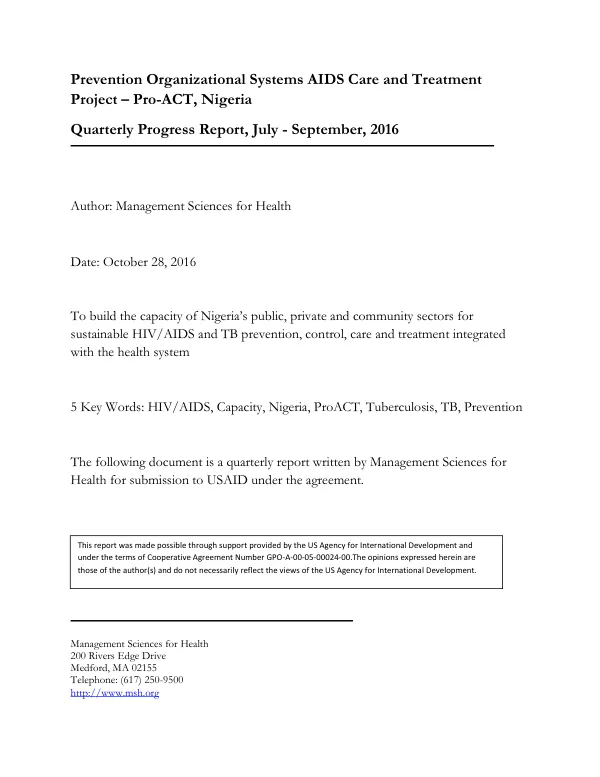
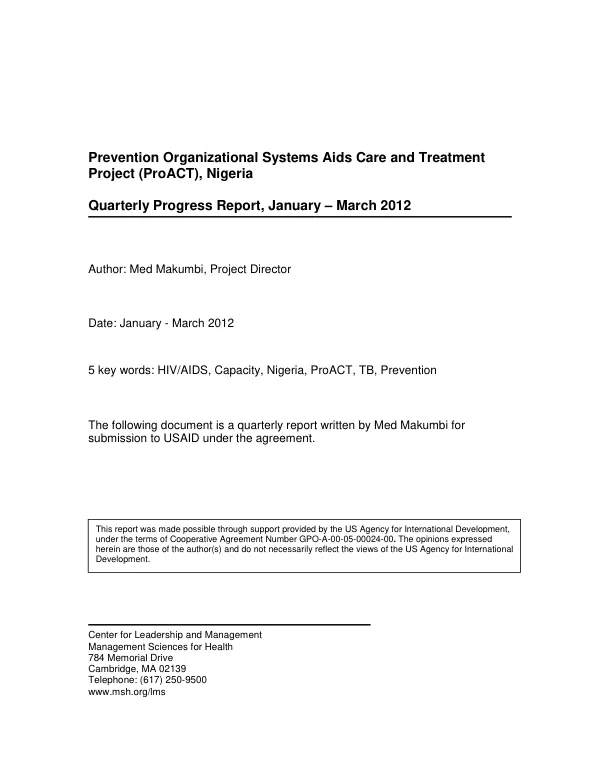
Prevention Organizational Systems AIDS Care and Treatment Project— ProACT Quarterly Progress Report, January – March 2012
Sign inMANAGEMENT SCIENCES FOR HEALTH
Prevention Organizational Systems AIDS Care and Treatment Project— ProACT Quarterly Progress Report, January – March 2012
The Prevention Organizational Systems AIDS Care and Treatment Project (ProACT) in Nigeria is a five-year USAID-funded Cooperative Agreement designed to develop leadership and management skills at all levels of healthcare organizations and programs.
2012 · 38 pages
Sign in to readA free account is required to download.
Abstract
The project's goal is to build the capacity of Nigeria's public, private, and community sectors for sustainable HIV/AIDS and TB prevention, control, care, and treatment. ProACT began operations in August 2009, taking over from the AIDS Care and Treatment (ACT) Project that started in October 2007. ProACT supports six state governments in Nigeria, including Kogi, Niger, Kwara, Kebbi, Adamawa, and Taraba, to operate 25 comprehensive HIV/AIDS treatment centers. The project is decentralized to the government state level and has established offices in each of the six states to provide technical support. ProACT's main office is located in Abuja, Nigeria. The project's activity objective is to build the capacity of Nigeria's public, private, and community sectors for sustainable HIV/AIDS and TB prevention, control, care, and treatment integrated with the health system. The project aims to increase demand for HIV/AIDS and TB services and interventions, especially among target groups, and to increase access to quality HIV/AIDS and TB services, practices, and products in selected states. ProACT's quarterly report for January to March 2012 highlights the project's progress in implementing its objectives. The report notes that the project has made significant progress in strengthening public, private, and community enabling environments, increasing access to quality HIV/AIDS and TB services, and increasing demand for HIV/AIDS and TB services and interventions. The report also highlights the project's achievements in the areas of health systems strengthening, HIV prevention program, abstinence and be faithful, condoms and other prevention, M&E, challenges, and next quarter plans. The project has established a supply chain management system (SCMS) to ensure the availability of essential medicines and medical supplies. The project has also established laboratory services to provide diagnostic testing for HIV and TB. ProACT's quarterly report for January to March 2012 also highlights the project's challenges, including the need to strengthen community systems for delivery of OVC, BASIC care and support services, and to improve clinical services. The report notes that the project will continue to work with stakeholders to address these challenges and to achieve its objectives. The project's estimated expenditures for the next quarter are $2,695,487, and the cumulative accrued expenditures to date are $27,263,240. The project's obligations to date are $34,896,477, and the current pipeline amount is $7,535,371. The project's life of activity is from July 16, 2009, to July 15, 2014, and the total estimated contract/agreement amount is $60,797,873. ProACT's quarterly report for January to March 2012 provides a comprehensive overview of the project's progress and achievements. The report highlights the project's commitment to building the capacity of Nigeria's public, private, and community sectors for sustainable HIV/AIDS and TB prevention, control, care, and treatment.