USAID DEC
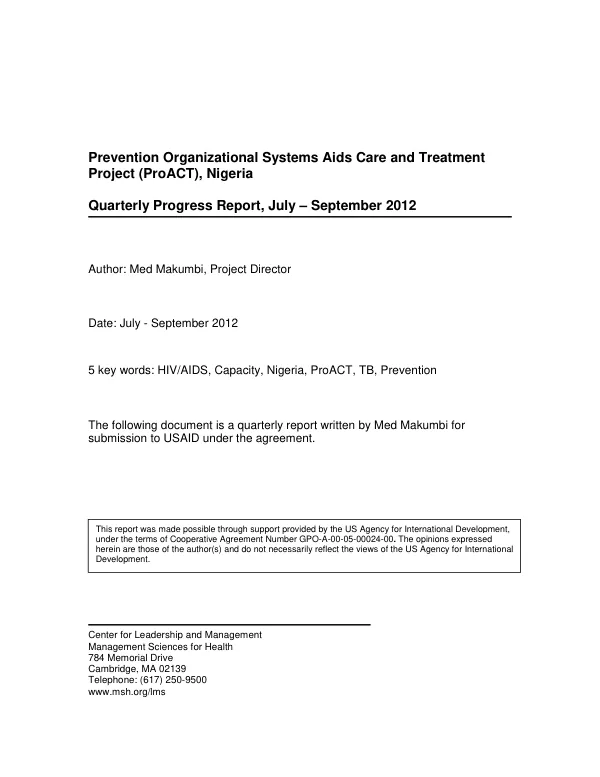
Prevention Organizational Systems AIDS Care and Treatment Project—ProACT Quarterly Report: July–September 2012
Sign inMANAGEMENT SCIENCES FOR HEALTH
Prevention Organizational Systems AIDS Care and Treatment Project—ProACT Quarterly Report: July–September 2012
The Prevention Organizational Systems AIDS Care and Treatment Project (ProACT) in Nigeria is a global five-year Cooperative Agreement funded by the United States Agency for International Development (USAID) to develop leadership and management skills at all levels of health care organizations and programs to effectively address change and improve health outcomes in the areas of family planning, reproductive health, HIV/AIDS, infectious disease, and maternal and child health.
2012 · 58 pages
Sign in to readA free account is required to download.
Abstract
In Nigeria, the LMS Program implements the ProACT project, which is an associate award funded by the US President's Emergency Plan for AIDS Relief (PEPFAR), whose goal is to build the capacity of Nigeria's public, private, and community sectors for sustainable HIV/AIDS and TB prevention, control, care, and treatment. The ProACT project began operations in August 2009, taking over from the AIDS Care and Treatment (ACT) Project that started in October 2007. ProACT now supports six state governments of Kogi, Niger, Kwara, Kebbi, Adamawa, and Taraba to operate 30 comprehensive HIV/AIDS treatment centers. With its main office in Abuja, Nigeria, ProACT is decentralized to the government state level and has established offices in each of the six states to bring technical support closer to the areas of greatest need. During the period of July to September 2012, ProACT continued to support the government of Nigeria in the provision and scale-up of HIV care and treatment services in the six focus states. One major key highlight of the quarter was MSH ProACT's contribution to the national Prevention of Mother-to-Child Transmission (PMTCT) efforts. Nigeria contributes about 30% of the global mother-to-child transmission of HIV (MTCT) burden, but has a depressingly low PMTCT coverage. In light of this, during this quarter, ProACT developed the State-specific hyper-implementation plan to support the ongoing efforts of the national HIV program in increasing access to PMTCT by scaling up PMTCT services to twenty-three more sites situated in underserved and hard-to-reach communities of Taraba State. This has increased the number of PMTCT sites from 58 in the last quarter to 81 by the end of September 2012. The current list of MSH-supported sites is attached as Appendix I. Other significant achievements attained in the quarter include the provision of Abstinence and Be Faithful (AB) messages to 6,198 clients, and the provision of prevention messages to 3,835 people from most-at-risk populations (MARP). These achievements add up to the 18,218 cumulatively reached during FY12. The ProACT project has also made significant progress in strengthening community systems for delivery of OVC, BASIC care, and support services. The project has established a robust monitoring and evaluation system to track progress and identify areas for improvement. The project has also established a strong partnership with the government of Nigeria, civil society organizations, and other stakeholders to ensure the sustainability of the project. The ProACT project has made significant contributions to the national HIV/AIDS response in Nigeria, including the provision of HIV care and treatment services, the prevention of mother-to-child transmission of HIV, and the strengthening of community systems for delivery of OVC, BASIC care, and support services. The project has also contributed to the development of the national HIV/AIDS response plan and has provided technical assistance to the government of Nigeria to improve the quality of HIV/AIDS services. The ProACT project has a strong focus on sustainability, and has established a robust system for monitoring and evaluation to track progress and identify areas for improvement. The project has also established a strong partnership with the government of Nigeria, civil society organizations, and other stakeholders to ensure the sustainability of the project. The project has made significant contributions to the national HIV/AIDS response in Nigeria, and has helped to improve the quality of HIV/AIDS services in the country.