CARE
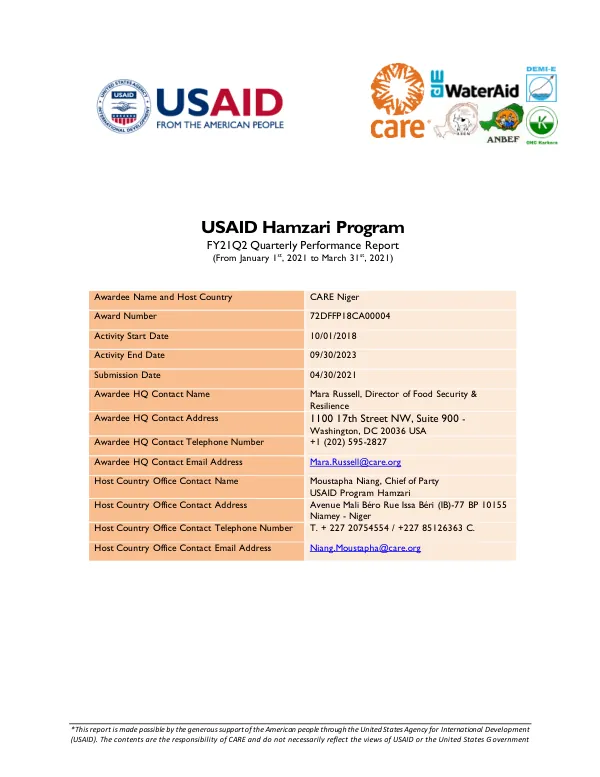
CARE Niger Hamzari - FY21Q2 Quarterly Performance Report
The Hamzari Program in Niger is a USAID-funded initiative aimed at promoting sustainable, equitable, and resilient food and nutrition security for vulnerable groups in the Maradi region.
2021 · 24 pages
Sign in to readA free account is required to download.
Abstract
The program targets all vulnerable households in three communes: Chadakori, Guidan Sori, and Guidan Roumdji in the Guidan Roumdji Department. The program has four main purposes: reducing extreme vulnerability for vulnerable women, youth, and marginalized households; improving nutritional status among children under 5 years of age, adolescent girls, and women of reproductive age; improving access and use of equitable and sustainable WASH services to reduce disease and malnutrition; and enhancing sustainable diversified livelihood opportunities for poor women, youth, and other vulnerable groups. The program has a total of 22,400 unique direct participant households, with a breakdown by program element as follows: Maternal and Child Health (14,105), Nutrition (14,105), FP/RH (7,277), Water Supply & Sanitation (7,893), Environment (728), Agriculture (9,447), Financial Sector (4,238), Civil Society (3,894), Climate Change - Adaptation (5,107), Disaster Readiness (824), Social Assistance (3,069), and Private sector Productivity (4,215). The program is led by CARE Niger, with technical partners including WaterAid, Karkara, AREN, ANBEF, and DEMI-E. CARE Niger is responsible for overall program coordination and accomplishments, while WaterAid leads the strategy and implementation of Purpose 3, which focuses on WASH services. Karkara supports the implementation of agriculture livelihoods and Village Savings and Loans Association (VSLA)/Income Generating Activity (IGA) technical components, while AREN supports the Livestock and DRR/Resilience technical components. The program's technical partners provide technical leadership and advice, including the development of technical tools and guides, training, supervision, monitoring, and quality control. CARE Niger is also responsible for financial management, management of vouchers and cash transfers, monitoring, evaluation, and learning, sub-recipient management, compliance with donor procedures and U.S. Government regulations, and maintenance of relationships with USAID/FFP. The program's implementation is guided by a set of roles and responsibilities, which include technical leadership and advice, program coordination and accomplishments, financial management, management of vouchers and cash transfers, monitoring, evaluation, and learning, sub-recipient management, compliance with donor procedures and U.S. Government regulations, and maintenance of relationships with USAID/FFP. The program's quarterly performance report for FY21Q2 highlights the progress made in the first quarter of the program, including the implementation of technical activities, program management, partnerships, collaborations, and linkages. The report also identifies challenges and lessons learned during the quarter, as well as plans for the next quarter. The program's implementation is expected to have a positive impact on the lives of vulnerable households in the Maradi region, improving their food and nutrition security, reducing disease and malnutrition, and enhancing their livelihood opportunities.
Related documents