COOPERATIVE FOR ASSISTANCE AND RELIEF EVERYWHERE INTERNATIONAL
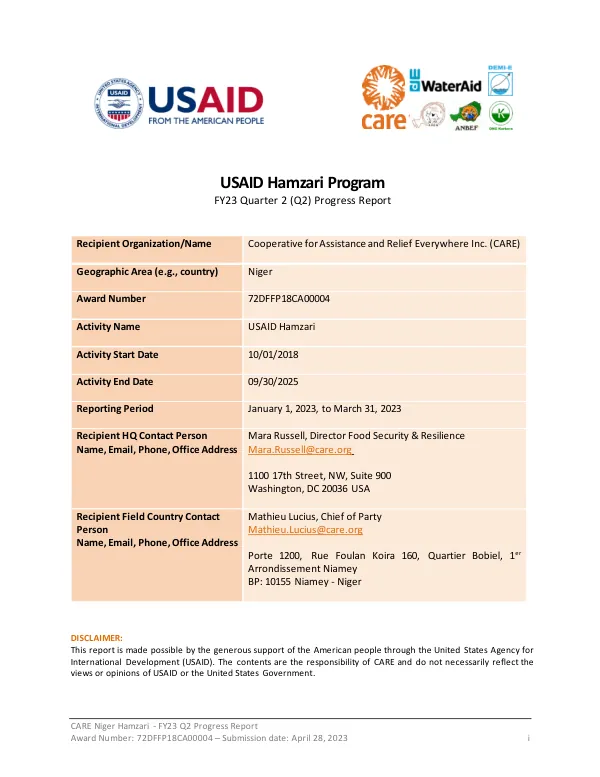
CARE Niger Hamzari - FY23 Q2 Progress Report
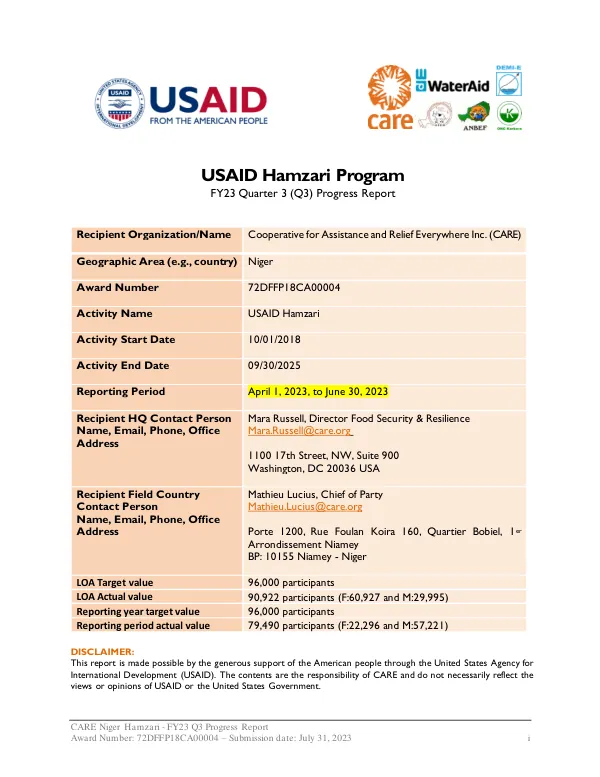
The USAID Hamzari Program in Niger aims to achieve sustainable, equitable, and resilient food and nutrition security for vulnerable groups in the Maradi Region.
2023 · 25 pages
Sign in to readA free account is required to download.
Abstract
The project targets all vulnerable households in three communes: Chadakori, Guidan Sori, and Guidan Roumdji. The program's goal is to reduce extreme vulnerability for women, youth, and marginalized households in Maradi. The project has four main purposes: reducing extreme vulnerability, improving nutritional status, improving access to equitable and sustainable WASH services, and enhancing sustainable diversified livelihood opportunities. To achieve these purposes, the program is led by CARE Niger, with technical partners including WaterAid, Karkara, AREN, Association Nigerienne pour un Bien-Être Familial (ANBEF), and Developpement pour un Mieux-Etre (DEMI-E). The program's technical partners provide leadership and advice on various aspects of the project, including the development of technical tools and guides, training, supervision, monitoring, and quality control. CARE Niger is responsible for overall program coordination, financial management, and ensuring the integration of gender equity into all aspects of the program. The security situation in Maradi Region remains unstable due to attacks by non-state armed groups, which has led to food insecurity affecting thousands of households. According to the Cadre Harmonisé, 19% of the population in Guidan Roumdji department is facing acute food insecurity, while 2% are facing emergency levels of food insecurity. The program continues to track these events and take precautionary measures to ensure the safety of its staff. The program's quarterly performance update highlights technical activities, program management, partnerships, collaborations, and linkages. The update also discusses challenges and lessons learned, as well as plans for the next quarter. The program's progress is monitored and evaluated through various indicators, including the reduction of extreme vulnerability, improvement of nutritional status, and enhancement of sustainable livelihood opportunities. The program's geographic focus is on the Maradi Region, with a specific emphasis on the communes of Chadakori, Guidan Sori, and Guidan Roumdji. The program's timeframes are from October 1, 2018, to September 30, 2025, with the current reporting period covering January 1, 2023, to March 31, 2023. The program's implementation involves various activities, including farmer training programs, infrastructure development, and market linkage facilitation. The program also focuses on improving access to water, sanitation, and hygiene services, as well as enhancing sustainable livelihood opportunities for vulnerable households. The program's progress is monitored and evaluated through various indicators, including the reduction of extreme vulnerability, improvement of nutritional status, and enhancement of sustainable livelihood opportunities. The program's quarterly performance update provides a comprehensive overview of its progress and challenges, as well as plans for the next quarter.