ABT ASSOCIATES
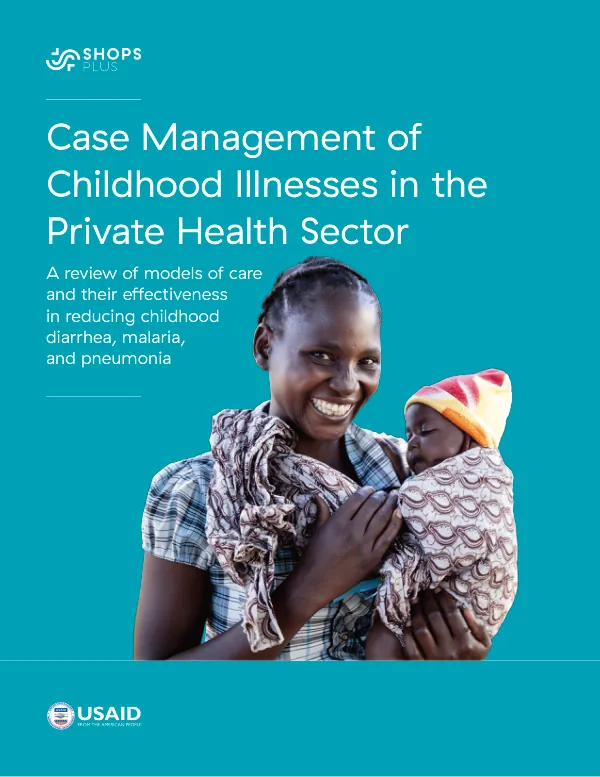
Case Management of Childhood Illnesses in the Private Health Sector
The private health sector plays a significant role in the management of childhood illnesses, particularly in low- and middle-income countries where access to healthcare services is limited.
2019 · 24 pages
Sign in to readA free account is required to download.
Abstract
Over the past two decades, there has been substantial progress in reducing preventable child and maternal mortality, with the global under-5 mortality rate declining by more than half since 1990. However, despite this progress, 5.4 million children under 5 still died in 2017, with childhood pneumonia and diarrhea being leading causes of death. Childhood pneumonia kills approximately 2,400 children per day, while diarrheal disease is the second leading infectious disease-related cause of death in children under 5, killing an estimated 525,000 children per year. Young children are also vulnerable to malaria, resulting in roughly 285,000 malaria-related deaths in children under 5 throughout Africa in 2016 alone. Concomitant malnutrition is a significant contributor to childhood illness and death, with nearly half of all deaths in children under 5 attributable to malnutrition. The Integrated Management of Childhood Illness (IMCI) strategy and other integrated child health service delivery strategies have been developed and implemented by international actors since the 1990s. These approaches recognize that reducing preventable childhood illness and death requires a focus on the well-being of the whole child, pursuing this focus through clinical and nonclinical services provided by families, communities, and health facilities. Private sector health facilities, such as community-based drug shops, pharmacies, nurses' and doctors' offices, health centers, and hospitals, are often more accessible than public facilities and are an important source of care for caregivers seeking sick child care outside the home. The private health sector has a key role to play in strengthening and scaling the delivery of child health interventions, including through commercial, nonprofit, and faith-based actors operating health services and distributing health products outside government structures. A review of peer-reviewed publications and gray literature was conducted by the USAID-funded Sustaining Health Outcomes through the Private Sector (SHOPS) Plus project to gather evidence of integrated approaches to the management of childhood illness implemented by the private sector. The review sought to assess the structure and effectiveness of these models in order to create an evidence-based summary of what works to improve child health when delivered by the private health sector. The review found that formal evaluations of private sector case management approaches for common childhood illnesses appear to be extremely limited, and there is minimal data demonstrating whether and how private sector child health programs can lead to sustained use of and improvements in child health services. However, the review did identify some promising interventions, including those involving private medical vendors or other community-based dispensing outlets, and those that included some form of subsidization of antimalarial commodities. Malaria case management was a key area of focus in the review, with 55 papers covering interventions involving private medical vendors or other community-based dispensing outlets. Almost half of the interventions included some form of subsidization of antimalarial commodities, and some resources highlighted negative findings or challenges that are important to consider in future interventions. For instance, evidence shows that further training may be needed to ensure that private providers understand the importance of proper malaria diagnosis and treatment. The review also found that there is a lack of pneumonia-specific private sector models, with pneumonia interventions typically described as part of a larger package of child health services included in private sector IMCI efforts. However, the review did identify some promising integrated approaches to childhood illness that included at least two childhood illnesses, including diarrhea and malaria. Overall, the review highlights the need for further research and evaluation of private sector case management approaches for childhood illnesses, particularly in low- and middle-income countries. It also emphasizes the importance of strengthening and scaling the delivery of child health interventions through the private health sector, including through commercial, nonprofit, and faith-based actors operating health services and distributing health products outside government structures.