USAID DEC
Case Study: Committed to Saving the Lives of Mothers, Their Babies, and Children
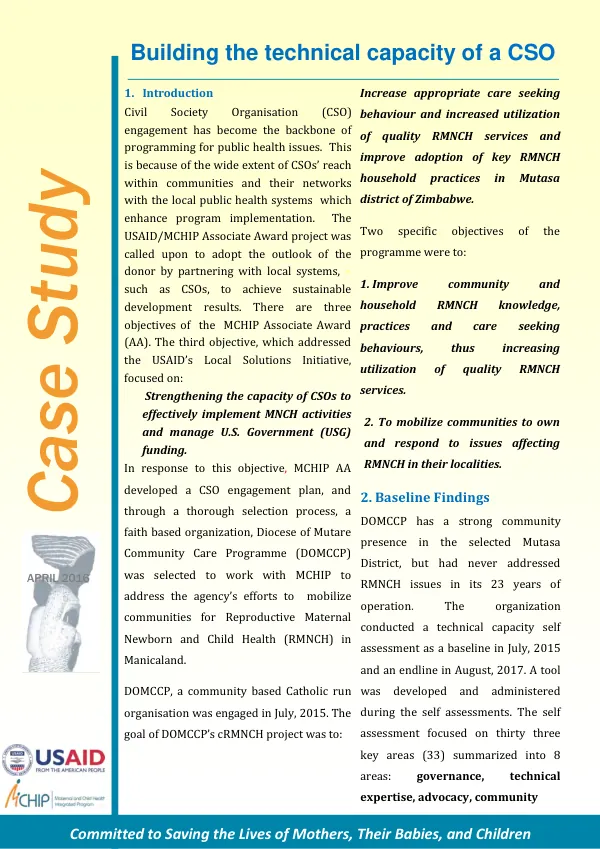
The USAID/MCHIP Associate Award project aimed to strengthen the capacity of Civil Society Organizations (CSOs) to effectively implement Maternal, Newborn, and Child Health (MNCH) activities and manage U.S.
2017 · 8 pages
Sign in to readA free account is required to download.
Abstract
Government funding. The project's third objective focused on the USAID's Local Solutions Initiative, which sought to strengthen the capacity of CSOs to implement MNCH activities and manage USG funding. In response to this objective, the MCHIP Associate Award developed a CSO engagement plan and selected the Diocese of Mutare Community Care Programme (DOMCCP) to work with MCHIP to address the agency's efforts to mobilize communities for RMNCH in Manicaland. DOMCCP, a community-based Catholic-run organization, was engaged in July 2015 to implement the cRMNCH project, which aimed to increase appropriate care-seeking behavior and increased utilization of quality RMNCH services and improve adoption of key RMNCH household practices in Mutasa District of Zimbabwe. The project's two specific objectives were to improve community and household RMNCH knowledge, practices, and care-seeking behaviors, thus increasing utilization of quality RMNCH services, and to mobilize communities to own and respond to issues affecting RMNCH in their localities. DOMCCP conducted a technical capacity self-assessment in July 2015 and an endline in August 2017. The self-assessment focused on 33 key areas, summarized into 8 areas: governance, technical expertise, advocacy, community mobilization for RMNCH, working with community-based health workers (CBHWs) to improve RMNCH, networking and coordination for improved RMNCH, monitoring and evaluation structure, functions, and capabilities, and working with government structures for health. At baseline, all 8 areas of assessment "mainly" 2 met the requirements. Using the baseline findings from the technical capacity self-assessments, MCHIP worked together with DOMCCP to build their technical and organizational capacity. Over the two-year period, trainings, refresher trainings, support, and supervision, onsite data verifications, and meetings were some of the methods used to build the capacity of the CSO. The cRMNCH project implemented by DOMCCP, together with USAID/MCHIP, was involved in the orientation of the board of trustees in RMNCH. The board included RMNCH issues into their current strategic plan for 2016-2020 and made RMNCH an agenda item during board meetings. DOMCCP staff were trained in the Community Action Cycle (CAC), an evidence-based methodology to mobilize communities for reproductive, maternal, newborn, and child health. The CAC is a cycle with 7 phases, including Organize, Explore, Plan Together, Act Together, and Evaluate Together, which are the 5 phases the communities follow. DOMCCP staff were trained in the CAC and led the Community Mobilization Team (CMT) through these stages. Refresher trainings were also conducted with DOMCCP personnel before conducting trainings in the communities. DOMCCP was supported by USAID/MCHIP to conduct post-orientation follow-ups and community mobilization activities. Through the Care Group Model, DOMCCP was able to mobilize communities for RMNCH using the Lead Mothers and Fathers. The Health Centre Committees (HCCs) and Family Health Groups (FHGs) under the CAC model also mobilized communities to take collective action and address RMNCH gaps within their localities. DOMCCP has worked with HCCs from 14 wards in Mutasa District, 120 Village Health Workers, and 725 Lead Mothers and Fathers. The organization, with support from MCHIP, developed Family Health Handbooks for use at the household level and Family Health Flip Charts, a job aid for the VHWs and Lead Mothers and Fathers during Care Group Sessions. The Lead Mothers/Fathers conducted Care Group sessions twice a month in the communities using the Family Health Flip Charts as aids to share and discuss key RMNCH issues. The VHWs supervise the Lead Mothers/Fathers. MCHIP also trained DOMCCP to mobilize communities for collective action to address RMNCH gaps in their localities by engaging the HCCs and FHGs.