USAID DEC
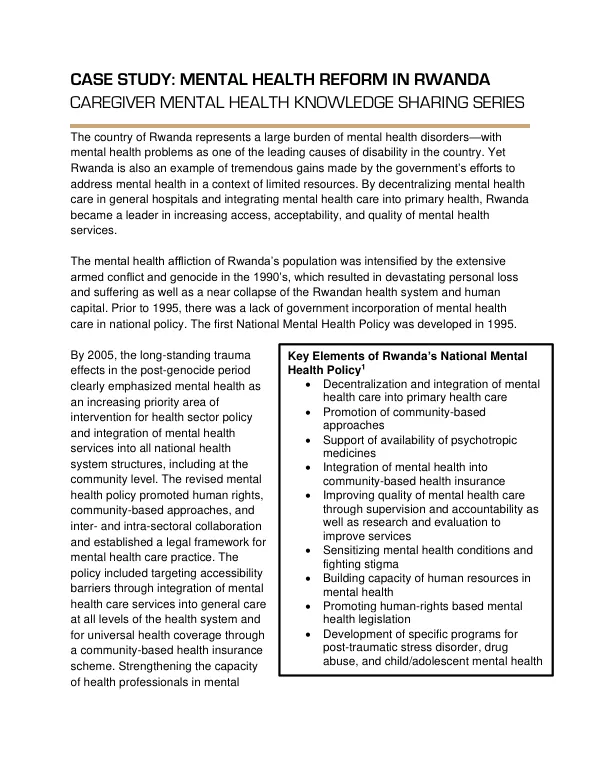
CASE STUDY: MENTAL HEALTH REFORM IN RWANDA CAREGIVER MENTAL HEALTH KNOWLEDGE SHARING SERIES
Sign inFOOD FOR THE HUNGRY, INTERNATIONAL
CASE STUDY: MENTAL HEALTH REFORM IN RWANDA CAREGIVER MENTAL HEALTH KNOWLEDGE SHARING SERIES
Rwanda's mental health reform efforts have been instrumental in increasing access, acceptability, and quality of mental health services in the country.
2021 · 3 pages
Sign in to readA free account is required to download.
Abstract
The government's efforts to address mental health in a context of limited resources have yielded significant gains. Decentralizing mental health care in general hospitals and integrating mental health care into primary health care has been a key strategy. Prior to 1995, mental health care was not incorporated into national policy. However, following the armed conflict and genocide in the 1990s, the government recognized the need to address mental health as a priority area of intervention. The first National Mental Health Policy was developed in 1995, and by 2005, the long-standing trauma effects in the post-genocide period clearly emphasized mental health as an increasing priority area of intervention. The revised mental health policy, developed in 2005, promoted human rights, community-based approaches, and inter- and intra-sectoral collaboration. The policy established a legal framework for mental health care practice and targeted accessibility barriers through integration of mental health care services into general care at all levels of the health system. The policy also included universal health coverage through a community-based health insurance scheme. Key elements of Rwanda's National Mental Health Policy include decentralization and integration of mental health care into primary health care, promotion of community-based approaches, support of availability of psychotropic medicines, and integration of mental health into community-based health insurance. Improving quality of mental health care through supervision and accountability, as well as research and evaluation to improve services, is also a key component of the policy. Mental health services are now decentralized across Rwanda, with each of the 38 District Hospitals having a mental health unit that can administer a comprehensive mental health care package of inpatient and outpatient services. Community Health Workers are trained to ensure an integrated mental health care component in Health Centers in community outreach, with referral to hospital-based care as needed. A combination of specialists and non-specialists deliver mental health and psychosocial support at all levels of the health system. Rwanda's success in mental health reform can be attributed to strong leadership and political commitment for the establishment of a national mental health policy and implementation plan. The introduction of psychiatric nurse practitioners into district hospitals has increased access and acceptability, while the use of both specialists and non-specialist mental health care providers has increased coverage and improved quality of care. Integrating mental health care and psychotropic medicine into community-based health insurance schemes has improved access and equity for all Rwandans. Despite challenges remaining, including limited funding, inadequate numbers of trained mental health professionals, and sustained stigma, Rwanda has overcome great odds to advance the mental health support afforded to its population.
Related documents
Documents in this collection
 2021
2021USAID DEC
USAID Rwanda Integrated Health Systems Activity Quarterly Progress Report FY 2021 QUARTER THREE
Open record 2021
2021USAID DEC