USAID. MISSION TO HONDURAS
Central American survivor"s assistance (CASA)
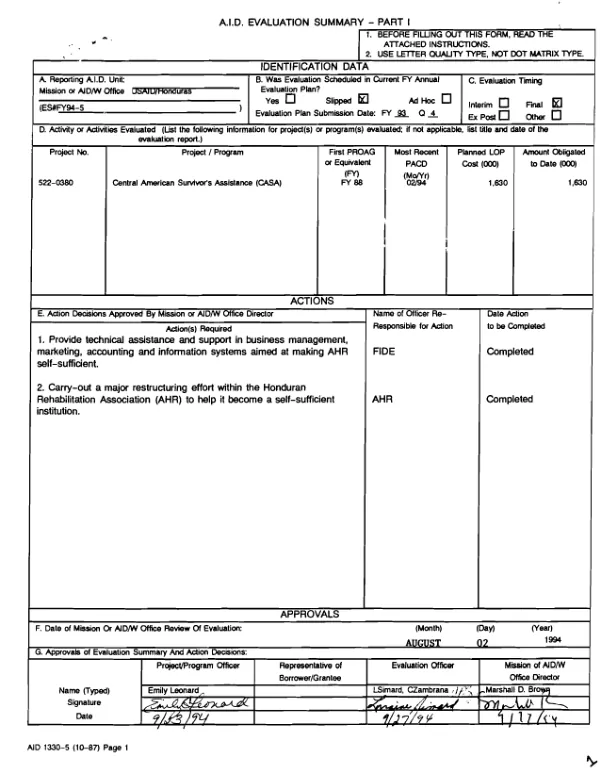
Summarizes final evaluation (PD-ABG-750) of a project (1988-2/94), which was mandated by Congress, to provide medical care and other relief for noncombatant victims of Central American civil strife (CASA project).
1994
Sign in to readA free account is required to download.
Abstract
The project was implemented by World Rehabilitation Fund (WRF), a U.S. PVO, and the Honduran Rehabilitation Association (AHR), a local NGO established by WRF to sustain project benefits after the PACD. The project achieved its social and moral objectives. There were 1,991 eligible recipients, and by 9/93 all had been treated as planned. (By the PACD, the number of those treated had risen to 2,031.) AHR appears to be meeting the effective demand without extending waiting times. In 4/93, the WRF/AHR requested continued support of rehabilitation activities in Honduras. The evaluation team did not find the proposal worthy of further USAID funding. AHR, which is one of the largest, if not the largest employer of disabled workers in Honduras, is attempting to continue a costly, labor-intensive system of community-based rehabilitation, which would require strong external support if sustainability were sought. AHR does not need further technical input from WRF or the backstopping of a technical office in the Mission. If it is to survive as a self-sustaining Honduran institution, it needs business assistance. To this end, USAID"s Private Sector Program Office has facilitated an affiliation with FIDE, a local nonprofit organization, which is now providing AHR with TA in management, marketing, and cost-recovery. The new AHR manager is a highly qualified professional with many years of experience in the business sector. There is a reasonable chance for AHR"s sustainability if the current proposal is redone with far lower costs and more attention to production, marketing, and private investment. The Mission identified one lesson learned (none were provided by the evaluators): although the project had short-term humanitarian objectives, the inclusion in the original design of a business component aimed at gradual self-sufficiency of the local implementing PVO could have ensured developmental as well as humanitarian impact.
Related documents