USAID
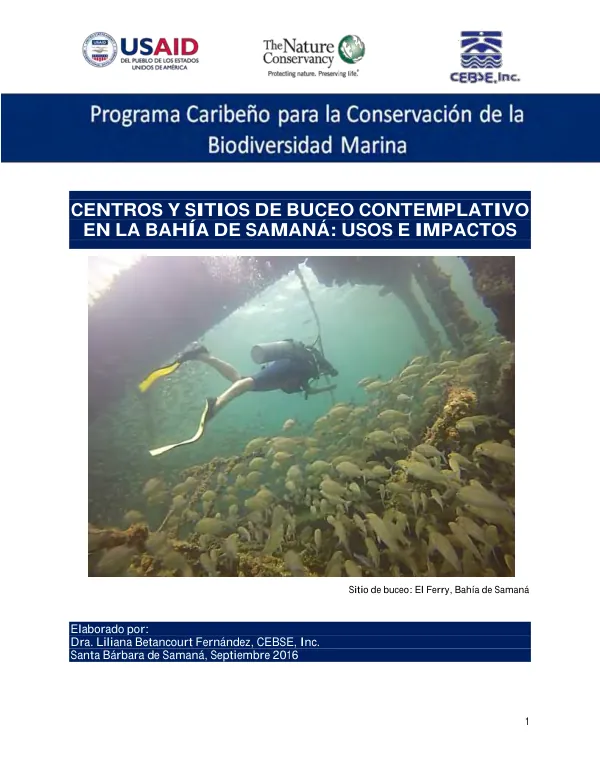
Centros y sitios de buceo contemplativo en la Bahía de Samaná: usos e impactos
The Bahía de Samaná is a region in the Dominican Republic known for its importance in fishing, tourism, and coastal protection.
2016 · 21 pages
Sign in to readA free account is required to download.
Abstract
The coral reefs in this area are a vital ecosystem, providing a habitat for a diverse array of marine life. However, the reefs have been understudied, and their exact boundaries and formations have not been accurately determined. Recent studies have focused on the health of the coral reefs in the Bahía de Samaná, with researchers applying the AGRRA protocol to various sites. These studies are part of the Caribbean Program for Marine Biodiversity Conservation, supported by the United States Agency for International Development (USAID). The results of these studies have not yet been published. The coral reefs in the Bahía de Samaná are limited by sedimentation, turbidity, and changes in salinity associated with the estuarine conditions in this area. The reefs begin to develop after Las Pascualas, with the largest development occurring north and east of the peninsula, where there is a strong oceanic influence. These reefs have been the most studied, with descriptions of their environments and communities of fish, corals, octocorals, and sponges in areas such as Las Terrenas, El Portillo, Puerto Escondido, and Cabo Cabrón. The present report aims to gather information on the centers and sites of contemplative diving in the Bahía de Samaná, with the goal of identifying their level of use, their general condition, and the current impacts on the coral reefs caused by these activities. The study area for this report includes the Bahía de Samaná and extends to the eastern coast of the peninsula, particularly Las Galeras, which is a potential site for the development of conservation projects for the coral reefs. The information collected in this study is based on the identification and visitation of diving centers in the Bahía de Samaná, including those located in Las Galeras, where interviews were conducted with their owners and instructors to gather information on the selected diving sites and their general characteristics, level of visitation, and aspects related to the conservation status of these sites and/or the anthropogenic impacts to which they are subjected. The study identified five diving centers in the interior of the Bahía de Samaná, all located on the northern coast of the bay. The Diving and Waters Sports center, located in front of the malecón of Samaná, has been operating for six years and offers excursions to 20 different diving sites in the region of Samaná, with instructors speaking multiple languages. Scuba Aquatic is a diving concessionaire based at the Bahía Príncipe hotels in Samaná and has three diving centers: one located at the Playa del Hotel Bahía Príncipe Cayacoa, another at the Playa de the Hotel Bahía Príncipe Cayo Levantado, and a third at the Playa del Hotel Grand Bahía Príncipe Samaná in Los Cacaos. This concessionaire also has a diving site at the Hotel Bahía Príncipe in Las Terrenas. Cayo Levantado Water Sport Center, located on the western side of Cayo Levantado, is a private center managed by the Dive Master and owner Noel Caccavelli. In the eastern coast of the Samaná Peninsula, there are three diving centers located in Las Galeras: Las Galeras Dive Center, Playitas Water Sport Center, and Scuba Libre Diving Center, which is a concessionaire of the Hotel Casa Marina in Las Galeras. In the northern coast of the Samaná Peninsula, the diving centers are concentrated in Las Terrenas and include Turtle Dive Center and Samaná Diving. These centers, although outside the scope of this study, frequently use the diving sites in the interior of the Bahía de Samaná, where there is greater protection during adverse sea conditions. Most of these centers offer tourists the option of PADI certification and their offers are based on aquatic activities and excursions with snorkeling and diving with a tank. These centers cover the activity with 13 more frequent diving sites in the interior of the bay and 18 sites on the eastern coast of the peninsula, in depths ranging from 5 to 40 meters, over coral reefs and/or sunken ships.
Related documents