USAID DEC
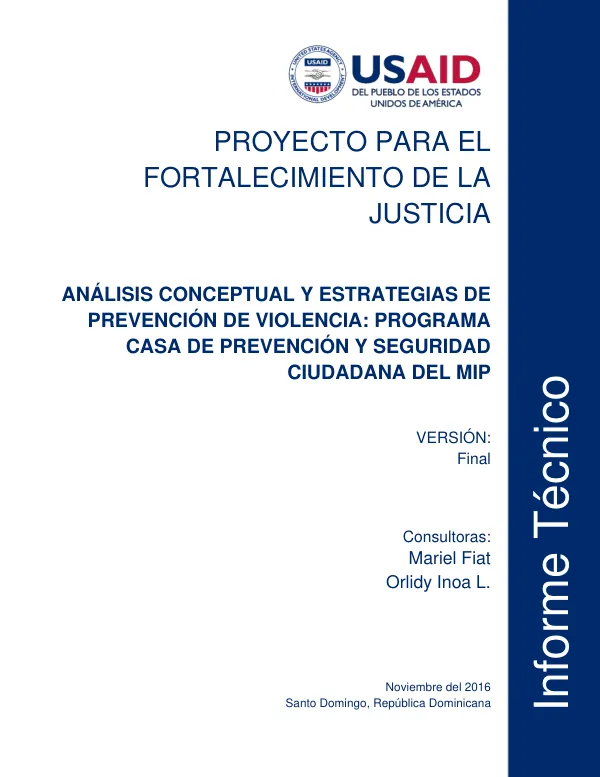
Proyecto para el Fortalecimiento de la Justicia: Análisis Conceptual y Estrategias de Prevención de Violencia
Sign inUSAID
Proyecto para el Fortalecimiento de la Justicia: Análisis Conceptual y Estrategias de Prevención de Violencia
The Proyecto para el Fortalecimiento de la Justicia (PFJ) is a project executed by Chemonics Internacional as a contractor for the United States Agency for International Development (USAID).
2016 · 66 pages
Sign in to readA free account is required to download.
Abstract
The project aims to strengthen the justice system in the Dominican Republic. The PFJ project focuses on addressing the issue of insecurity in the Dominican Republic, which is characterized by high levels of violence, crime, and victimization. According to the report, the country has a high rate of homicides, injuries, and other violent crimes, including femicides, robberies, and micro-trafficking. The report also highlights the need for effective policies to address these issues, including the implementation of the Plan de Seguridad Ciudadana (PSC) and the Plan de Seguridad Democrática (PSD). The PSD is a comprehensive plan that aims to address the root causes of insecurity in the Dominican Republic. The plan was implemented in 2004 and had several key objectives, including reducing crime rates, improving public safety, and promoting social cohesion. The report highlights the successes of the PSD, including the reduction of crime rates and the improvement of public safety. The PFJ project also focuses on the role of Casas Comunitarias de Justicia (CCJ) and Casas de Prevención y Seguridad Ciudadana (CPSC) in addressing insecurity in the Dominican Republic. The report highlights the importance of community-based initiatives in preventing crime and promoting social cohesion. The report also provides recommendations for policies and strategies to address insecurity in the Dominican Republic, including the implementation of community-based programs, the strengthening of the justice system, and the promotion of social cohesion. The report also highlights the importance of addressing the root causes of insecurity in the Dominican Republic, including poverty, inequality, and social exclusion. The report recommends the implementation of policies and programs that address these issues, including the promotion of economic development, the reduction of poverty, and the improvement of access to education and healthcare. The PFJ project has several key partners, including the Ministry of Interior and Police (MIP), the National Police, and the Office of the Attorney General. The project also works closely with civil society organizations and community groups to implement its programs and activities. The report concludes by highlighting the importance of continued support for the PFJ project and its efforts to address insecurity in the Dominican Republic. The report also emphasizes the need for sustained commitment and resources to address the root causes of insecurity and to promote social cohesion and public safety. The PFJ project has several key outcomes, including the reduction of crime rates, the improvement of public safety, and the promotion of social cohesion. The project has also contributed to the strengthening of the justice system and the promotion of human rights in the Dominican Republic. The PFJ project has several key recommendations, including the implementation of community-based programs, the strengthening of the justice system, and the promotion of social cohesion. The report also recommends the implementation of policies and programs that address the root causes of insecurity, including poverty, inequality, and social exclusion.