INTERNATIONAL ORGANIZATION FOR MIGRATION
Profile DE L'ASSURANCE-MALADIE: GHANA
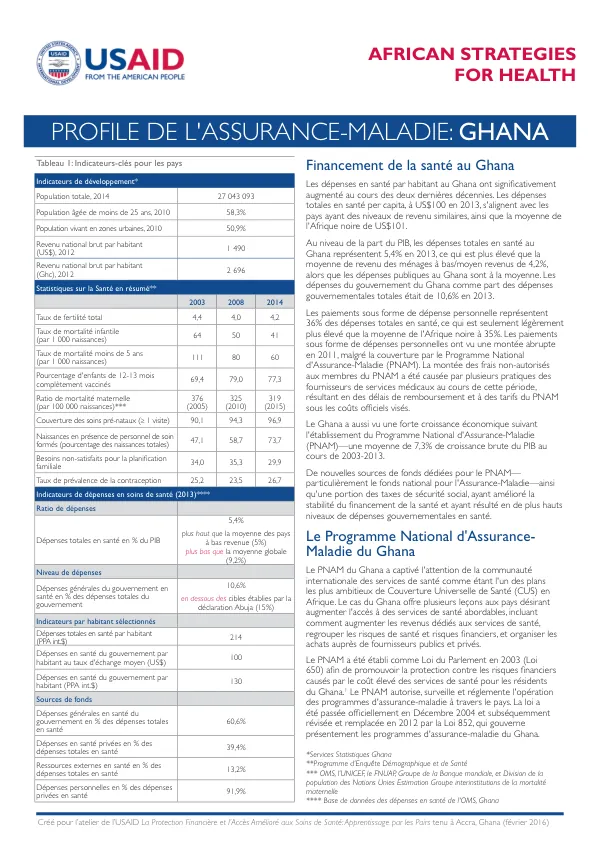
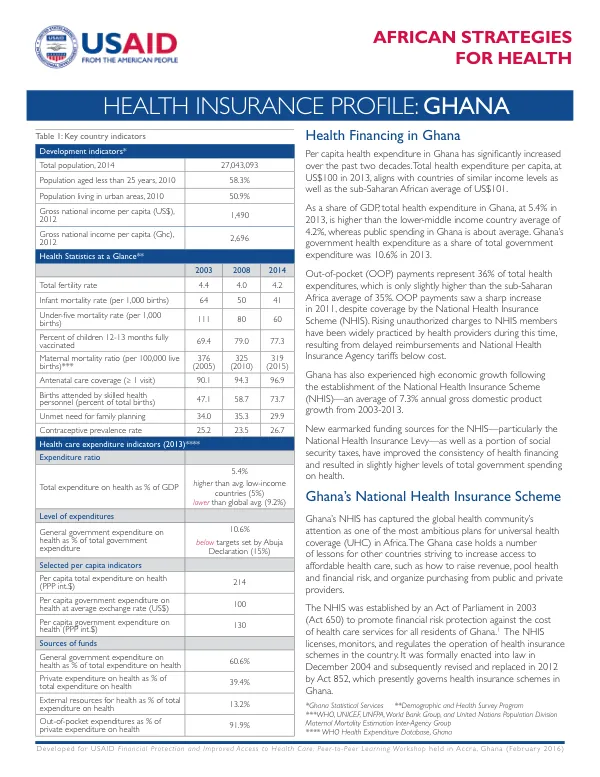
The Ghanaian National Health Insurance Scheme (NHIS) was established in 2003 as a law of the Parliament (Law 650) to promote protection against financial risks caused by the high cost of healthcare for Ghanaian residents.
2016 · 4 pages
Sign in to readA free account is required to download.
Abstract
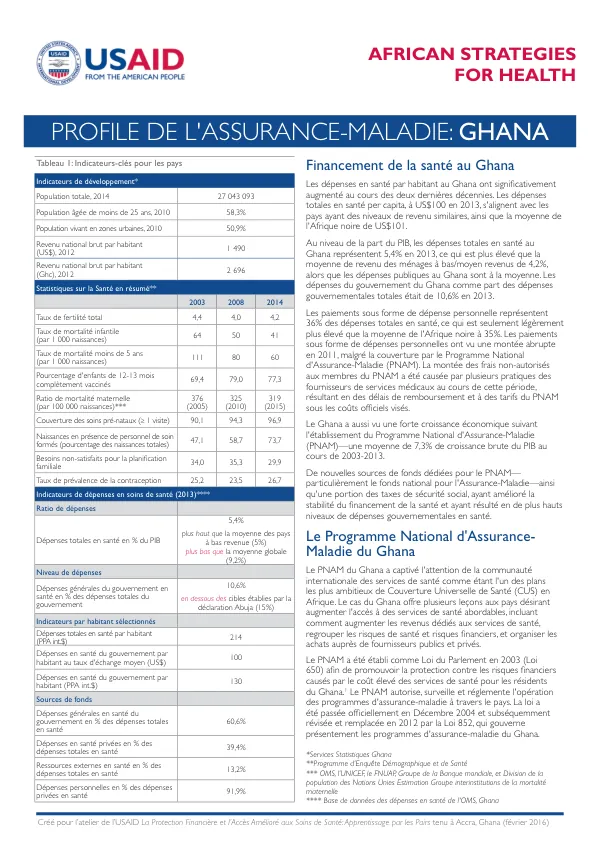
The NHIS authorizes, monitors, and regulates the operation of health insurance programs across the country. The law was officially passed in December 2004 and subsequently revised and replaced in 2012 by Law 852, which currently governs health insurance programs in Ghana. The NHIS is managed by the National Health Insurance Authority (NHIA), a centralized government agency with its headquarters in Accra. The law establishes a unified program with offices across the country, including a headquarters, regional offices, and district offices. The NHIA accredits public and private providers and is responsible for the policies and operations of the NHIS. The NHIS is funded at the national level from a single fund, the National Health Insurance Fund (NHIF), which allows for the sharing of financial and health risks. All funds are directed towards the NHIS. The primary source of funding is the national health insurance tax based on the value-added tax (VAT, 2.5%). Dedicated funds constitute 90% of total revenues; more than 70% come from the tax, and approximately 20% from contributions made by administrative sector workers to the National Social Security Reserve (NSSR). An additional 10% comes from other sources, including premium payments. One of the main goals of the NHIS is to reduce exposure to financial risks related to health for Ghanaians. Individual registration is mandatory by law but not enforced in practice. The majority of the population is exempt from paying premiums. Children under 18 years, pregnant women, individuals aged 70 years or older, NSSR pensioners, and those living in poverty are exempt from paying premiums. Other members must pay an annual premium of $8-12. According to the law, members do not pay deductibles or co-payments when receiving healthcare, but providers are recognized for charging insured users unauthorized fees, in the form of what is incorrectly called "co-payments," resulting in a sudden increase in personal payments in 2011 and in subsequent years. Although the entire benefit package covers 95% of diseases in Ghana, several insured patients still make out-of-pocket (OOP) payments to approved establishments for the NHIS.