KWAME NKRUMAH UNIVERSITY OF SCIENCE AND TECHNOLOGY
Toward Food Security in Ghana: Financing Options for Sustainable Food Supply Chains
Sustainable food supply chains are crucial for Ghana's socio-economic development and food security.
2021 · 8 pages
Sign in to readA free account is required to download.
Abstract
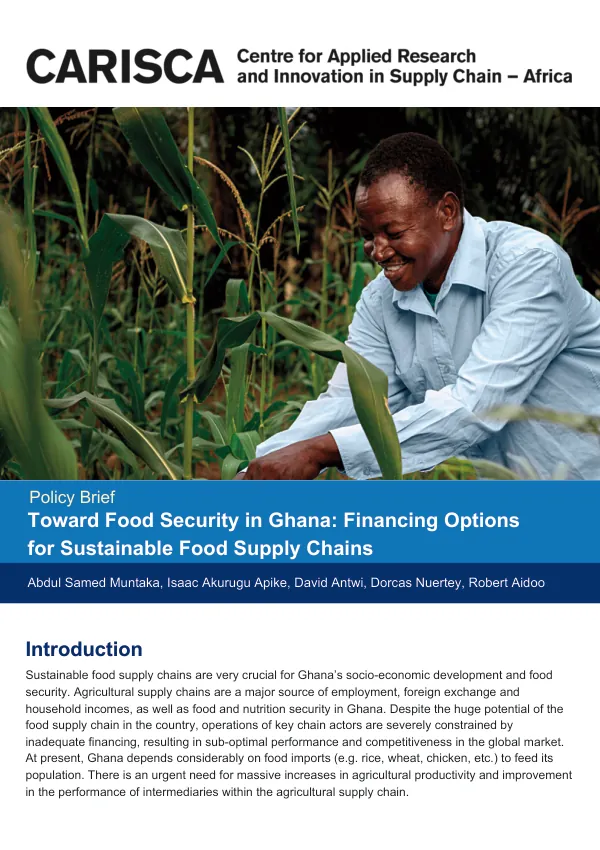
Agricultural supply chains are a major source of employment, foreign exchange, and household incomes, as well as food and nutrition security in Ghana. Despite the huge potential of the food supply chain in the country, operations of key chain actors are severely constrained by inadequate financing, resulting in sub-optimal performance and competitiveness in the global market. Ghana depends considerably on food imports to feed its population, and there is an urgent need for massive increases in agricultural productivity and improvement in the performance of intermediaries within the agricultural supply chain. Safeguarding food security is a critical aspect of Ghana's development, and securing sufficient funding plays a pivotal role in this endeavor. The Ghanaian government, in collaboration with various stakeholders, has placed great emphasis on enhancing food security, recognizing its profound impact on national stability, economic growth, and the overall well-being of its citizens. Agricultural financing remains a major issue in Ghana despite previous efforts. Access to adequate financing for farmers, aggregators, processors, and traders in the food supply chain is key to unleashing the great potential of the Ghanaian agricultural sector. Financing the agricultural supply chain in Ghana dates back several decades, but the structure has seen very little innovation. Funds for agricultural operations have often been provided through interventions from the country's government, loans via the financial sector, donor funds, family heritage, and individual savings, among others. A study conducted by CARISCA found that only 31.37% of supply chain actors who sought credit got financing. The inability of supply chain actors to provide collateral security was the chief reason for not getting credit. Financial institutions in Ghana require collateral security in the form of land and buildings with proper documentation, as well as cocoa farm or any other plantation crop. In most cases, farmers do not have proper documentation covering their lands, making it difficult for them to access financing from formal financial institutions in Ghana. The study also found that default risk and financing structure are significant challenges to sustainable supply chain financing. However, accessibility and appropriateness were found to be significant enhancers of sustainable supply chain financing in the maize sector. The study recommended a pooled financing scheme through a common digital platform as a way forward. Group (pooled) financing through a common digital platform appears to provide the best opportunity for sustaining financing in the maize supply chain. The pooled financing scheme would involve financiers in the Agricultural Supply Chain financing ecosystem coming together to form a digital platform/consortium where funds they intend to make available for financing agricultural activities are put together (pooled). Under the scheme, all individuals, groups, and institutions seeking funds would be able to access a single platform, reducing the complexity and costs associated with accessing multiple financiers. This would provide a more efficient and effective way of financing agricultural activities, ultimately leading to increased productivity and competitiveness in the global market. The Ghanaian government and other stakeholders should consider implementing the pooled financing scheme as a way to address the challenges of agricultural financing in the country. This would require collaboration and coordination among various stakeholders, including financial institutions, government agencies, and farmer groups. By working together, it is possible to create a more sustainable and efficient agricultural financing system that benefits all stakeholders involved.