USAID DEC
Characterizing Motivational Intensity of Need for Family Planning Among Non-Users in Sub-Saharan Africa
Sign inCARE
Characterizing Motivational Intensity of Need for Family Planning Among Non-Users in Sub-Saharan Africa
The Health Policy Project, a five-year cooperative agreement funded by the U.S.
2014 · 1 pages
Sign in to readA free account is required to download.
Abstract
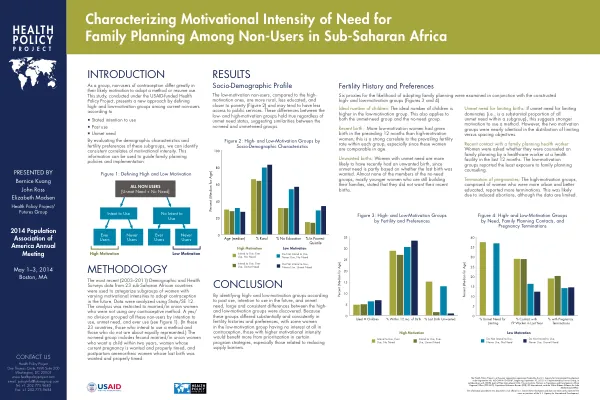
Agency for International Development, conducted a study to identify high- and low-motivation groups among current non-users of contraception in sub-Saharan Africa. The study aimed to define these groups according to stated intention to use, past use, and unmet need, and to evaluate the demographic characteristics and fertility preferences of these subgroups. The study used the most recent Demographic and Health Surveys data from 23 sub-Saharan African countries, collected between 2003 and 2011. The data were analyzed using Stata/SE 12, and the analysis was restricted to married/in union women who were not using any contraceptive method. The women were grouped into high- and low-motivation categories based on their intention to use, unmet need, and ever use of contraception. The results showed that the low-motivation non-users were more rural, less educated, and closer to poverty compared to the high-motivation non-users. These differences held true regardless of unmet need status, suggesting similarities between the no-need and unmet-need groups. The low-motivation groups also reported less exposure to family planning counseling and had higher ideal numbers of children. The study found that women in the low-motivation group had recently given birth in the preceding 12 months, and were more likely to have had an unwanted birth. In contrast, women in the high-motivation group reported more terminations, likely due to induced abortions. The study also found that the high-motivation groups, comprised of women who were more urban and better educated, reported more terminations. The findings of this study suggest that high- and low-motivation groups differ substantially and consistently in fertility histories and preferences. This information can be used to guide family planning policies and implementation, particularly in prioritizing program strategies related to reducing supply barriers. The study's results can inform the development of targeted interventions to address the needs of women with varying levels of motivation to adopt family planning methods.