JHPIEGO
Checklist for HBB training
The HBB training checklist for OSCE – STATION A outlines the steps for assisting in the delivery of a term baby.
2014 · 4 pages
Sign in to readA free account is required to download.
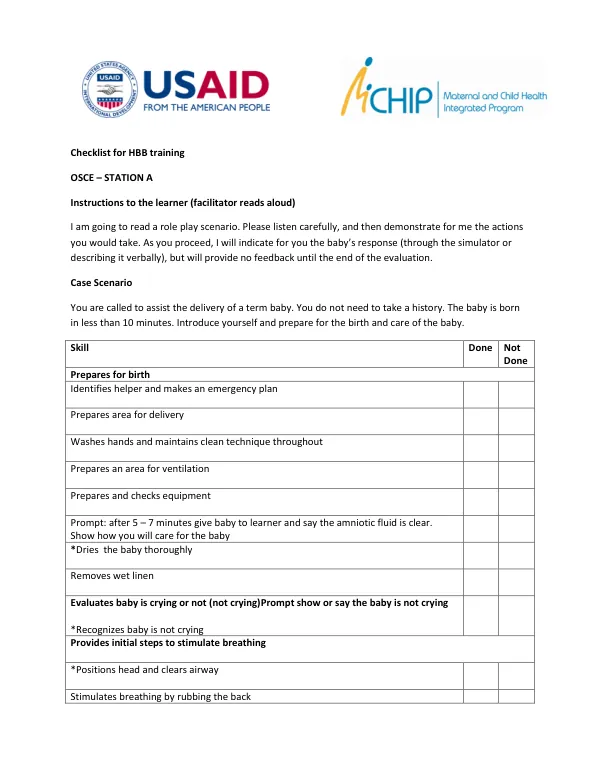
Abstract
The facilitator reads a role-play scenario and instructs the learner to listen carefully and demonstrate the actions they would take. The learner is then presented with a case scenario where they are called to assist in the delivery of a term baby, born in less than 10 minutes. Upon arrival, the learner prepares for the birth and care of the baby by introducing themselves and making an emergency plan. They identify a helper and prepare the area for delivery. The learner also washes their hands and maintains clean technique throughout the process. The learner then prepares the area for ventilation and checks the equipment. After 5-7 minutes, the facilitator prompts the learner to give the baby to them and states that the amniotic fluid is clear. The learner is then responsible for caring for the baby, which includes drying the baby thoroughly, removing wet linen, and evaluating the baby's breathing. The learner recognizes that the baby is not crying and provides initial steps to stimulate breathing, including positioning the head and clearing the airway, and stimulating breathing by rubbing the back. The learner evaluates the response to these initial steps and recognizes that the baby is breathing well. The learner then clamps or ties and cuts the cord, positions the baby skin-to-skin on the mother, and communicates with the mother. In contrast, the HBB training checklist for OSCE – STATION B outlines the steps for assisting in the delivery of a preterm baby or a baby with meconium-stained liquor. The facilitator reads a role-play scenario and instructs the learner to listen carefully and demonstrate the actions they would take. The learner is then presented with a case scenario where they are called to assist in the delivery of a 34-week gestation baby or a baby with meconium-stained liquor, arriving 2 minutes before the birth. The learner washes their hands and maintains clean technique throughout the process, prepares and checks the equipment, and dries the baby thoroughly. The learner removes wet linen and evaluates the baby's breathing, recognizing that the baby is not crying. The learner provides initial steps to stimulate breathing, including positioning and clearing the airway, and stimulating breathing by rubbing the back. However, the learner recognizes that the baby is not breathing and takes steps to improve ventilation, including re-applying the mask, repositioning the head, clearing secretions, and ventilating with the mouth slightly. The learner continues to ventilate the baby, evaluating breathing and heart rate, and recognizing that the baby is not breathing but has a good heart rate. The learner continues to ventilate the baby, following the guidelines for ventilation within the Golden Minute.