USAID
Chewa Language Assessment for Literacy Skills
The Chichewa language learning program for primary school students began with a focus on reading skills.
2 pages
Sign in to readA free account is required to download.
Abstract
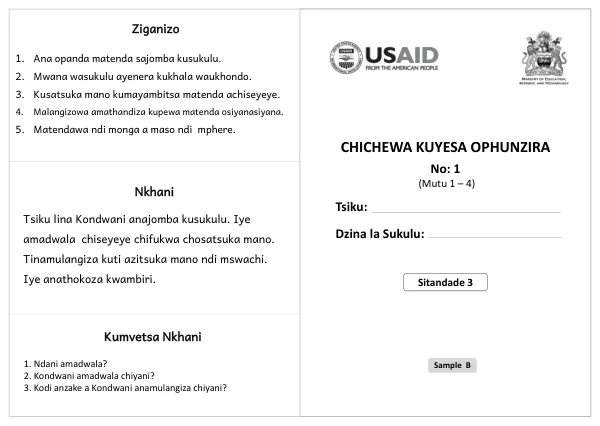
The program's curriculum included teaching learners to read aloud various items, such as letter names, sounds, syllables, and words. Assessments were conducted to evaluate learners' progress in these skills. To assess letter names, sounds, syllables, and words, learners were asked to read aloud all 10 items in each of these skills. If a learner read at least 7 out of 10 items correctly, they were considered to have acquired that skill. The assessment for sentence reading involved asking learners to read all 5 sentences, with a minimum of 3 correct readings required to demonstrate proficiency. The program also included a story reading component, where learners were asked to read the story fully, pausing at the full stops. A learner who made no more than 2 mistakes while reading the story was considered to have acquired the story reading skill. To evaluate comprehension, learners who had demonstrated story reading proficiency were asked three oral comprehension questions, with a minimum of 2 correct answers required to demonstrate understanding. The program's curriculum emphasized the importance of reading aloud and comprehension skills in language learning. Assessments were designed to evaluate learners' progress in these areas, with the goal of ensuring that students acquired the necessary skills to become proficient readers in Chichewa. In the Chichewa language learning program, learners were encouraged to practice reading aloud and comprehension skills through various activities. The program's assessments were designed to evaluate learners' progress in these areas, with the goal of ensuring that students acquired the necessary skills to become proficient readers in Chichewa. The program's curriculum included a range of reading materials, including stories and sentences, which were used to assess learners' reading skills. The assessments were designed to evaluate learners' ability to read aloud and comprehend the material, with the goal of ensuring that students acquired the necessary skills to become proficient readers in Chichewa. The Chichewa language learning program's assessments were designed to evaluate learners' progress in reading skills, with a focus on letter names, sounds, syllables, words, sentences, and story comprehension. The program's curriculum emphasized the importance of reading aloud and comprehension skills in language learning, and the assessments were designed to ensure that students acquired the necessary skills to become proficient readers in Chichewa.
Related documents