USAID DEC
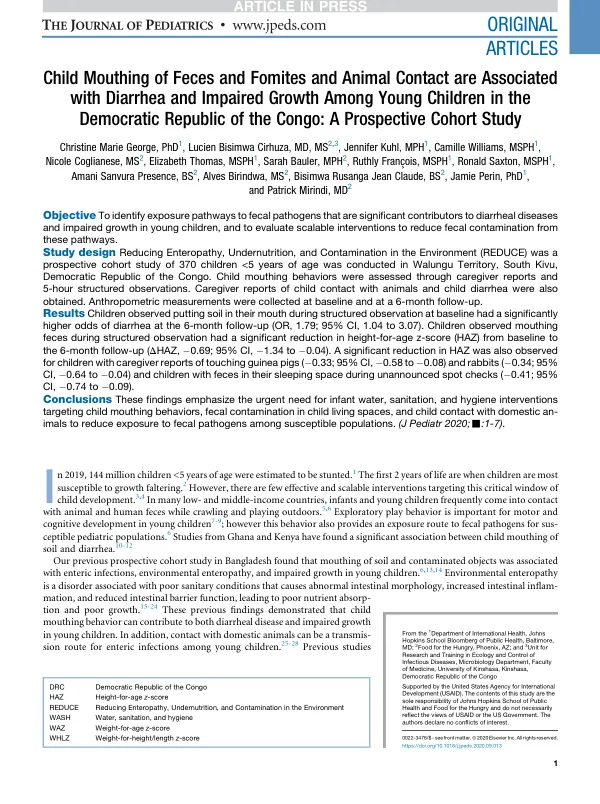
Child Mouthing of Feces and Fomites and Animal Contact are Associated with Diarrhea and Impaired Growth Among Young Children in the Democratic Republic of the Congo: A Prospective Cohort Study
Sign inFOOD FOR THE HUNGRY, INTERNATIONAL
Child Mouthing of Feces and Fomites and Animal Contact are Associated with Diarrhea and Impaired Growth Among Young Children in the Democratic Republic of the Congo: A Prospective Cohort Study
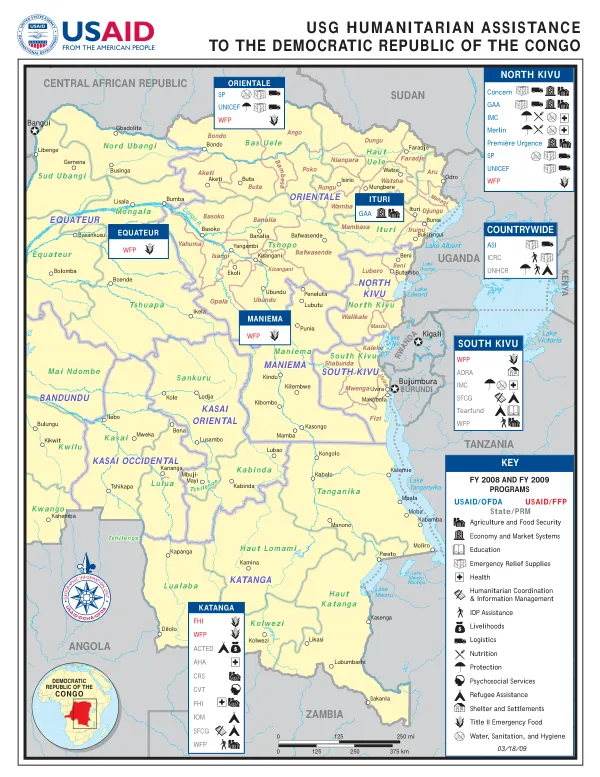
The study was conducted in the Walungu region of South Kivu, Democratic Republic of the Congo.
2020 · 8 pages
Sign in to readA free account is required to download.
Abstract
A prospective cohort study of 370 children under the age of 5 was conducted between June 2018 and August 2019. The study aimed to identify exposure pathways to fecal pathogens that contribute to diarrheal diseases and impaired growth in young children. Child mouthing behaviors were assessed through caregiver reports and 5-hour structured observations. The observations revealed that children who put soil in their mouth during the structured observation had a higher odds of diarrhea at the 6-month follow-up. Children who mouthed feces during the structured observation had a significant reduction in height-for-age z-score (HAZ) from baseline to the 6-month follow-up. The study also found that children who touched guinea pigs had a significant reduction in HAZ, and children who had feces in their sleeping space during unannounced spot checks had a significant reduction in HAZ. These findings emphasize the importance of infant water, sanitation, and hygiene interventions targeting child mouthing behaviors, fecal contamination in child living spaces, and child contact with domestic animals. The study's results suggest that child mouthing of contaminated fomites and feces, as well as close contact with animals, are associated with diarrheal diseases and impaired growth in young children. The study's findings highlight the need for effective interventions to reduce fecal contamination from these pathways. The study's methodology involved a 5-hour structured observation, caregiver reports, and unannounced spot checks of the household. The study's results were analyzed using anthropometric measurements, including height-for-age z-score (HAZ), weight-for-age z-score (WAZ), and weight-for-height/length z-score (WHLZ). The study's findings have implications for the development of effective interventions to reduce diarrheal diseases and impaired growth in young children. The study's results suggest that infant water, sanitation, and hygiene interventions targeting child mouthing behaviors, fecal contamination in child living spaces, and child contact with domestic animals may be effective in reducing diarrheal diseases and impaired growth in young children. The study's results also highlight the need for further research on the exposure pathways to fecal pathogens that contribute to diarrheal diseases and impaired growth in young children. The study's findings suggest that child mouthing of contaminated fomites and feces, as well as close contact with animals, are significant contributors to diarrheal diseases and impaired growth in young children.
Related documents