NATIONAL UNIVERSITY OF SCIENCES AND TECHNOLOGY , ISLAMABAD
Circular Economy of Water and Water Reuse in Vietnam
Vietnam's economic growth over the last three decades has averaged 5.9% annually from 2011 to 2020, resulting in rapid industrialization and environmental problems, including water sources contamination due to industrial wastewater discharges and the over-use of chemical fertilizers and pesticides in agriculture.
2023 · 4 pages
Sign in to readA free account is required to download.
Abstract
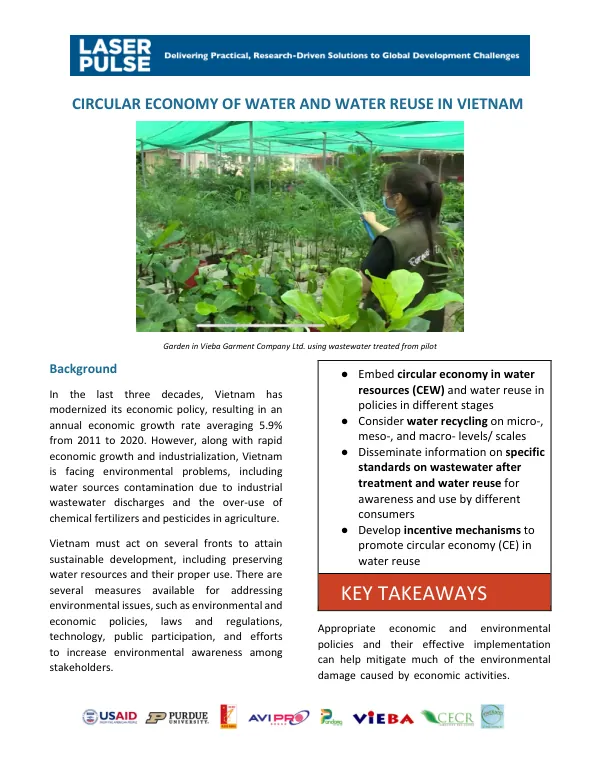
To attain sustainable development, Vietnam must act on several fronts, including preserving water resources and their proper use. The concept of Circular Economy of Water (CEW) has been introduced in Vietnam, which aims to reduce, conserve, and optimize water use through efficient use and maintenance to ensure water quality and environmental protection. CEW is an economic framework that maintains economic development while minimizing adverse impacts on water resources. Many countries have adopted this approach, and Vietnam is now considering its application. Despite the benefits of CEW, water resources in Vietnam continue to be degraded due to development activities, resulting in water scarcity and pollution. The value and services provided by water resources must be recognized and embodied in the planning and decision-making regarding conservation, use, and reuse of water resources. Context-specific policies, regulations, and institutional arrangements are indispensable to lessen the pressure on water resources and promote their prudent use. The "Decentralized water resource circulation as a sustainable solution for plantation" project implemented activities focused on developing practices that promote decentralized water circulation to reuse water and nutrients in domestic wastewater to support greenifying local areas without excessively exploiting local natural resources. The research team reviewed general CEW literature, existing decrees, regulations, guidelines, and organized stakeholder consultations/interviews to identify potential applications of CEW. The opportunities for applying CEW in Vietnam include increasing interest in CE on the part of government and stakeholders to respond to environmental pollution and the depletion of natural resources, especially water resources. Increasing consumer attention to environmental and sustainable consumption practices, increasing use of data, connectivity, analysis, and mechanization to transform manufacturing and other industries fostered by the Fourth Industrial Revolution (4IR), and increasing government attention to CE as it develops new economic development policies, strategies, and guidelines are also opportunities for CEW application. The challenges for the application of CEW in Vietnam include a growing water demand resulting from agricultural production, aquaculture, urbanization, industrialization, tourism-related development, and population growth, increasing water pollution due to wastewater from urban, industry, aquaculture, and agrochemical and fertilizer runoff in rural areas, increasing salinity intrusion because of climate change in coastal areas, hurting crop yields, and effective promotion and implementation of CE in natural resources management by authorities at provincial levels to foster change behavior for wastewater recycling. To address these challenges, policy relevant recommendations include revising the Law on Water Resources to encourage the application of CE in water and wastewater reuse, developing technical guidelines and standards for water treatment and reuse, and incentivizing private sector businesses and industries to transition to CEW application. Additionally, awareness campaigns targeting businesses and communities are necessary to address safety and hygiene concerns around using recycled water.
Related documents