USAID DEC
Civic Education in the Digital Age: How to Use the Civic Education Assessment Tool to Assess and Build Civic Education Programs
Sign inUSAID
Civic Education in the Digital Age: How to Use the Civic Education Assessment Tool to Assess and Build Civic Education Programs
The Civic Education Assessment Tool (CEAT) is a diagnostic tool developed by the Democracy, Human Rights, and Governance (DRG) Center to help USAID strategic planners and program designers assess and build civic education programs.
2023 · 2 pages
Sign in to readA free account is required to download.
Abstract
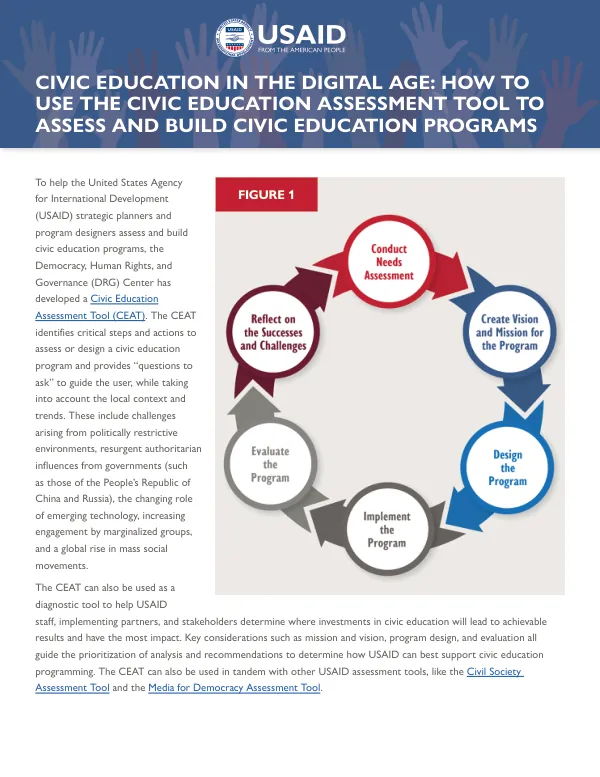
The CEAT identifies critical steps and actions to assess or design a civic education program, taking into account the local context and trends. These include challenges arising from politically restrictive environments, resurgent authoritarian influences from governments, the changing role of emerging technology, increasing engagement by marginalized groups, and a global rise in mass social movements. The CEAT can be used as a diagnostic tool to help USAID staff, implementing partners, and stakeholders determine where investments in civic education will lead to achievable results and have the most impact. Key considerations such as mission and vision, program design, and evaluation guide the prioritization of analysis and recommendations to determine how USAID can best support civic education programming. The CEAT can also be used in tandem with other USAID assessment tools, like the Civil Society Assessment Tool and the Media for Democracy Assessment Tool. The CEAT outlines six steps for designing and evaluating a civic education program: conducting a needs assessment, creating a vision and mission for the program, designing the program, implementing and monitoring the program, evaluating the program, and reflecting on the successes and challenges. Each step outlines the actions and questions to ask to implement it. For example, during the needs assessment step, illustrative questions to ask include how the entity being worked with defines civic education, what are the primary civic education issues affecting the country, and how do the current political dynamics shape opportunities and challenges that impact civic education programs. The CEAT also emphasizes the importance of considering the strengths, weaknesses, and opportunities of the current civic education system when creating a vision and mission for the program. Additionally, it highlights the need to identify what civic knowledge, skills, dispositions, and attitudes are essential to address the program's vision and objectives. The CEAT provides a framework for program designers to develop indicators and collect monitoring data for the civic education program's theory of change, and to evaluate the program's effectiveness in achieving its outcomes. The CEAT is a valuable resource for USAID staff, implementing partners, and stakeholders seeking to design and implement effective civic education programs. By using the CEAT, they can ensure that their programs are tailored to the local context and are likely to achieve their intended outcomes.
Related documents
Documents in this collection
 2021
2021USAID DEC
Remote Developmental Evaluation: A Guide for Funders and Practitioners
Open record
USAID DEC
Design, Implementation, Monitoring, and Evaluation of Cross-Cultural HIV-Related Mental Health and Psychosocial Assistance Programs: A User’s Manual for Researchers and Program Implementers (Adult Version)
Open record