INTERNATIONAL CITY AND COUNTY MANAGEMENT ASSOCIATION
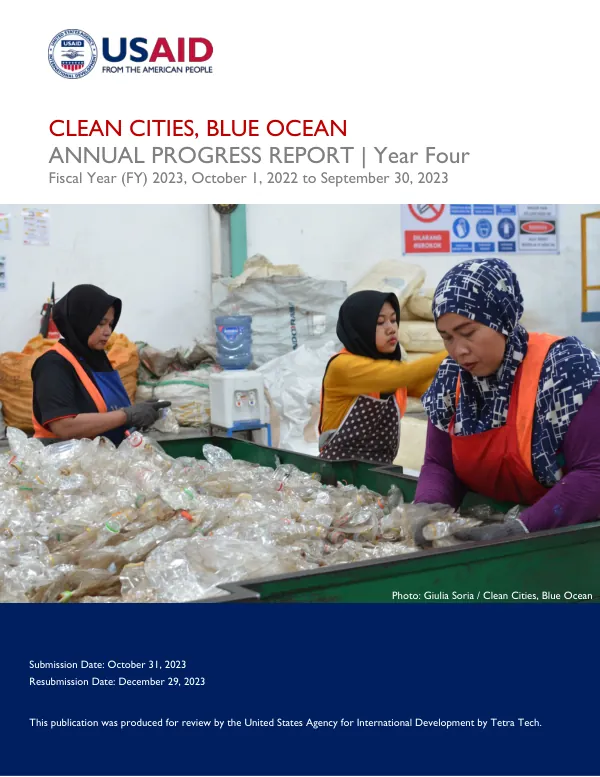
Clean Cities, Blue Ocean | Year Four (FY23) Annual Report
The Clean Cities, Blue Ocean initiative aims to address the growing issue of plastic pollution in the world's oceans.
2023 · 110 pages
Sign in to readA free account is required to download.
Abstract
The program, which began in 2019 and is set to conclude in 2024, focuses on improving waste management and recycling systems in low- and middle-income countries. The initiative is led by Tetra Tech, with support from the United States Agency for International Development (USAID). The program's technical objectives are centered around six key focus areas. The first focus area involves building the capacity of Clean Cities, Blue Ocean engagement sites in improved solid waste management. This includes providing training and technical assistance to local governments and communities to enhance their waste management practices. The second focus area focuses on improving the enabling environment for the 3Rs (reduce, reuse, and recycle) with a focus on Clean Cities, Blue Ocean engagement sites. This involves working with local governments and stakeholders to create policies and regulations that support waste reduction and recycling. The third focus area involves building social and behavior change (SBC) for the 3Rs and improved solid waste management, as well as addressing livelihood challenges for waste workers. This includes conducting research and analysis to identify effective SBC strategies and implementing programs to promote behavior change among waste workers and local communities. The fourth focus area focuses on supporting gender equality and women's economic empowerment, particularly in the context of waste management. This involves working with local women's groups and organizations to provide training and technical assistance on waste management and recycling. The fifth focus area involves strengthening public-private partnerships and/or multi-stakeholder alliances to support waste management and recycling. This includes working with local businesses and organizations to develop partnerships and collaborations that can help to improve waste management practices. The sixth focus area involves strengthening USAID leadership in combating marine plastics, which includes providing technical assistance and support to USAID missions and partners to help them develop effective strategies for addressing marine plastic pollution. During the fourth year of the program, which spanned from October 1, 2022 to September 30, 2023, significant progress was made in all six focus areas. In Latin America and the Caribbean, the program worked with local governments and communities to improve waste management practices and increase recycling rates. In Asia, the program focused on building the capacity of local governments and communities to implement effective waste management systems. The program also made significant progress in implementing its work plan, with 95% of activities completed on time and within budget. The program's monitoring, evaluation, and learning (MEL) system was also strengthened, with the development of new indicators and targets to measure progress. The program's communications and reporting efforts were also enhanced, with the production of regular newsletters and reports to stakeholders. Despite the progress made, the program also faced several challenges, including delays in the implementation of some activities and difficulties in working with some local governments and communities. However, the program's team was able to adapt and respond to these challenges, and the program's overall progress was not significantly impacted. The program's financial performance was also strong, with 99% of budgeted funds expended during the fourth year. The program's grants management system was also effective, with 100% of grants awarded and expended on time and within budget. Overall, the Clean Cities, Blue Ocean initiative has made significant progress in addressing the issue of plastic pollution in the world's oceans. The program's focus on improving waste management and recycling systems in low- and middle-income countries has the potential to prevent ocean plastic pollution and promote sustainable development.