TETRA TECH
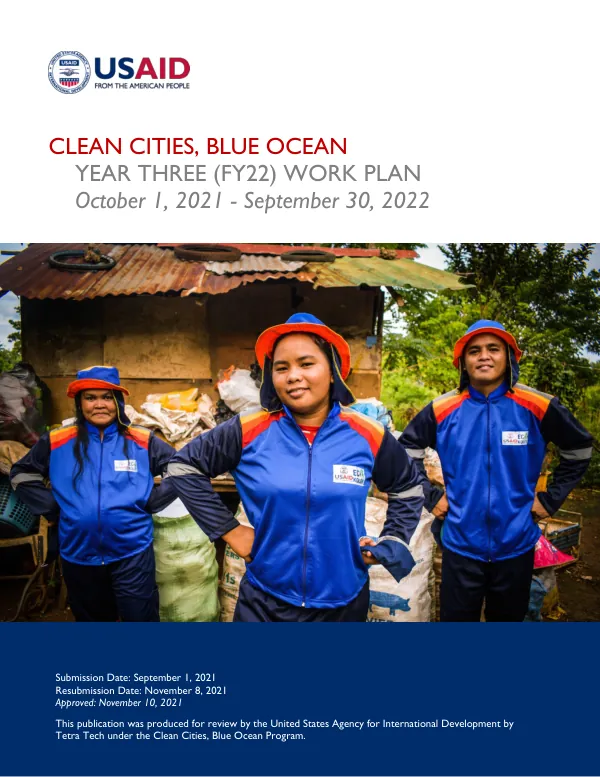
Clean Cities, Blue Ocean | Year Three Work Plan (DRAFT)
The Clean Cities, Blue Ocean (CCBO) program is a five-year initiative aimed at addressing the global crisis of ocean plastic pollution.
2021 · 57 pages
Sign in to readA free account is required to download.
Abstract
Funded by the U.S. Agency for International Development (USAID), the program targets land-based leakage directly at its source in seven countries and over 25 cities and towns in rapidly urbanizing areas across Asia, Latin America, and the Caribbean. The objectives of CCBO are multifaceted, focusing on promoting reduce, reuse, and recycle (3Rs) practices, strengthening local and regional markets for recycled plastics, and building social and behavior change (SBC) for 3Rs and sustainable solid waste management (SWM). CCBO's work is guided by a Theory of Change, which outlines the program's approach to achieving its objectives. The program's structure and implementation mechanisms are designed to support the achievement of its objectives, with a focus on building capacity and effective governance for SWM and recycling systems. The program's activities are organized around six focus areas, each addressing a critical aspect of the 3Rs and SWM. Focus Area 1, Build Capacity of CCBO Engagement Sites in Improved Solid Waste Management, aims to enhance the capacity of CCBO engagement sites to manage solid waste effectively. This includes providing training and technical assistance to local governments and stakeholders to improve their solid waste management practices. Focus Area 2, Improve Enabling Environment for 3Rs with a Focus on CCBO Engagement Sites, seeks to create an enabling environment for the adoption of 3Rs practices in CCBO engagement sites. This includes developing policies and regulations that support the 3Rs and providing incentives for businesses and individuals to adopt sustainable waste management practices. Focus Area 3, Build SBC for 3Rs and Improved SWM and Address Livelihood Challenges for Waste Workers, aims to build social and behavior change for 3Rs and SWM practices among waste workers and their communities. This includes developing and implementing SBC strategies that promote the adoption of 3Rs practices and improve the livelihoods of waste workers. Focus Area 4, Support Gender Equality and Women's Economic Empowerment, seeks to address and improve the livelihoods of women working in the SWM and recycling sectors. This includes providing training and technical assistance to women to improve their skills and access to markets for recycled plastics. Focus Area 5, Strengthen Public-Private Partnerships and/or Multi-Stakeholder Alliances, aims to strengthen public-private partnerships and multi-stakeholder alliances to support the adoption of 3Rs practices and improve SWM. This includes developing and implementing partnerships with businesses, civil society organizations, and governments to promote sustainable waste management practices. Focus Area 6, Strengthen USAID Leadership in Combating Marine Plastics, seeks to strengthen USAID's leadership in combating marine plastics and promoting sustainable waste management practices globally. CCBO's work is guided by a set of indicators, targets, and anticipated adjustments that are outlined in the program's Theory of Change Results Framework. The program's activities are also supported by a grants program that provides funding to local governments, businesses, and civil society organizations to support the adoption of 3Rs practices and improve SWM. The program's implementation timeline is outlined in the Year Three Work Plan Activities and Implementation Timeline, which provides a detailed schedule of the program's activities and milestones. Overall, the CCBO program is a comprehensive initiative that aims to address the global crisis of ocean plastic pollution by promoting the adoption of 3Rs practices and improving SWM in seven countries and over 25 cities and towns in rapidly urbanizing areas across Asia, Latin America, and the Caribbean.
Related documents