USAID
Climate Change Threat Package: Sector Specific 1 – Natural Systems
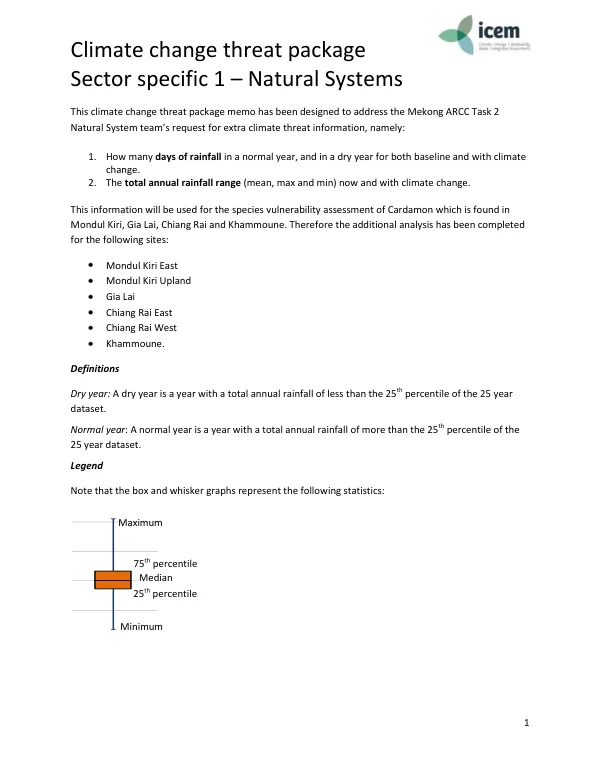
Climate change threat package Sector specific 1 – Natural Systems addresses the Mekong ARCC Task 2 Natural System team's request for extra climate threat information.
2012 · 7 pages
Sign in to readA free account is required to download.
Abstract
The analysis focuses on the number of days of rainfall in a normal year and a dry year for both baseline and with climate change conditions. This information is crucial for the species vulnerability assessment of Cardamon, which is found in Mondul Kiri, Gia Lai, Chiang Rai, and Khammoune. The analysis was completed for six sites: Mondul Kiri East, Mondul Kiri Upland, Gia Lai, Chiang Rai East, Chiang Rai West, and Khammoune. A dry year is defined as a year with a total annual rainfall of less than the 25th percentile of the 25-year dataset, while a normal year is a year with a total annual rainfall of more than the 25th percentile of the 25-year dataset. The results show that the total annual precipitation in Mondul Kiri East has a minimum of 1,455 mm, an average of 1,858 mm, and a maximum of 2,305 mm under baseline conditions. With climate change, the total annual precipitation ranges from 1,614 mm to 2,511 mm. The average number of days of precipitation in normal years and dry years remains relatively stable, with 238.6 days in normal years and 232.3 days in dry years under baseline conditions, and 238.8 days in normal years and 232.7 days in dry years with climate change. Similar trends are observed in the other sites, with slight variations in precipitation amounts and days of rainfall. For example, in Gia Lai, the total annual precipitation ranges from 1,099 mm to 2,527 mm under baseline conditions, and from 1,221 mm to 2,766 mm with climate change. The average number of days of precipitation in normal years and dry years is 205.2 days in normal years and 178.7 days in dry years under baseline conditions, and 205.6 days in normal years and 177.2 days in dry years with climate change. The results of this analysis will be used to inform the species vulnerability assessment of Cardamon, which is an important step in understanding the potential impacts of climate change on this species. The findings highlight the importance of considering climate change projections when assessing the vulnerability of species to changing environmental conditions.
Related documents
Documents in this collection
 2023
2023USAID DEC
Situation Assessment and Gap Analysis on the Monitoring, Measurement, and Management of Methane Emissions in the ASEAN Oil and Gas Market
Open record 2023
2023USAID DEC