USAID DEC
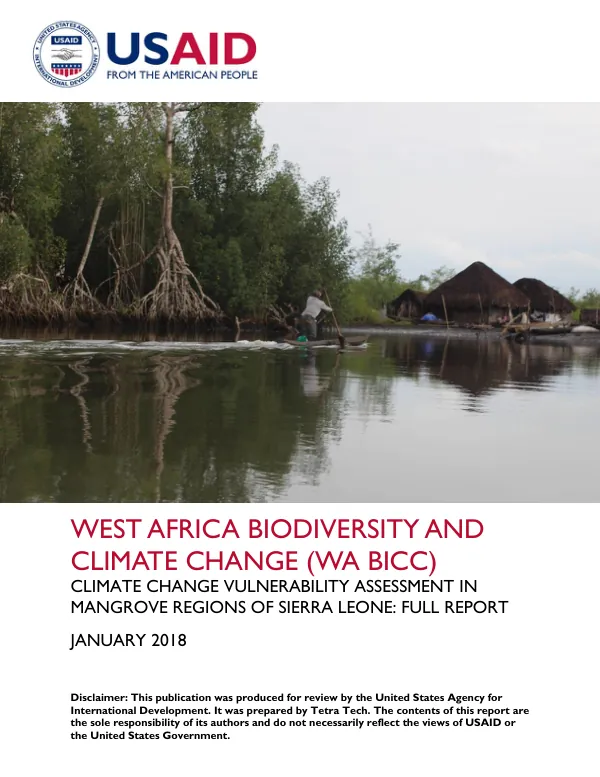
Climate Change Vulnerability Assessment in Mangrove Regions of Sierra Leone: Full Report
Sign inTETRA TECH
Climate Change Vulnerability Assessment in Mangrove Regions of Sierra Leone: Full Report
The climate change vulnerability assessment in mangrove regions of Sierra Leone was conducted to identify the potential impacts of climate change on the country's coastal communities.
2018 · 169 pages
Sign in to readA free account is required to download.
Abstract
The assessment was led by the Center for International Earth Science Information Network (CIESIN) of the Earth Institute of Columbia University, under contract with Tetra Tech, and involved a team of researchers from various institutions in Sierra Leone. The assessment used a combination of ecosystem and population vulnerability assessments to identify the most vulnerable communities in the mangrove regions of Sierra Leone. The methodology involved preliminary information gathering and area/population selection, followed by a scoping visit to the coastal areas of Sierra Leone. The team selected three coastal areas for the assessment: the Western Area, the Northern Province, and the Southern Province. The assessment used a combination of household surveys, participatory rural appraisal, and ecosystem vulnerability assessment to collect data on the socio-economic characteristics of the communities, climate and environment, and mangrove ecosystems. The data was analyzed using a combined vulnerability analysis, which involved the computation of aggregated indicators to identify the most vulnerable communities. The assessment found that the communities in the mangrove regions of Sierra Leone are highly vulnerable to climate change, with high levels of poverty, limited access to education and healthcare, and dependence on natural resources for livelihoods. The communities are also highly exposed to climate-related hazards, such as flooding, storm surges, and droughts. The assessment identified several key climate-related risks and vulnerabilities, including: * Sea-level rise and coastal erosion * Increased frequency and severity of flooding and storm surges * Changes in temperature and precipitation patterns * Impacts on fisheries and aquaculture * Loss of mangrove forests and associated ecosystem services The assessment also identified several adaptation solutions that can help communities in the mangrove regions of Sierra Leone to adapt to climate change, including: * Erosion control measures, such as seawalls and beach nourishment * Flood protection measures, such as dunes and levees * Climate-resilient agriculture and fisheries practices * Mangrove restoration and conservation efforts * Climate information and early warning systems The assessment recommended that the government of Sierra Leone, in collaboration with international partners and local communities, should prioritize the implementation of these adaptation solutions to reduce the vulnerability of communities in the mangrove regions to climate change.