DAI
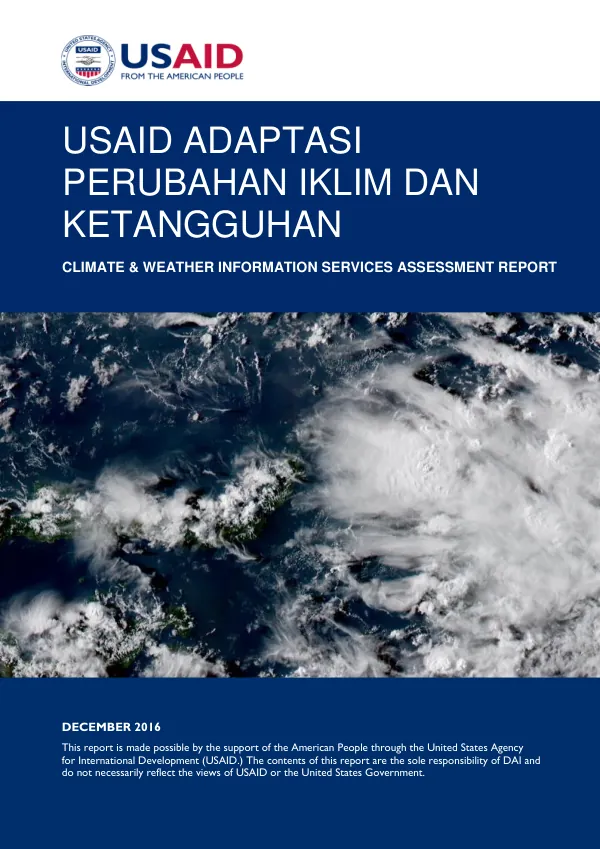
Climate & Weather Information Services Assessment Report
The Adaptasi Perubahan Iklim dan Ketangguhan (APIK) program, sponsored by the USAID/Indonesia Office of Environment, aims to strengthen climate and weather information services in Indonesia.
2016 · 206 pages
Sign in to readA free account is required to download.
Abstract
The program's vision is to enhance the country's resilience to climate change by improving the availability, accessibility, and usability of climate and weather information. The APIK program focuses on strengthening the climate and weather information services value chain, which involves various institutions, products, and communication modes. The program's assessment approach and methodology involve a top-down and bottom-up assessment of the CWI institutional landscape, including key actors, products, and communication modes. The CWI services value chain is complex, with multiple phases and cross-cutting themes. The program identifies the National Meteorological and Climate Agency (BMKG) as a key institution in the CWI services value chain, responsible for data collection and processing, product development, dissemination and communication, and application and use. The BMKG plays a crucial role in providing climate and weather information to various stakeholders, including government agencies, private sector companies, and the general public. The APIK program also assesses the role of other key actors in the CWI services value chain, including the National Disaster Management Agency (BNPB), national ministries, universities and research institutions, media, private sector companies, and the military. The program identifies opportunities for strengthening the CWI services marketplace, including improving data collection and processing, enhancing product development and dissemination, and increasing the use of climate and weather information by various stakeholders. The APIK program's geographic coverage includes Indonesia, with a focus on East Java. The program's assessment approach and methodology involve a comprehensive analysis of the CWI institutional landscape, including key actors, products, and communication modes. The program's findings highlight the importance of strengthening the CWI services value chain to enhance Indonesia's resilience to climate change. The APIK program's assessment reveals that the CWI services value chain is complex, with multiple phases and cross-cutting themes. The program identifies the need for improved data collection and processing, enhanced product development and dissemination, and increased use of climate and weather information by various stakeholders. The program's recommendations aim to strengthen the CWI services marketplace, improve the availability, accessibility, and usability of climate and weather information, and enhance Indonesia's resilience to climate change. The APIK program's assessment also highlights the importance of collaboration and coordination among various stakeholders, including government agencies, private sector companies, universities and research institutions, media, and the military. The program's recommendations aim to promote collaboration and coordination among these stakeholders to strengthen the CWI services value chain and enhance Indonesia's resilience to climate change. The APIK program's assessment reveals that the CWI services value chain is critical to Indonesia's resilience to climate change. The program's recommendations aim to strengthen the CWI services marketplace, improve the availability, accessibility, and usability of climate and weather information, and enhance Indonesia's resilience to climate change. The program's findings and recommendations provide valuable insights for policymakers, practitioners, and researchers working to strengthen the CWI services value chain and enhance Indonesia's resilience to climate change.
Related documents