USAID DEC
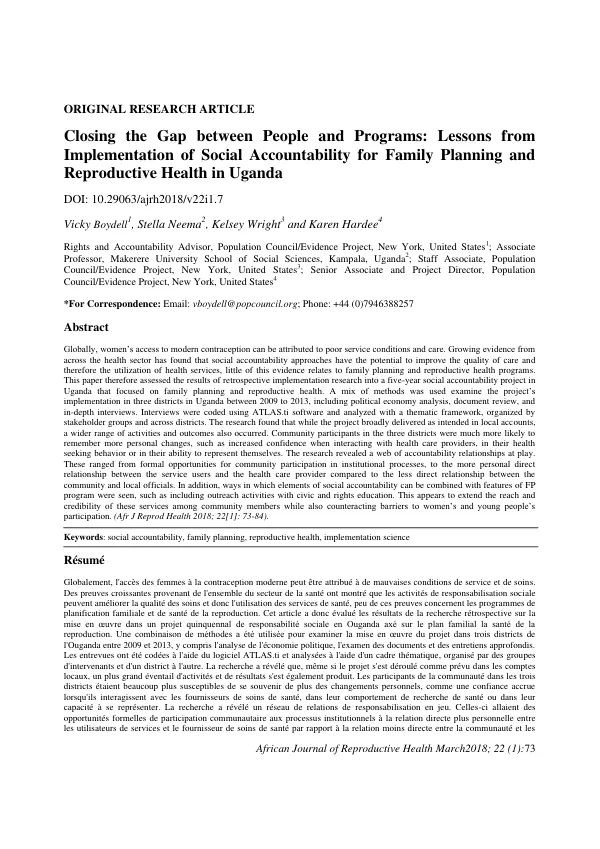
Closing the Gap between People and Programs: Lessons from Implementation of Social Accountability for Family Planning and Reproductive Health in Uganda
Sign inUSAID DEC
Closing the Gap between People and Programs: Lessons from Implementation of Social Accountability for Family Planning and Reproductive Health in Uganda
The Healthy Action Project (HAP) was a five-year social accountability project implemented in Uganda between 2009 and 2013.
2018 · 12 pages
Sign in to readA free account is required to download.
Abstract
The project focused on family planning and reproductive health, with the goal of improving the quality of care and utilization of health services. A mix of methods was used to examine the project's implementation in three districts in Uganda, including political economy analysis, document review, and in-depth interviews. The research found that while the project broadly delivered as intended in local accounts, a wider range of activities and outcomes also occurred. Community participants in the three districts were much more likely to remember personal changes, such as increased confidence when interacting with healthcare providers, in their health-seeking behavior or in their ability to represent themselves. The research revealed a web of accountability relationships at play, ranging from formal opportunities for community participation in institutional processes to the more personal direct relationship between service users and healthcare providers. Social accountability approaches, where community members identify the challenges they face in using services and hold those responsible to account for their decisions and actions, hold much promise for addressing the challenges that women face in seeking services. Community participatory approaches have been shown to improve patient-centered quality of care, knowledge of the right to quality healthcare, and respectful treatment, as well as the responsiveness of healthcare providers to community needs. The project's implementation was guided by a Theory of Change, which posited that social accountability would lead to improved service delivery, increased client satisfaction, and better oversight and monitoring of health systems. The research found that the project's activities, such as participatory budgeting, citizen hearings, and community scorecards, were effective in promoting social accountability and improving the quality of care. The study's findings suggest that social accountability can be an effective approach for improving the delivery of family planning and reproductive health services. The project's results demonstrate the potential for social accountability to address on-the-ground challenges in availability, access, and quality of contraceptive services. The study's conclusions highlight the importance of understanding how social accountability changes are produced and achieved, and what happens in the implementation process. The Healthy Action Project's implementation in Uganda provides valuable lessons for policymakers and practitioners seeking to improve the delivery of family planning and reproductive health services. The project's results demonstrate the potential for social accountability to improve the quality of care and utilization of health services, and highlight the importance of community participation and engagement in promoting social accountability.
Related documents