USAID DEC
CLTS Performance Envelope Quantitative Analysis
Community Led Total Sanitation (CLTS) has been widely adopted as a strategy to end open defecation globally.
2021 · 1 pages
Sign in to readA free account is required to download.
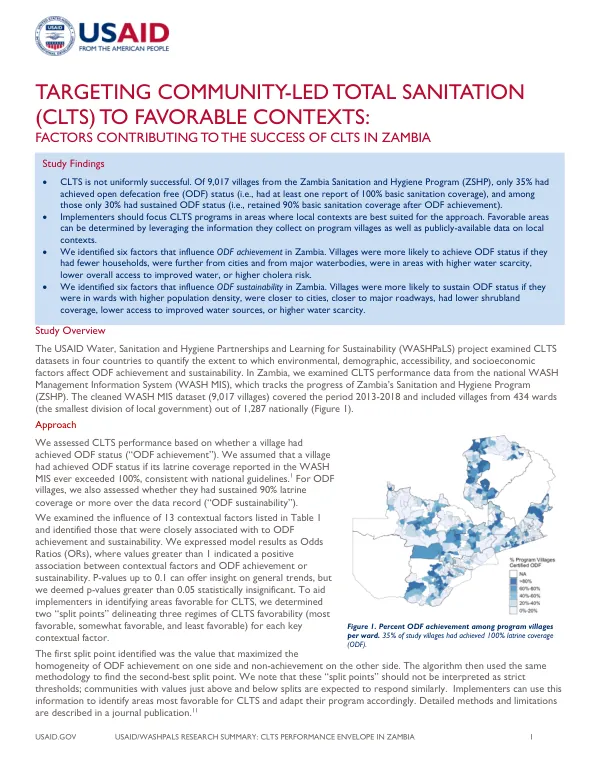
Abstract
Dozens of countries have incorporated the approach as part of national policy for rural sanitation. Research indicates that the effectiveness of CLTS programs to achieve and sustain open defecation free (ODF) communities is influenced by both context and implementation modality. The relative influence of these factors on CLTS performance is not yet well understood. USAID's Water, Sanitation and Hygiene Partnerships and Learning for Sustainability (USAID/WASHPaLS) activity partnered with CLTS implementers and governments to research and better understand the range of conditions in which CLTS is most effective. This research aimed to guide future implementation and investment decisions by governments, donors, and implementers. The CLTS Performance Envelope research was guided by two questions: What is the relative importance of context as compared to program implementation for ODF achievement? Are some contextual characteristics strong predictors of ODF achievement? To address the first question, USAID/WASHPaLS examined CLTS datasets in four countries—Cambodia, Ghana, Liberia, and Zambia—to quantify the extent to which environmental, demographic, accessibility, and socioeconomic factors affect ODF achievement and sustainability. Data for analysis was drawn from various public sources such as Demographic and Health Survey (DHS), Multiple Indicator Cluster Survey (MICS), WorldPop, the Dartmouth Flood Observatory, and others. The analysis used both bivariate and multivariate statistical models, supplemented with interviews of CLTS implementers to confirm findings. The results of the quantitative analysis are presented in four country briefs: Factors Contributing to the Success of CLTS in Cambodia, Factors Contributing to the Success of CLTS in Ghana, Factors Contributing to the Success of CLTS in Liberia, and Factors Contributing to the Success of CLTS in Zambia. These briefs provide insights into the relative importance of context and program implementation for ODF achievement in each country. The analysis highlights the importance of understanding the specific contextual characteristics that influence CLTS performance in different settings. The CLTS Performance Envelope research aims to inform future implementation and investment decisions by governments, donors, and implementers. By understanding the range of conditions in which CLTS is most effective, stakeholders can tailor their approaches to the specific needs and contexts of different communities. This research has the potential to improve the effectiveness of CLTS programs and ultimately contribute to the achievement of ODF status in rural communities worldwide.