USAID DEC
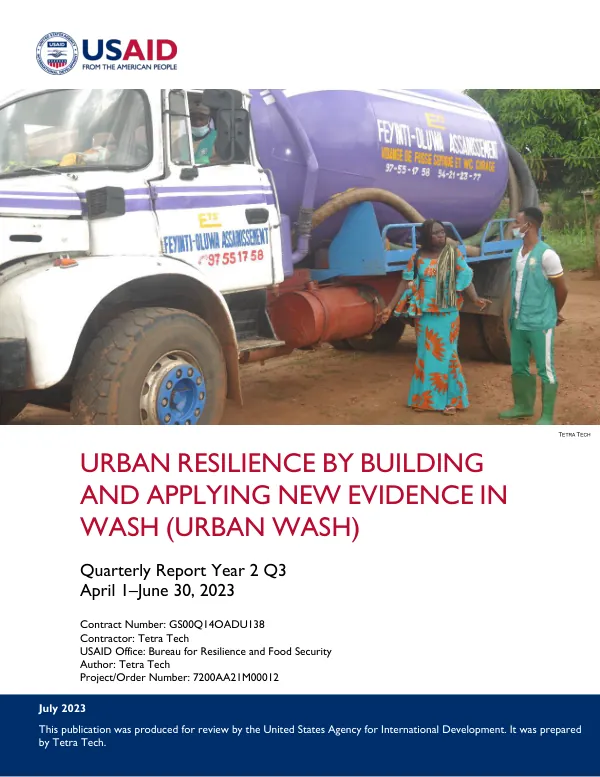
Urban Resilience by Building and Applying New Evidence in WASH (URBAN WASH) Quarterly Report Year 2 Q3
Sign inIRIS GROUP, INC.
Urban Resilience by Building and Applying New Evidence in WASH (URBAN WASH) Quarterly Report Year 2 Q3
The Urban Resilience by Building and Applying New Evidence in WASH (URBAN WASH) project is a five-year centrally funded activity of the United States Agency for International Development (USAID) Bureau for Resilience and Food Security.
2023 · 38 pages
Sign in to readA free account is required to download.
Abstract
The project was awarded to Tetra Tech on September 14, 2021, under USAID's One Acquisition Solution for Integrated Services Pool 1 Indefinite Delivery Indefinite Quantity contract. Tetra Tech implements the project in collaboration with several nongovernmental organizations and small business partners. The URBAN WASH project supports the Agency's goal of promoting impactful, sustainable, equitable, and climate-resilient water, sanitation, and hygiene (WASH) policy and programming in urban and peri-urban areas through strengthening evidence-based decision-making of partners and host governments at the local, regional, state, and national levels. To achieve this objective, the URBAN WASH project performs tasks and accomplishes deliverables under three interrelated components. Component 1: Establish and support strategic engagement and partnerships to ensure local and broader relevance of research and use of evidence. Component 2: Generate high-quality evidence through implementation research to increase the sector's understanding in three main areas: enabling environment for urban WASH and water resources management (WRM) policies and regulations, approaches for sustainable small and informal service provision, and sustainable approaches to improve source water protection and diversification for resilient water supplies. Component 3: Provide short-term and on-demand technical assistance to support USAID/Mission WASH and WRM research, learning, evaluation, and analytics across the program cycle. During the quarter from April 1 to June 30, 2023, Component 1 focused on establishing and supporting strategic engagement and partnerships. This included working with local and international partners to ensure the relevance of research and use of evidence. Component 2 generated high-quality evidence through implementation research in three main areas: enabling environment for urban WASH and WRM policies and regulations, approaches for sustainable small and informal service provision, and sustainable approaches to improve source water protection and diversification for resilient water supplies. Component 3 provided short-term and on-demand technical assistance to support USAID/Mission WASH and WRM research, learning, evaluation, and analytics across the program cycle. This included providing technical assistance to USAID missions on WASH and WRM research, learning, evaluation, and analytics. The URBAN WASH project also implemented several activities during the quarter, including the Accra Water Connection Subsidy Study, the Small and Informal Service Provider Implementation Research in Zambia, the Ghana Water Quality and Efficiency Study, and the IUWASH Tangguh Impact Evaluation. The project's progress on management and performance indicators from the Activity Monitoring, Evaluation, and Learning Plan is provided in Annex A. The financial summary for the period ending June 30, 2023, is provided in Section 4 of this report. The URBAN WASH project will continue to implement its activities and deliverables under the three interrelated components in the next quarter. The key activities planned for next quarter include continuing to establish and support strategic engagement and partnerships, generating high-quality evidence through implementation research, and providing short-term and on-demand technical assistance to support USAID/Mission WASH and WRM research, learning, evaluation, and analytics across the program cycle. The project's goal is to promote impactful, sustainable, equitable, and climate-resilient WASH policy and programming in urban and peri-urban areas through strengthening evidence-based decision-making of partners and host governments at the local, regional, state, and national levels. The URBAN WASH project will continue to work towards this goal in the next quarter and beyond. The project's implementation research in three main areas: enabling environment for urban WASH and WRM policies and regulations, approaches for sustainable small and informal service provision, and sustainable approaches to improve source water protection and diversification for resilient water supplies, will continue to provide high-quality evidence to support the sector's understanding and decision-making. The URBAN WASH project's short-term and on-demand technical assistance to support USAID/Mission WASH and WRM research, learning, evaluation, and analytics across the program cycle will continue to provide critical support to USAID missions on WASH and WRM research, learning, evaluation, and analytics. The project's financial summary for the period ending June 30, 2023, shows that the project has made significant progress in implementing its activities and deliverables under the three interrelated components. The project's financial summary will continue to be provided in future reports to ensure transparency and accountability. The URBAN WASH project's progress on management and performance indicators from the Activity Monitoring, Evaluation, and Learning Plan is provided in Annex A. The project will continue to monitor and evaluate its progress against the indicators and make adjustments as necessary to ensure the project's success. The URBAN WASH project's goal is to promote impactful, sustainable, equitable, and climate-resilient WASH policy and programming
Related documents