USAID DEC
Final Report on Ahotor Oven Market Development and Financing Outcomes and Lessons Learned
Sign inCOASTAL RESOURCES CENTER
Final Report on Ahotor Oven Market Development and Financing Outcomes and Lessons Learned
The Sustainable Fisheries Management Project (SFMP) is a USAID-funded initiative aimed at rebuilding marine fish stocks and catches in Ghana through the adoption of responsible fishing practices.
2019 · 24 pages
Sign in to readA free account is required to download.
Abstract
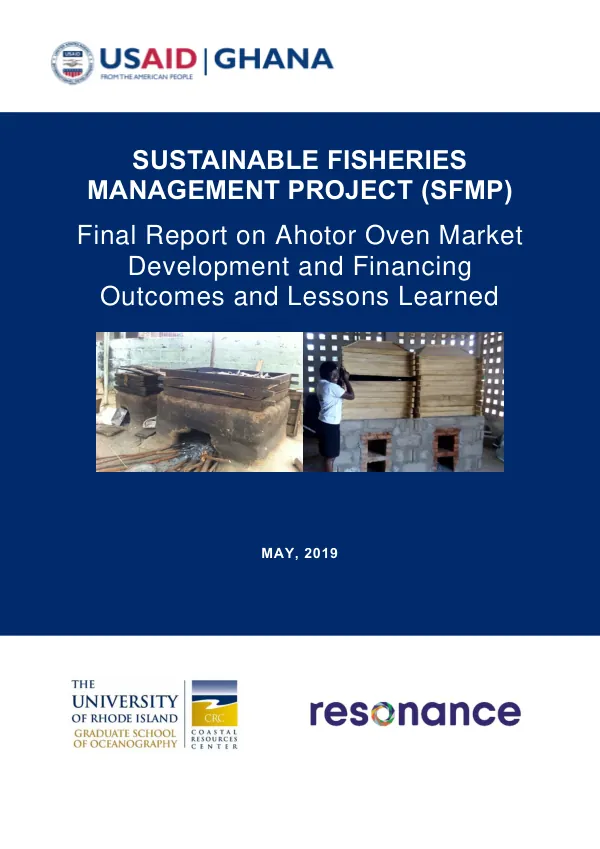
Rebuilding marine fish stocks also requires reducing post-harvest losses and maximizing incomes by improving the post-harvest value chain. SFMP's principal strategy to achieve this was to promote the adoption of improved fish preservation methods, with a focus on smoking. Since 70% of all fish harvest is preserved through smoking, SFMP collaborated with the Fisheries Commission and the Food Research Institute of the Council for Scientific and Industrial Research (CSIR) to develop and deploy the Ahotor oven, an improved smoker technology that provides economic, environmental, and health benefits for fish processors and consumers compared to existing options. The Ahotor oven is designed to reduce post-harvest losses and maximize incomes for fish processors. It is an improved smoker technology that provides economic, environmental, and health benefits for fish processors and consumers compared to existing options. The oven is designed to reduce the time and energy required for smoking fish, resulting in higher quality and more consistent products. SFMP's efforts to increase the adoption of the Ahotor oven included three primary pathways: communications targeting behavioral change, awareness raising, and demand creation; developing the Ahotor supply chain to increase oven supply, ensure oven quality, and decrease oven costs; and providing affordable financing options and building the business skills of fish processors to support the purchase of the Ahotor. Despite these efforts, uptake has been slow, with 319 ovens constructed for fish processors by SFMP and another 214 constructed by the Fisheries Commission Post Harvest Unit with support from the World Bank WARFP project. This represents 8.9% of SFMP's original target. Ahotor purchases and construction have been adversely affected by low fish catch at the landing beaches, limited access to finance for fish processors, the high cost of the oven and key oven components, and low consumer awareness on the benefits of Ahotor smoked fish. However, uptake could increase if the Department of Health and the Ministry of Fisheries and Aquaculture Development (MOFAD) Fisheries Commission (FC) could reinforce the campaign on the health benefits of the Ahotor oven and Ahotor smoked fish to consumers. Increased consumer awareness and demand – and a resulting price premium for Ahotor smoked fish – could help to encourage more fish processors to use the Ahotor oven. The Ahotor oven has been tested and evaluated by SFMP's implementing partners, with discussions held with early adopters and a desk study of existing research on fish processing in Ghana. The results of these efforts have been synthesized into this report, which provides a comprehensive overview of the successes, challenges, and lessons learned related to SFMP's efforts to increase the adoption of the Ahotor oven. The report highlights the importance of addressing the key barriers to adoption, including limited access to finance, high costs, and low consumer awareness. It also emphasizes the need for continued support and reinforcement from key stakeholders, including the Department of Health and the Ministry of Fisheries and Aquaculture Development (MOFAD) Fisheries Commission (FC). Overall, the report provides a detailed analysis of the challenges and opportunities related to the adoption of the Ahotor oven in Ghana, and offers recommendations for increasing uptake and promoting the benefits of this improved smoker technology.