COASTAL RESOURCES CENTER
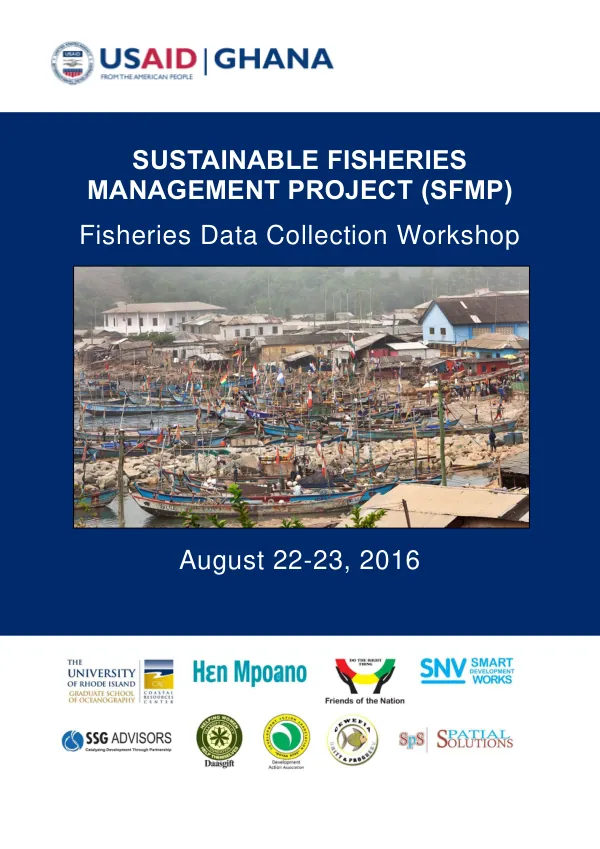
Fisheries Data Collection Workshop, August 22-23, 2016
The Ghana Sustainable Fisheries Management Project (SFMP) organized a Fisheries Data Collection Workshop on August 22-23, 2016, to evaluate the current data flow for catch and effort data being collected in the field and the databases used to manage that data in the Fisheries Scientific Survey Division (FSSD) office.
2016 · 10 pages
Sign in to readA free account is required to download.
Abstract
Current practice involves paper-based survey techniques with data being hand-entered into desktop data systems in the FSSD office in Tema. Data frequently takes 8 to 12 months to move from the canoe fishery landing site to the statistical survey effort at FSSD. The workshop aimed to identify a collective vision and objectives of the improved fisheries data collection system, identify synergies with the West Africa Regional Fisheries Project (WARFP) funded activities relative to the fisheries data collection system, discuss the ICT tools necessary to implement an efficient data collection program for monitoring the actions of the National Fisheries Management Plan (NFMP), design a pilot project using E-reporting (Tablets), and outline a timeline for core activities from start-up to scale. The data flow from vessels to the FSSD involves four distinct fleets, each with customized data collection methods. The canoe fleet uses five different gear types, while the tuna fishing fleet is restricted to pole and line and purse seines. The trawler fleet uses a short-trawl, and the semi-industrial fleet employs a mix of all methods. Sampling of the catch by the artisanal fishing fleet of canoes is done at approximately 50 sampling sites out of more than 300 landing sites. Data collected in each of Ghana's fisheries management regions is reviewed by zonal officers in charge of the enumerators. The information, on hand-written sheets, is then sent to FSSD where it is collated and manually entered into various databases. The ARTFISH software, created by the Food and Agriculture Organization (FAO), is used by the FSSD for information collected from the canoe and semi-industrial fleets. The database for trawler data is programmed using DBASE, and the International Commission for the Conservation of Atlantic Tuna (ICCAT) database is used for reporting information on tuna catches. The workshop also discussed the use of modern technology to improve the speed of information acquisition and management as well as the quality of the resulting data. Multiple efforts are being explored by SFMP, WARFP, and the FAO to move the Ghana Fisheries Commission toward electronic data collection. The main objectives of the workshop were to identify a collective vision and objectives of the improved fisheries data collection system, identify synergies with WARFP funded activities, discuss the ICT tools necessary to implement an efficient data collection program, design a pilot project using E-reporting (Tablets), and outline a timeline for core activities from start-up to scale. The workshop participants included representatives from the Ghana Fisheries Commission, the Coastal Resources Center, the University of Rhode Island, and other partner organizations. The workshop aimed to bring together stakeholders to determine the best direction for the Ghana Fisheries Commission to move towards electronic data collection and improve the fisheries data collection system.
Related documents