USAID DEC
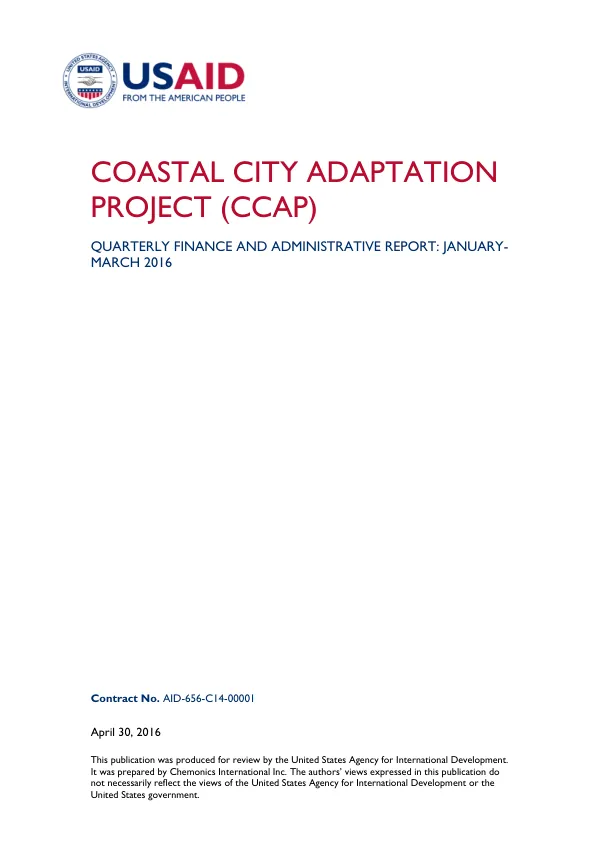
Coastal City Adaptation Project (CCAP) Quarterly Finance and Administrative Report: January-March 2016
Sign inCHEMONICS
Coastal City Adaptation Project (CCAP) Quarterly Finance and Administrative Report: January-March 2016
The Coastal City Adaptation Project (CCAP) is a USAID-funded initiative aimed at enhancing the resilience of coastal cities in Mozambique to climate change.
2016 · 6 pages
Sign in to readA free account is required to download.
Abstract
The project is implemented by Chemonics International Inc. and focuses on improving the capacity of municipal governments to adapt to climate-related risks. Implementation of the project's activities has been ongoing, with CCAP drafting memoranda of understanding (MoUs) with the Municipalities of Quelimane and Pemba. The MoUs outline the roles and responsibilities of CCAP and the municipalities in implementing project activities. However, the project has faced challenges in finalizing the MoUs due to the need to include budget figures for the activities included in the MoU. CCAP has discussed this issue extensively with USAID and prepared estimates of direct costs associated with each activity. Chemonics is also working to obtain formal recognition from Mozambican authorities for Chief of Party (COP) Maria Olanda Bata to serve as the legal representative associated with Chemonics' foreign branch operating license for CCAP. The process has been delayed due to internal information technology (IT) issues at the Maputo One Stop Shop, which has yet to issue the revised operating license. CCAP is checking on the status of the request on a regular basis. The project has also made progress in implementing its technical activities. UEM Faculty of Science has completed the first two milestones under the grant agreement, but timeliness remains a concern. CCAP facilitated the initial contact between UEM and CCAP's international subcontractor TechChange to kick off efforts to transform UEM's course materials into an online course. UEM Faculty of Forestry Engineering has completed the local adaptation plans (PLA) for the municipalities of Pemba and Quelimane through a broad and participatory process. UN-Habitat began work under the grant agreement in January, focusing on developing basic criteria for site and beneficiary selection, clarifying the participatory and transparent processes for carrying out the work in Pemba and Quelimane, and defining the roles and responsibilities for the respective municipality. CCAP and UN-Habitat conducted fieldwork in Quelimane, which included site visits and various planning meetings and led to an action plan to guide continuing efforts. INGC confirmed that their local disaster response committees made use of the emergency management kits provided by CCAP in the Paquitequete and Chibuabuari neighborhoods following the extreme rains early January. CCAP continues to work with INGC and the Municipality of Pemba to resolve the handover of the final two emergency management kits earmarked for Pemba. The project has also engaged UEM Department of Biological Sciences to conduct a rapid green infrastructure assessment in Pemba. The purpose of the assessment is to identify potential options and local partners for CCAP to help the Municipality enhance green infrastructure(s) to help protect the city and its residents. Professor Salomão Bandeira is leading the UEM team, which began fieldwork the last week in March. In addition, CCAP technical staff in cooperation with CVM staff decided to postpone proposing a grant for improving first aid response and preparedness in CCAP target cities so that volunteers are fully trained for the 2016-2017 emergency season. CVM revised their proposal to reflect the new dates and submitted to CCAP for consideration in March. The CCAP Selection Committee reviewed CVM's proposal at the end of the reporting period and determined that CVM's application required additional clarification. CCAP completed an initial draft of a program description for the Annual Program Statement, which outlines the project's goals, objectives, and activities. The project is expected to continue implementing its activities in the coming months, with a focus on finalizing the MoUs with the Municipalities of Quelimane and Pemba and completing the technical activities.
Related documents