USAID DEC
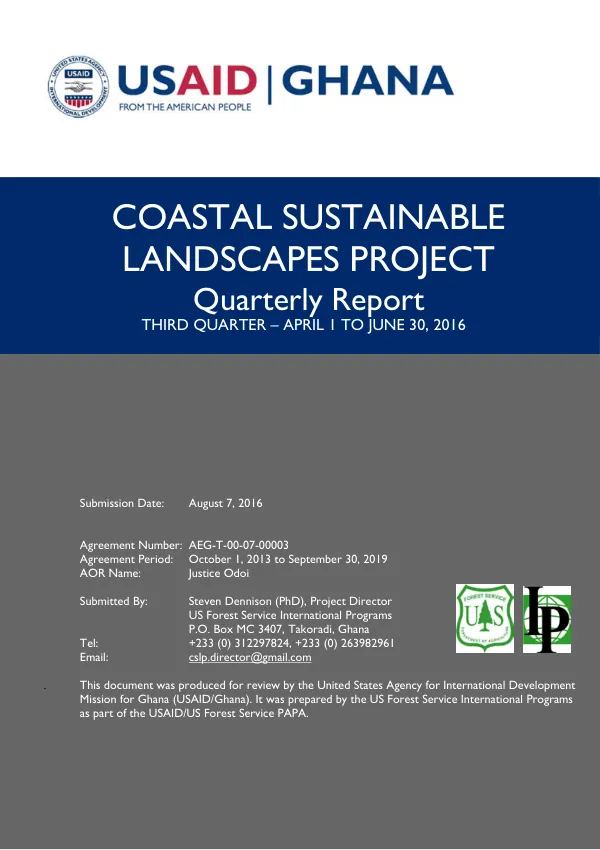
Coastal Sustainable Landscapes Project Quarterly Report: THIRD QUARTER – APRIL 1 TO JUNE 30, 2016
Sign inMINISTRY OF AGRICULTURE AND FISHERIES
Coastal Sustainable Landscapes Project Quarterly Report: THIRD QUARTER – APRIL 1 TO JUNE 30, 2016
The Coastal Sustainable Landscapes Project (CSLP) is a USAID-funded initiative aimed at promoting low emissions development in Ghana's Western Region.
2016 · 36 pages
Sign in to readA free account is required to download.
Abstract
The project operates in the six coastal districts of the Western Region, covering an area that stretches from the Cote d'Ivoire border eastward through the Greater Amanzule wetlands complex, Cape Three Points, the Sekondi-Takoradi Metropolitan Area (STMA), and east to the Central Region border. The project's primary objective is to improve carbon sequestration, forest management, and livelihoods in the six coastal districts. To achieve this goal, the CSLP focuses on community-level interactions that work to achieve low emissions development goals. One key element of the CSLP strategy is the application of a Village Savings and Loan Association (VSLA) model, which aims to empower local communities to manage their natural resources sustainably. The CSLP is part of the USAID Sustainable Landscapes (SL) Results Framework, which focuses on Strategic Objective 1: Accelerate the transition to low emission development through investments in clean energy and sustainable landscapes. The project's overall long-term impact will be to promote low emissions development in Ghana's Western Region by strengthening community-based natural resource management and monitoring. The project's geographic area is characterized by high population centers, land use pressures, and unsustainable natural resource management practices. The region is also vulnerable to climate change, with changing rainfall patterns, droughts, floods, and rising sea levels posing significant risks to the landscape. To address these challenges, the CSLP aims to improve forest management, promote sustainable agriculture practices, and enhance community-based natural resource management. The project's activities target landscape-level engagement with communities, non-governmental organizations, Government of Ghana agencies, the private sector, and international partners. The CSLP will contribute to all four components of the USAID Fisheries and Coastal Management (FCM) Program, with a focus on the fourth component: improved management of marine and coastal natural resources for multiple benefits. The project's implementation period is from October 1, 2013, to September 30, 2019, with a reporting period of April 1 to June 30, 2016. The project is managed by the US Forest Service International Programs, in partnership with the Ghana Forestry Commission, the Ghana Ministry of Food and Agriculture, and other local stakeholders. The CSLP's primary activities include: * Community-level interactions to promote sustainable natural resource management practices * Application of the VSLA model to empower local communities to manage their natural resources sustainably * Forest management and conservation activities to improve carbon sequestration and reduce deforestation * Promotion of sustainable agriculture practices to enhance livelihoods and reduce pressure on the landscape * Strengthening community-based natural resource management and monitoring to promote low emissions development The project's overall goal is to promote low emissions development in Ghana's Western Region by strengthening community-based natural resource management and monitoring. The project's long-term impact will be to improve forest management, promote sustainable agriculture practices, and enhance community-based natural resource management, ultimately contributing to the achievement of Ghana's goal of becoming an established middle-income country by 2022.