USAID DEC
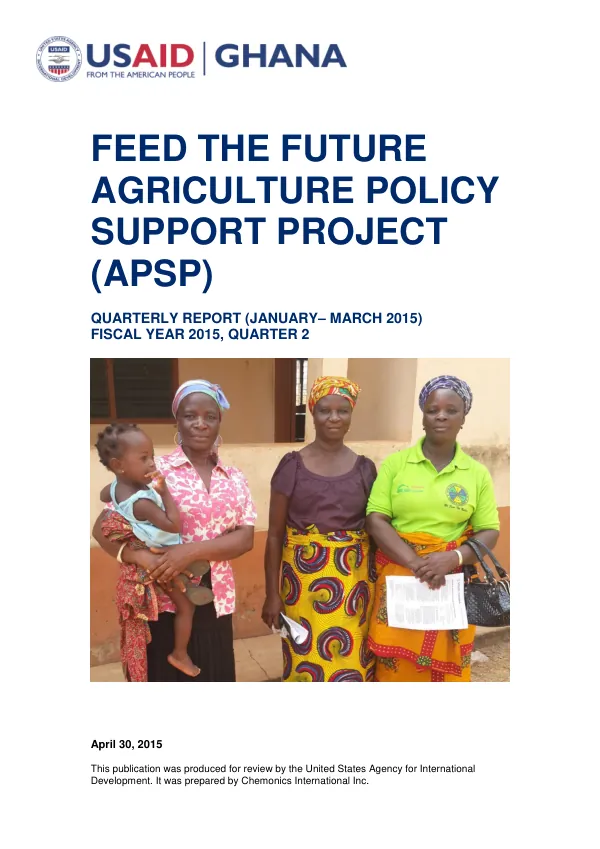
Quarterly Report (January– March 2015) for the Feed the Future Agriculture Policy Support Project (APSP)
Sign inCHEMONICS
Quarterly Report (January– March 2015) for the Feed the Future Agriculture Policy Support Project (APSP)
The USAID/Ghana Feed the Future Agriculture Policy Support Project (APSP) is focused on improving the food security enabling environment for private sector investment.
2015 · 46 pages
Sign in to readA free account is required to download.
Abstract
The project's main objective is to increase the capacity of public and private stakeholders to implement evidence-based agriculture policies. APSP activities are centered around three components: policy formation and implementation, policy research, and policy advocacy. Policy formation and implementation is the first component, aimed at improving Ghana's agricultural sector policy process for evidence-based decision making related to food security. This component involves strengthening the institutional and technical capacities of public and private organizations to participate and amplify their voice in the public policy process. During the reporting period, the project placed a policy advisor with the Policy Planning and Budget Directorate of the Ministry of Food and Agriculture (MoFA). The advisor will contribute to the acceleration of support to MoFA to strengthen the agriculture policy process. A Soil Fertility Management Study was completed through a partnership with the Ghana Strategic Support Program (GSSP)/International Food Policy Research Institute (IFPRI), the USAID/West Africa Fertilizer Program (WAFP), and the Agricultural Development Bank (AFAD). The study's preliminary findings were presented to government officials and other private stakeholders. Technical workshops on strengthening policy formation and implementation were conducted, attended by over 300 public and private stakeholders. The workshops covered sensitization and adjustments and drafting of agriculture-related laws. Meetings of the SAKSS Nodes and the Steering Committee of the Medium Term Agriculture Sector Investment Plan (METASIP) were implemented, leading to the identification of research topics and development of work plans. The project will support these activities through its small grants fund and technical assistance, respectively. Educational agriculture policy forums were conducted, engaging public and private stakeholders in fruitful dialogues. The forums improved the knowledge and skills of the 900 attendees in Northern Ghana and other regions of the country on key agriculture policy documents, such as the Food and Agriculture Sector Development Policy (FASDEP) and METASIP. The forums assisted district-level authorities in identifying and agreeing on the development or improvement of agriculture-related bylaws and regulations. Tenders were issued to implement agriculture policy advocacy, conduct training activities, and build the institutional capacity of private sector organizations. These activities will support and launch several other initiatives linking private stakeholders in the analysis, discussion, and implementation of agriculture policy. Additionally, more than 50 Ghanaian journalists were trained in agriculture reporting, communication, and budget tracking. As a result, these journalists launched their own social media platforms to advance agricultural reporting and contribute to agriculture policy advocacy. The project's second component, policy research, aims to increase rigorous policy analysis capacity for evidence-based policy making. This component involves conducting research studies and providing technical assistance to support the development of evidence-based policies. During the reporting period, the project conducted a Soil Fertility Management Study through a partnership with GSSP/IFPRI, WAFP, and AFAD. The study's preliminary findings were presented to government officials and other private stakeholders. The project also supported the development of work plans for the Steering Committee of METASIP. The project's third component, policy advocacy, aims to strengthen the institutional and technical capacities of private organizations and the media to participate and amplify their voice in the public policy process. This component involves building the capacity of private sector organizations to engage in policy dialogue and advocacy. During the reporting period, the project issued tenders to implement agriculture policy advocacy, conduct training activities, and build the institutional capacity of private sector organizations. These activities will support and launch several other initiatives linking private stakeholders in the analysis, discussion, and implementation of agriculture policy. Additionally, more than 50 Ghanaian journalists were trained in agriculture reporting, communication, and budget tracking. The project's activities are focused on improving the food security enabling environment for private sector investment in Ghana. The project's main accomplishments during the reporting period include placing a policy advisor with MoFA, completing a Soil Fertility Management Study, conducting technical workshops, implementing meetings of the SAKSS Nodes and the Steering Committee of METASIP, conducting educational agriculture policy forums, issuing tenders, and training journalists in agriculture reporting. The project's geographic focus is Ghana, with a specific emphasis on improving the food security enabling environment for private sector investment. The project's timeframes are centered around the fiscal year 2015, with a focus on the second quarter (January to March 2015). The project's recommendations include continuing to support the development of evidence-based policies, strengthening the institutional and technical capacities of public and private organizations, and building the capacity of private sector organizations to engage in policy dialogue and advocacy. The project's implementation details include the placement of a policy advisor with MoFA, the completion of a Soil Fertility Management Study, the conduct of technical workshops, the implementation of meetings of the SAKSS Nodes and the Steering Committee of METASIP, the conduct of educational agriculture policy forums, the issuance of tenders, and the training of journalists in agriculture reporting. The project's geographic focus is Ghana, with a specific emphasis on improving the food security enabling environment