USAID DEC
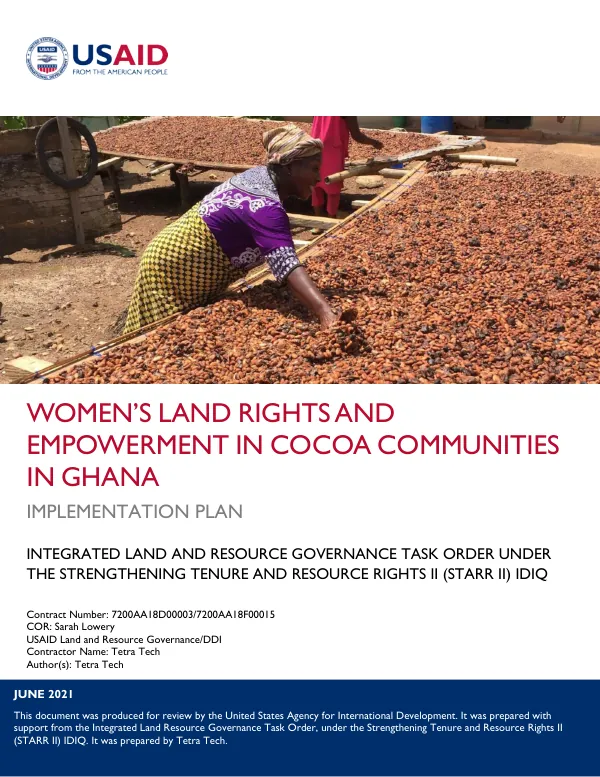
Women’s Land Rights and Empowerment in Cocoa Communities in Ghana: Implementation Plan
Sign inMINISTRY OF AGRICULTURE AND FISHERIES
Women’s Land Rights and Empowerment in Cocoa Communities in Ghana: Implementation Plan
The proposed activity aims to strengthen women's land rights, promote gender equality, and empower women in the cocoa value chain in Ghana.
2021 · 27 pages
Sign in to readA free account is required to download.
Abstract
The activity is informed by an initial gender assessment carried out between November 2020 and March 2021, which provided a better understanding of ECOM's current practices and capacity on gender equality and women's empowerment, as well as the barriers and opportunities for women's empowerment, access to productive resources, and income diversification. The assessment included a review of existing primary and secondary data, interviews with 40 ECOM staff and local stakeholders, and focus group discussions with 122 women and men farmers in Assin Fosu and Antoakrom Districts. The activity will draw from other ILRG partnerships with large agribusiness investors to promote women's land rights and women's empowerment in value chains in India and Mozambique. Private sector actors have an influential role in the cocoa sector and are strategically positioned to lead efforts to empower women by adopting sourcing policies that recognize and respond to women's needs and providing gender-responsive training and resources. Inclusive business models make social and economic sense through increased profitability for farmers and companies, greater compliance with sustainability goals, and positive brand image. The proposed 18-month activity will focus on three strategic approaches: building ECOM staff capacity at management and field levels and integrating gender equality and women's economic empowerment into ECOM's core business operations; promoting women's economic empowerment through increased access to resources and gender norms change; and promoting income diversification and economic resilience for women farmers. The first strategic approach aims to build ECOM staff capacity at management and field levels and integrate gender equality and women's economic empowerment into ECOM's core business operations. This will involve integrating gender expertise into the ECOM Ghana team, developing a country-level gender equality strategy, policies, and practices, and providing capacity building at management and field levels. The second strategic approach aims to promote women's economic empowerment through increased access to resources and gender norms change. This will involve providing integrated household level gender norms change and good social practices training, developing a women's empowerment and entrepreneurship curriculum, and training and technical assistance to local stakeholders. The third strategic approach aims to promote income diversification and economic resilience for women farmers. This will involve identifying and supporting alternative economic opportunities for women, and providing training and technical assistance to local stakeholders. The activity will be implemented in the Assin Fosu and Asamankese districts, leveraging existing field infrastructure for efficient start-up and implementation. The data gathered during the gender assessment applies to Asamankese due to similar contexts and stakeholders involved. The overall vision, approach, expected results, and areas of work are built upon the findings of the gender assessment carried out by ILRG, which was organized according to five domains: 1) laws, policies, regulations, and institutional practices; 2) social norms and beliefs; 3) gender roles, responsibilities, and time use; 4) access to and control over assets and resources; and 5) patterns of power and decision-making. The main barriers and opportunities and proposed responses are summarized in the table below. The table highlights the importance of addressing the barriers to women's empowerment, including unequal access to productive resources, unbalanced power relationships, and harmful gender norms, and promoting opportunities for women's empowerment, including increased access to resources and gender norms change. The activity will be monitored, evaluated, and learned through a robust monitoring, evaluation, and learning (MEL) framework, which will track progress against expected results and provide insights for improvement. The MEL framework will include a range of indicators, including changes in women's land rights, gender equality, and women's empowerment, as well as improvements in income diversification and economic resilience for women farmers. The activity will be implemented by ECOM, with technical assistance from ILRG, and will be supported by a range of stakeholders, including local communities, farmers, and private sector actors. The activity is expected to have a positive impact on women's land rights, gender equality, and women's empowerment in the cocoa value chain in Ghana, and will contribute to the achievement of the Sustainable Development Goals (SDGs) related to gender equality and women's empowerment.
Related documents